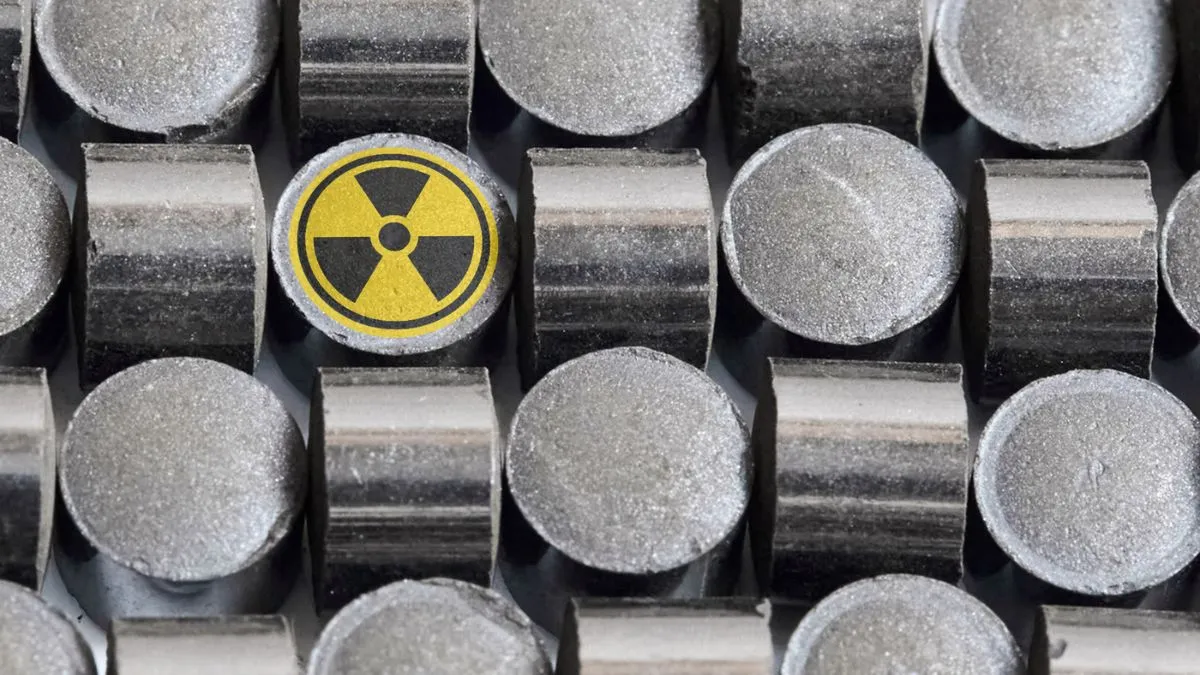
Uranium is a naturally occurring silvery-white radioactive element which has the atomic number of 92 and chemical symbol U in the periodic table. Uranium was discovered in 1789 by Martin Klaproth, a German chemist. It was named after the planet Uranus, which had been discovered eight years earlier. Uranium can be found in rocks, soil, and seawater.
Uranium was formed in supernovae roughly 6.6 billion years ago, prior to the formation of our solar system. The radioactive decay of uranium, along with thorium and potassium-40 within the Earth’s crust, acts as the primary source of heat that keeps the Earth’s outer core liquid.
On a scale arranged according to the increasing mass of their nuclei, uranium is one of the heaviest of all the naturally occurring elements. Uranium is 18.7 times as dense as water. Did you know that India is recognised as the world's ninth-largest producer of uranium, with an output of 617 tonnes in 2022?
Uranium occurs in three main naturally occurring 'isotopes', namely uranium-238, uranium-235 (U-235), and uranium-234 (U-234). Uranium-238 (U-238) is 99.3 per cent naturally abundant, and uranium-235 (U-235) is about 0.7 per cent. The isotope U-235 is important because under certain conditions it can readily be split. It is therefore said to be 'fissile'.
Uranium-235 (U-235) is a fissile isotope, containing 92 protons and 143 neutrons in its nucleus, which becomes unstable upon absorbing a neutron. This neutron capture causes the nucleus to undergo fission, splitting into lighter elements, releasing ~200 MeV of heat energy, and expelling 2–3 new neutrons that can sustain a self-propagating chain reaction.
Natural uranium contains mostly uranium-238 and only 0.7 per cent of uranium-235, which is not suitable as fuel for most nuclear reactors. This is where uranium enrichment comes into play.
What is enriched uranium?
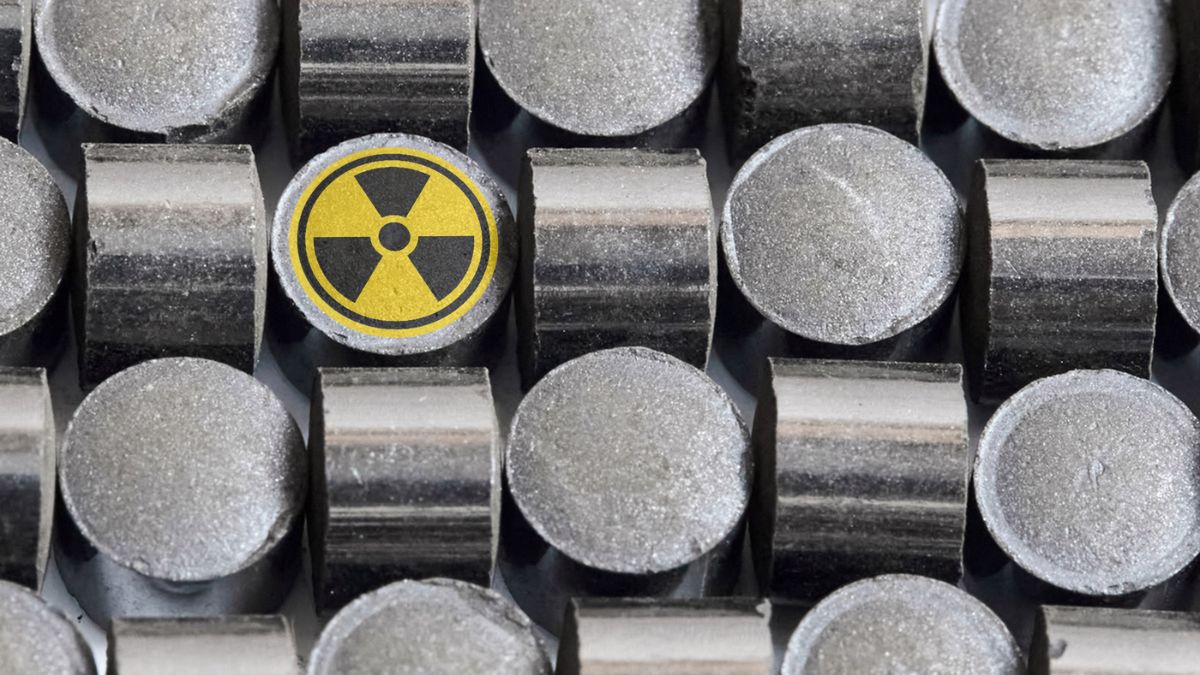
Enriched uranium is a type of uranium in which the percentage of the fissile isotope uranium-235 (U-235) has been increased through isotope separation. While natural uranium contains only about 0.7 per cent U-235, enrichment raises this concentration.
- Low-Enriched Uranium (LEU): Contains 3 to 5 per cent U-235.
- High-Enriched Uranium (HEU): Contains 20 per cent or upto 90 per cent or higher U-235.
What is the uranium enrichment process?
Natural uranium is converted into a gas (uranium hexafluoride) and then passed through high-speed centrifuges to separate the lighter U-235 from the heavier U-238.
Mining & Milling: Uranium ore is extracted and refined into 'yellowcake'.
Conversion: Natural uranium is converted into uranium hexafluoride gas (UF₆).
Centrifugation: UF₆ gas is spun in ultra-fast centrifuges (~70,000 rpm); the heavier U-238 moves outward, while lighter U-235 concentrates near the centre.
Cascade Process: Thousands of centrifuges are connected in series and parallel known as cascade. Each centrifuge only increases the U-235 through repeated separations.
What is enriched uranium used for?
Commercial nuclear power generation: Most commercial reactors such as Light Water Reactors use low-enriched uranium (LEU) containing 3 to 5 per cent U-235 as fuel, which is also often referred to as “reactor-grade uranium”, to generate electricity.
Nuclear weapons: Uranium enriched above 20 per cent can be used for weapons, with 'weapons-grade' typically being 90 per cent or higher. Enriching uranium from 60 per cent to 90 per cent (weapons-grade) is rapid, potentially taking only a few days to two weeks depending on the number and efficiency of centrifuges.
Naval propulsion: Highly Enriched Uranium is mostly used in naval propulsion reactors (for example nuclear-powered submarines and ships), nuclear weapons and some research reactors.
Research and medical isotopes: Specialised research reactors using High Enriched Uranium to study nuclear processes and produce medical radioisotopes used in diagnostic imaging.