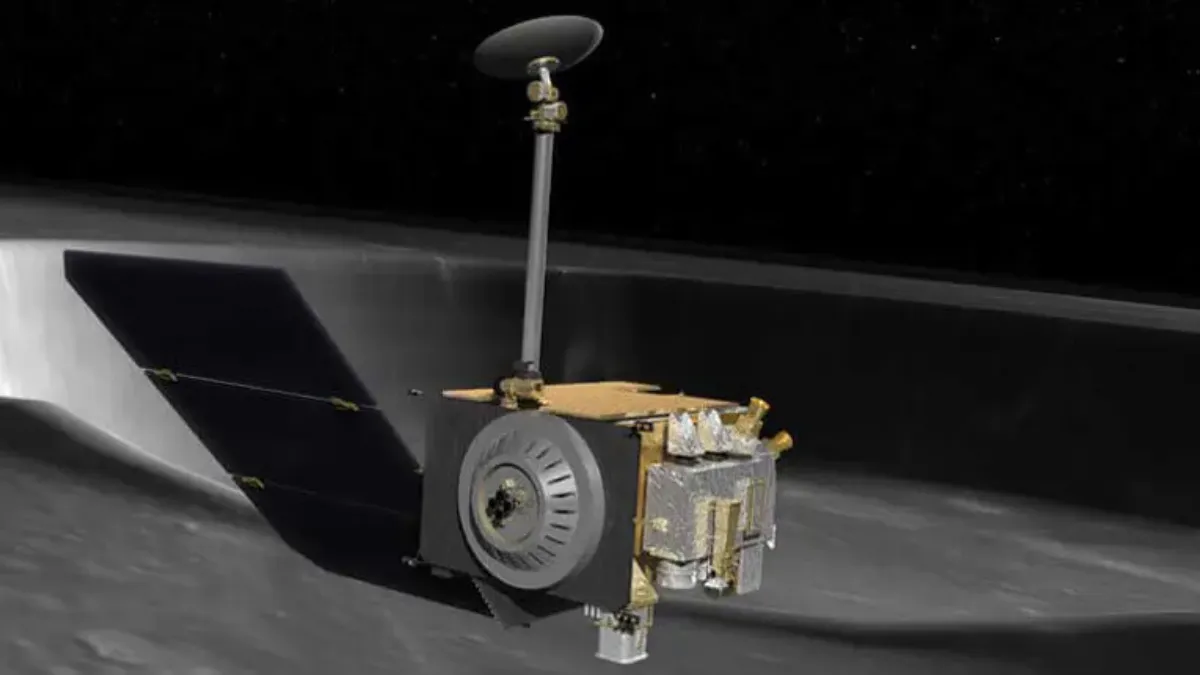
A recent study of NASA Lunar Reconnaissance Orbiter data has confirmed that the polar areas of the Moon have accreted water ice at steady rates in the past 1.5 billion years, a fact supported by scientists. This observation explains the dynamics of ice formation on the moon over long periods, eliminating the possibility of abrupt phenomena such as huge collision of comets.
How was Ice on Moon Discovered?
A recent study published in Nature Astronomy reveals that ice in the Moon's permanently shadowed regions (PSRs) has built up gradually. The scientists used ultraviolet measurements of the Lyman-Alpha Mapping Project (LAMP) on NASA's Lunar Reconnaissance Orbiter (LRO) and compared exposure of ice to the age of the shadowed regions.
PRSs of younger age (around 100 million years old) contain 3.4% surface ice, whereas older PSRs contain less ice on their surface because it is buried or has been gardened by micrometeorites.
Formation Process
Water ice is delivered through comets, asteroids or solar wind and is then trapped in cold traps where it drops to -160 C. These PSRs have been widened by the decreasing obliquity of the Moon through billions of years, and have made them capable of accumulating continuously.
This cyclical cycle of delivery, burial and subsequent loss has maintained ice deposits at least 1.5 billion years.
Key Findings of Ice on Moon
The distribution of ice is related to PSR age: recent shadows contain more conspicuous ice.
No signs of single event formation, but rather constant cycles in the environment.
The oldest deposits are found in polar craters more than 3 billion years old, which have been damaged by micrometeorites.
Implications for Space Exploration
Such reserves are capable of providing water, oxygen, and fuel to future missions, such as NASA with its Artemis program and ISRO with its lunar aspirations. Confident ice maps can help in the base location, which improves sustainability. With the progress of such agencies as NASA and ISRO, this information narrows down resource plans as Chandrayaan continues to make subsurface ice discoveries.