Vallabh Ramesh: 18-Year-Old Student Creates Smart Gel That Could Aid Drug Delivery Inside Human Body


An 18-year-old Kentucky student has developed a 3D-printable smart gel that solidifies at body temperature and could have future applications in drug delivery, tissue engineering and soft robotics.
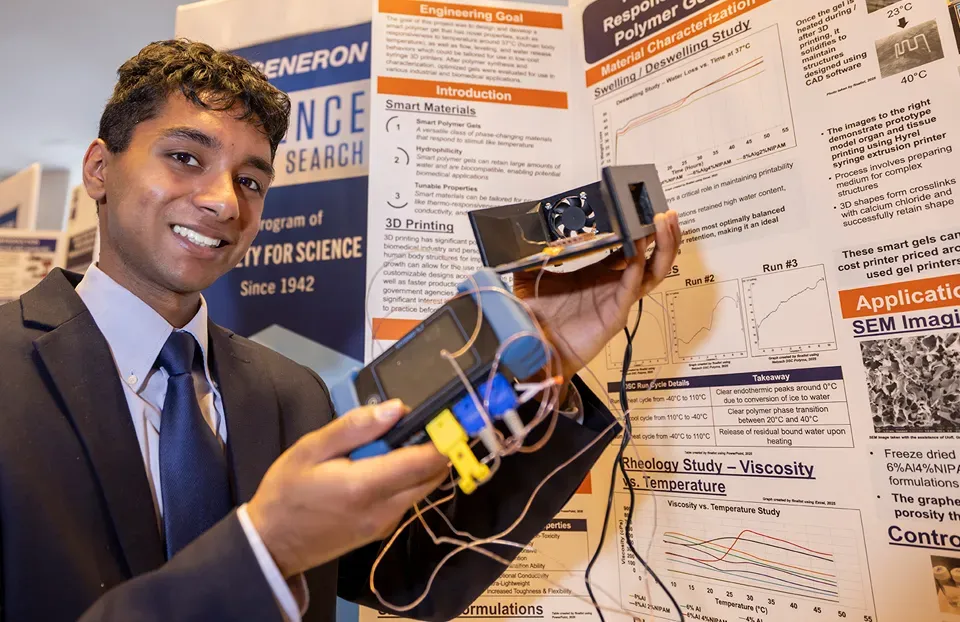
An 18-year-old student from Kentucky has developed a 3D-printable smart gel that solidifies at body temperature, a material that could eventually find applications in drug delivery, tissue engineering and other areas of biomedical technology. Vallabh Ramesh, a student at duPont Manual Magnet High School in Louisville, developed the material as part of his research into next-generation smart materials.
Ramesh’s work gained fresh recognition in 2026. He was selected as a finalist in the 2026 Regeneron Science Talent Search, one of the major science competitions for high school students in the US. His project, titled Next-Gen Smart Materials: Thermo-Responsive and Conductive 3D Printable Polymer Gels for Diverse Applications, explores how these materials could be made using more accessible 3D-printing technology.
How Did Vallabh Ramesh Develop The Smart Gel?
Ramesh’s project focuses on smart materials, which can change their properties in response to external conditions such as temperature.
In his experiments, he developed a polymer gel that can be processed through 3D printers and solidifies at body temperature. According to the Society for Science, Ramesh experimented with different concentrations of the material’s components to identify a formulation that could work with lower-cost printers.
The approach is significant because complex smart-material structures can traditionally require expensive equipment. Ramesh’s research explores whether similar structures can instead be produced using more accessible 3D-printing systems.
How Could The Gel Be Used In Medicine?
One of the most interesting possibilities is controlled drug delivery.
Ramesh demonstrated this potential by creating small smart-gel “pouches” that released chemicals over time. The experiment was designed to show how the material could potentially be used to control the release of substances.
Because the gel responds to temperature, researchers could potentially explore systems that change behaviour when exposed to the body’s temperature. However, the project is still at the research stage, and much more testing would be required before such a material could be used for medical treatment.
The gel could also have potential applications in tissue engineering, where 3D-printed structures can be used to explore ways of supporting or replacing biological tissues.
Student Also Tested Other Uses
Ramesh’s experiments were not limited to drug delivery.
He initially used the material to 3D-print structures such as jaws to demonstrate how the gel could be formed into different shapes. He also tested the material as a heat sink for electronics and found that it could function as a conductive material, with performance that compared favourably with commercial gels in his testing.
These experiments show why the material could have applications beyond medicine. Its temperature response, conductivity and ability to be 3D printed make it an interesting candidate for several emerging technologies.
Latest Recognition For The 18-Year-Old
Ramesh’s research received major recognition in 2026 when he was named one of the 40 finalists of the Regeneron Science Talent Search. The finalists were selected from more than 2,600 entrants, representing the largest applicant pool for the competition since its launch in 1942.
His work also received recognition through the 2026 Digital Manufacturing Challenge, where his high-school project was named the winning design in the high-school category. The winning submission focused on a cicada-inspired 3D-printed micropillar patch design for thermo-responsive smart-gel-based drug delivery systems.
This was not Ramesh’s first success in the competition. SME records show that he also won the high-school category in the 2025 Digital Manufacturing Challenge for research involving 3D-printed composite repair patches.
What Could Happen Next?
The smart gel is still an experimental technology, meaning it should not be described as an existing medical treatment. More research and testing would be needed to determine whether it can eventually be safely used inside the human body.
For now, the 18-year-old’s work demonstrates how advances in 3D printing and smart materials could open new possibilities for personalized medicine. The ability to produce temperature-responsive structures with potentially lower-cost printing systems could be particularly useful if future research confirms the material’s medical applications.
Ramesh’s project also highlights how high-school research can tackle problems normally associated with advanced materials science. What began as a student research project has now earned recognition at major US science and manufacturing competitions, while exploring a technology that could one day contribute to drug delivery and tissue engineering.
Sahil Behl is an education journalist at Jagran with over a year of experience in journalism. Prior to joining Jagran, he worked as a Sub-Editor in NDTV's Education department, where he was responsible for writing and editing education-related content as well as managing the department's social media presence. At Jagran, he covers a wide range of education topics, including board examinations, school updates, admissions, and job notifications, while leveraging his editorial expertise and strong understanding of digital content strategy.
Sahil holds a Bachelor's degree in Business Administration and has also completed an eight-month certification program in Data Science. Passionate about emerging technologies, particularly artificial intelligence, he closely tracks their growing role in journalism and explores how they are transforming shaping the future of the media industry.