Why Is India Called The “Pharma Capital Of The World"?
India is called the "Pharmacy of the World" because it supplies 20% of all generic medicines globally and exported $30.5 billion worth of drugs in 2024-25 to 191 countries. It's cheap, fast, and trusted worldwide. Let's discover how India built this reputation.
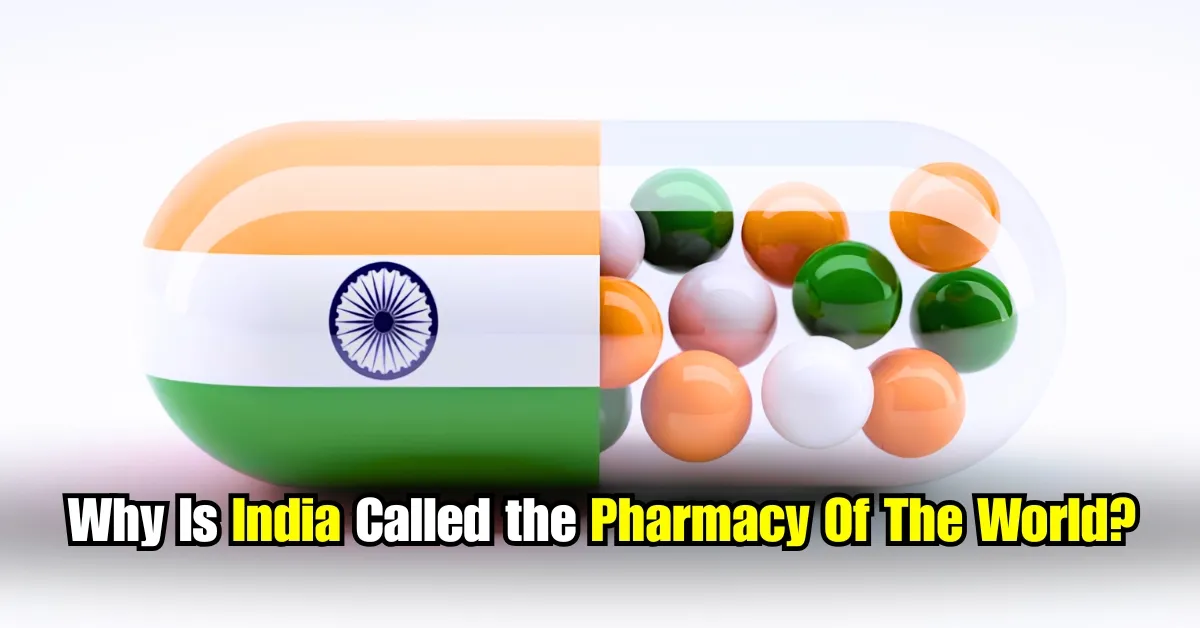
India lies in the region of South Asia between the Arabian Sea and the Bay of Bengal, surrounded by countries like Pakistan, China, Nepal, Bhutan, Bangladesh, and Myanmar. India is the seventh-largest country in the world in terms of geographical area and, as of 2026, is the most populous country in the world, with over 1.4 billion people. However, India not only occupies a significant area in the world, but it is also the medicine chest of the world. The country contributes up to 20% of total generic medicines in the world, with exports amounting to $30.5 billion in 2024-25 to 191 countries.
Why Does India Supply 20% of the World's Generics?
This is how it looks in the simplest terms. India makes medicine inexpensive and makes a lot of it. Labour is inexpensive. There are millions of trained chemists and pharmacists. Because of the Patent Act of 1970, Indian companies have been working on legal reverse engineering of medicines for many years, doing process copying rather than product copying. As a result, India got a strong competitive advantage when other countries' patents expired. Currently, there are more than 3,000 companies and over 10,500 manufacturing facilities producing over 60,000 different brands in 60 different therapeutic segments. More than 262 FDA-approved plants are in India, which is more than anywhere else except in the USA. Adding more than 1,400 WHO GMP-approved facilities, you'll get the picture of a country producing medicine quickly and cheaply, and meeting international standards.
The Biopharma SHAKTI Moment: Why India Is Pivoting From Generics to Global Innovation
The use of generics has put India in this position. However, generics have narrow profit margins, and everyone knows that. Therefore, the Union Budget 2026-27 came up with a plan called Biopharma SHAKTI. Biopharma SHAKTI is a Rs. 10,000 crore, five-year program designed to make India move towards biologics and biosimilars. As stated in the Economic Survey 2025-26, non-communicable diseases are responsible for 57 per cent of all deaths in India. Biologics and biosimilars are expensive and complicated drugs used for the treatment of cancer, diabetes, and autoimmune diseases. Biopharma SHAKTI will build three new National Institutes of Pharmaceutical Education and Research, will improve seven existing NIPERs, and will develop more than 1,000 clinical trial sites across India. Moreover, the drug regulator, CDSCO, will get a special scientific review team.
India's Secret Vulnerability: The One Thing That Could Cripple the Pharmacy of the World
The problem lies with the following fact that all these drugs require APIs, or Active Pharmaceutical Ingredients which are essentially the chemical base of all those pills that we consume daily and almost 70% of India’s APIs are imported from China. So basically, what is happening is that in case of any tension between the two countries and restriction of API exports, the whole engine of the pharmaceutical industry of India will stop working right away. As a matter of fact, the impact was seen during the outbreak of COVID-19 in 2020. It resulted in frozen chains and skyrocketing prices. To counter such a problem, a production-linked incentive scheme has been launched by the Indian government along with three new bulk drug parks in Gujarat, Himachal Pradesh and Andhra Pradesh for the production of APIs.
Conclusion
So, can we say that India is truly the pharmacy of the world? Mostly yes, but there is a very important weakness that lies under all this success. As long as India is still dependent on China, which provides 70% of APIs, it cannot be considered an independent country. The gap should be bridged to decide if India will be able to remain the pharmacy of the world.

Kriti Barua is a skilled digital journalist and communications professional with 4+ years of experience, currently writing for the General Knowledge section at Jagran New Media. She has established herself as a subject matter expert in History, Geography, Trending National and International News, Sports, Science, and Defence, producing clear, reliable, and search-optimised content that connects with readers worldwide.
Kriti holds a BA degree from Delhi University and a one-year diploma in TV Production and Journalism, an academic background that adds research depth and strong storytelling instincts to her writing. Her experience spans brand writing, content marketing, and digital media, giving her a sharp understanding of what makes content both helpful to readers and visible in search.
At Jagran New Media, she applies this expertise to national and international news coverage, query-based articles, and in-depth pieces across her specialist subject areas. Her content is defined by easy language, factual accuracy, strong keyword strategy, and reader-friendly storytelling.


![[OUT] RPSC 2nd Grade Teacher Admit Card 2026 LIVE: सेकंड ग्रेड एडमिट कार्ड लिंक recruitment.rajasthan.gov.in पर जारी, SSO ID से डाउनलोड करें सीनियर टीचर हॉल टिकट PDF](https://img.jagranjosh.com/images/2026/July/972026/RPSC-2nd-Grade-Teacher-Admit-Card-2026.jpg)

![[OUT] RPSC 2nd Grade Admit Card 2026 Live: Download Senior Teacher Hall Ticket PDF at rpsc.rajasthan.gov.in- Link Active](https://img.jagranjosh.com/images/2026/July/972026/RPSC-2nd-Grade-Admit-Card.jpg)