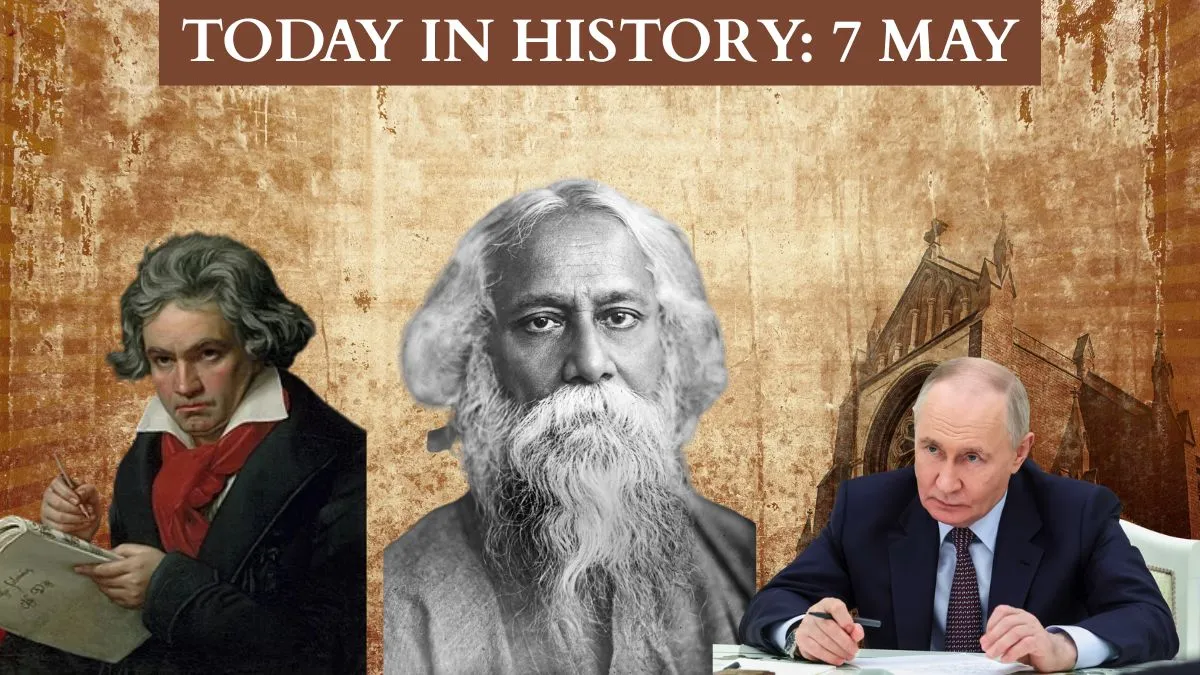
May 7th in History is the day when art, war, and national identity intersected and shaped the world. It is a day of sad closings and brilliant new beginnings that continue to influence our lives today. On this day, a single torpedo brought the United States a step nearer to a world war, and a poetic genius was born who would shape the spirit of modern India. You will know how each of these isolated moments has shaped the world that we live in.
A Deaf Master’s Final Bow and the Birth of a Literary Genius
1824: The Silent Standing Ovation for Beethoven’s Greatest Work
On this day, Ludwig van Beethoven walked on a stage in Vienna and led the first performance of his Ninth Symphony. It was the first time he had been on stage in 12 years and the audience was ready and waiting. The composer had become completely deaf by that time and could hear no music. He continued playing even after the orchestra had stopped playing since he was not aware that the piece had ended. One of the singers had to get him to turn around to see the crowd cheering wildly. This moment proved that man's creativity can overcome even the most difficult physical limits.
1861: The Birth of Rabindranath Tagore, the Voice of India
A little boy named Rabindranath Tagore was born to a family of thinkers and artists in Kolkata. He was to become the first non-European to win the Nobel Prize in Literature. Tagore was more than just a writer; he was a polymath who reshaped Bengali literature and music. He is the only one to be the author of the national anthem of two countries, India and Bangladesh. Today, his writing "Gitanjali" continues to resonate with readers, touching their hearts and minds with its profound exploration of nature and the human soul.
1907: Mumbai Swaps Horses for the Spark of Electricity
The first electric tram car ran its first route in Mumbai (then Bombay) and changed the face of public transport in India forever. Until this day heavy horses pulled the city's trams through the busy streets. The new electric system was a giant step in the development of the city's economy. It enabled the workers to move further for lower wages, thus establishing the city as a financial center. The people lined the streets and cheered on the modern machine, which was no longer powered by horses.
1912: The Mountain Peak Logo First Appears in Hollywood
This day marks the founding of Famous Players Film Company (now known as Paramount Pictures) by Adolph Zukor. One of the oldest film studios in the world and contributed to the development of the "star system" that exists in Hollywood today. The iconic mountain with the snow-capped peak was inspired by a childhood memory of a mountain in Utah. From there on, Paramount made some of the most iconic movies ever made, and it changed the way the world consumes stories and entertainment.
Did You Know?
On this day in 1824, Beethoven conducted his Ninth Symphony, but was so out of tune with the music that the musicians were instructed not to pay attention to his movements, but to follow the lead violinist!
The Torpedo That Changed the Course of a Global War
1915: The 18-Minute Sinking of the RMS Lusitania
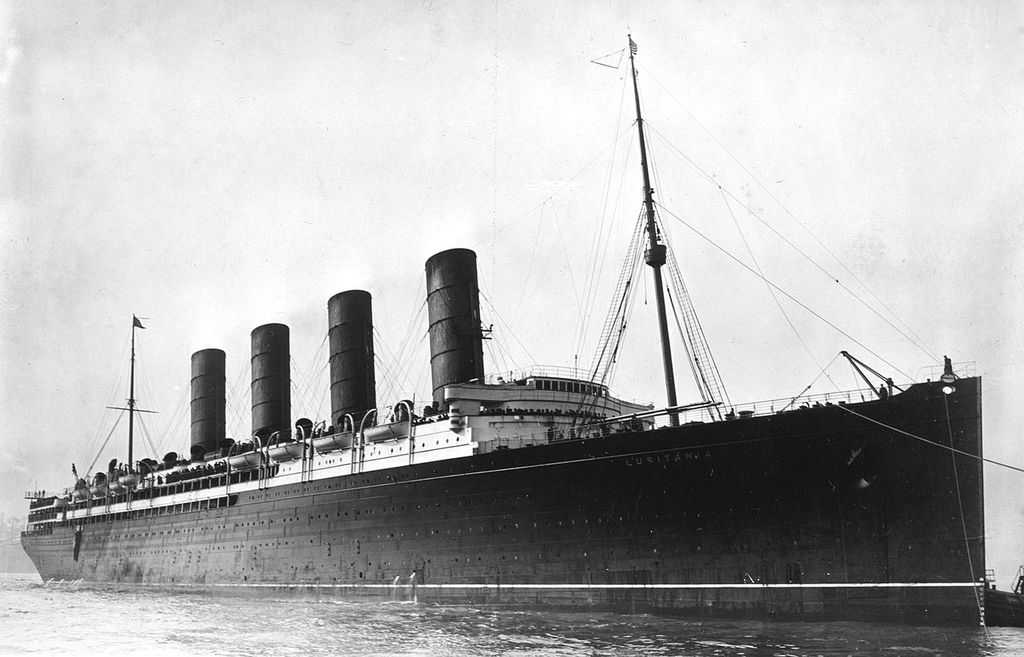
Off the Irish coast, a German submarine, U-20, fired one torpedo into the side of the British ocean liner Lusitania. The vessel was enormous, but sank in 18 minutes and claimed 1,198 lives. 128 Americans were among the dead, leading to an outburst of anger in the United States. German Captain Walther Schwieger said that the ship was transporting war supplies, but the people saw it as murder. This tragedy was one of the factors that brought the United States into World War 1, changing the balance of power in Europe.
Source: Wikimedia Commons
1945: Nazi Germany Signs the Paper That Ended the War
German Gen. Alfred Jodl signed a document of unconditional surrender in a small red schoolhouse in Reims, France. This was the official end of the war in WWII for the Third Reich. The surrender was to be effective the next day – now known as VE Day. The days of bloodshed in Europe were over after six years of the most terrible war in history. The news set off an explosion of joy from London to New York as families came to understand that their relatives may be coming home.
1954: The Fall of Dien Bien Phu Ends French Rule in Vietnam
The Battle of Dien Bien Phu was a 55-day battle between the Vietnamese army and the French army. A great triumph for a colonial people over a great European power. France lost, and had to abandon Indochina and partition Vietnam into two parts. This event marked not only the end of French rule, but also paved the way for the subsequent Vietnam War in America. It showed that a determined local force could beat a modern army with cunning tactics and determination.
Space Frontiers and Recovered Masterpieces
1960: A Cold War Spy Mystery Is Solved on Live TV
Soviet leader Nikita Khrushchev came as a surprise to the world by claiming that an American spy pilot was alive and in custody. Earlier, the U.S. government said the missing aircraft was simply a weather plane that got lost. But the Soviets had taken prisoner pilot Francis Gary Powers and the remains of his U-2 spy plane. This 'U-2 Incident' disrupted a peace summit and escalated the Cold War even more. It was a demonstration of the reality and danger of the "invisible" war of spies, and the first to be shown to the world.
1992: The Space Shuttle Endeavour Takes Its First Flight
It was on this day that NASA's Space Shuttle Endeavour was launched for the first time. The shuttle was unique because it was constructed from spare parts that were used to replace the Challenger, which was lost in 1986. In its first week in orbit, the crew conducted a record-breaking three-person spacewalk to capture an out-of-control satellite. Endeavour continued to make 25 missions, including critical repairs to the Hubble Space Telescope. It still stands as a testament to the ability of the space program to rise up and get back to business following tragedy.
1994: The World’s Most Famous "Scream" Is Recovered
Police in Norway have recovered the famous painting "The Scream" by Edvard Munch, three months after it was stolen. In only 50 seconds the thieves managed to break into the National Gallery in Oslo and steal the masterpiece. They even left a note saying "Thanks for the poor security. Fortunately, the painting was recovered in a hotel north of the capital without any damage. This recovery rescued one of the most famous images in art history, a representation of the raw anxiety of the modern age.
2000: Vladimir Putin Takes the Reins of Power in Russia
On this day, Vladimir Putin was sworn in as President of Russia for the first time. This was a ceremony of his first presidency of the nation, although he had been acting president. He pledged to establish a "strong and prosperous" state following the tumultuous 1990s. His rise to power changed the global political landscape and led to a new era of Russian influence. His leadership remains one of the most discussed and influential in contemporary world politics.
Check out some more interesting articles from the general knowledge section to boost your knowledge of national and international topics. Stay connected with Jagran Josh for more topics like this.