How Many Languages Are Spoken in India: India is incredibly diverse, especially in the way people speak. Across the country, people use 121 major languages and more than 1,500 dialects. Sanskrit and Tamil are some of the oldest languages in the world, but do you know how many languages are spoken in India? In this article, we'll explore the history and variety of these languages.
How Many Languages Are Spoken in India?
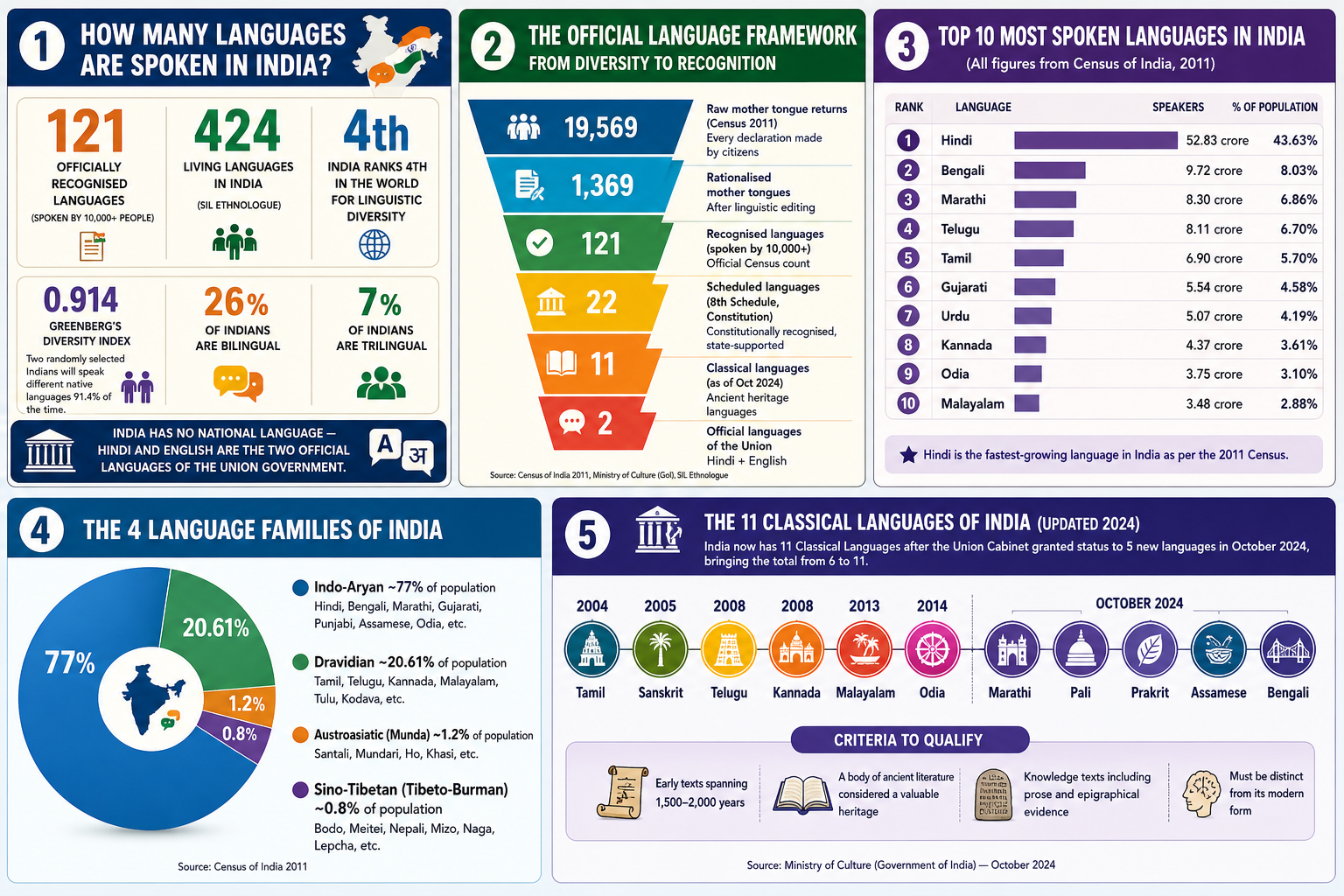
Source: Generated by AI (Original Jagran Josh)
- India is among the most linguistically diverse countries in the world.
- The 2011 Census, after examining over 19,500 linguistic affiliations, recognises 1,599 mother tongues, grouped into 122 languages.
- Of these, 22 are scheduled languages in Part A, and 99 are non-scheduled languages in Part B.
- The SIL Ethnologue estimates there are 424 living languages in India.
- In October 2024, the Union Cabinet granted classical language status to Marathi, Pali, Prakrit, Assamese, and Bengali, raising the total number of recognised classical languages to 11.
- The earlier classical languages were Tamil (2004), Sanskrit (2005), Telugu and Kannada (2008), Malayalam (2013), and Odia (2014).
- India's Greenberg's diversity index is 0.914, meaning that if you pick two Indians at random, there is a 91% chance they speak different native languages.
List of Most Spoken Languages by State/ (Census 2011)
| State / UT | Primary official language(s) | Other widely spoken | Approx. speakers |
| Andhra Pradesh | Telugu | Urdu, Hindi | ~84M Telugu speakers |
| Arunachal Pradesh | Bengali, Nyishi, Adi | Hindi, Nepali | ~47 languages spoken |
| Assam | Assamese, Bengali, Bodo | Hindi, Nepali, Meitei | ~15M Assamese speakers |
| Bihar | Hindi, Maithili | Urdu, Bhojpuri, Magahi | ~13.5M Maithili speakers |
| Chhattisgarh | Hindi | Chhattisgarhi, Gondi | ~16M Chhattisgarhi speakers |
| Goa | Konkani, Marathi | English, Hindi, Portuguese | ~2.4M Konkani speakers |
| Gujarat | Gujarati | Hindi, Sindhi, Urdu | ~55M Gujarati speakers |
| Haryana | Hindi | Haryanvi, Punjabi, Urdu | Hindi dominant |
| Himachal Pradesh | Hindi | Pahari dialects, Kangri | ~6M Pahari speakers (grouped under Hindi) |
| Jharkhand | Hindi, Santali, Bengali | Odia, Maithili, Gondi | ~7.4M Santali speakers |
| Karnataka | Kannada | Urdu, Telugu, Tamil, Tulu | ~44M Kannada speakers |
| Kerala | Malayalam | Tamil, Tulu, Kannada | ~35M Malayalam speakers |
| Madhya Pradesh | Hindi | Bundeli, Malvi, Bhili, Gondi | Hindi dominant; ~10M Bhili speakers (national) |
| Maharashtra | Marathi | Hindi, Urdu, Gujarati | ~83M Marathi speakers |
| Manipur | Meitei (Manipuri) | Nagamese, Hindi, Tangkul | ~1.5M Meitei speakers |
| Meghalaya | Khasi, Garo, English | Bengali, Hindi | ~1.4M Khasi speakers |
| Mizoram | Mizo (Lushai) | Bengali, Hindi, English | ~800K Mizo speakers |
| Nagaland | Nagamese, English | Hindi; ~16 Naga languages | ~16 tribal languages |
| Odisha | Odia | Hindi, Telugu, Santali | ~37M Odia speakers |
| Punjab | Punjabi | Hindi, Urdu | ~33M Punjabi speakers |
| Rajasthan | Hindi | Rajasthani, Mewati, Sindhi | ~25M Rajasthani speakers (grouped under Hindi) |
| Sikkim | Nepali, Sikkimese, Lepcha | Hindi, English, Tibetan | Nepali dominant |
| Tamil Nadu | Tamil | Telugu, Kannada, Urdu | ~69M Tamil speakers |
| Telangana | Telugu, Urdu | Hindi, Marathi | ~84M Telugu speakers (combined AP+TG) |
| Tripura | Bengali, Kokborok | Manipuri, Hindi | Bengali dominant |
| Uttar Pradesh | Hindi, Urdu | Bhojpuri, Awadhi, Braj | Hindi is the largest, with ~51M Bhojpuri speakers nationally |
| Uttarakhand | Hindi | Garhwali, Kumauni, Sanskrit | ~2M Garhwali + Kumauni speakers |
| West Bengal | Bengali | Hindi, Urdu, Nepali, Santali | ~97M Bengali speakers (India + Bangladesh) |
| Jammu & Kashmir | Kashmiri, Dogri, Hindi, Urdu | Punjabi, Ladakhi | ~7M Kashmiri speakers |
| Ladakh | Hindi, Ladakhi (Bhoti) | Urdu, English | ~100K Ladakhi speakers |
| Delhi (NCT) | Hindi, Punjabi, Urdu | Bengali, Maithili | Hindi dominant |
| Andaman & Nicobar | Hindi, Bengali, Tamil | Telugu, Malayalam, Nicobarese | Highly diverse migrant population |
| Chandigarh | Hindi, Punjabi | Urdu | Bilingual territory |
| Puducherry | Tamil, French, Telugu, Malayalam | Hindi, English | Tamil dominant |
| Lakshadweep | Malayalam | Hindi, English | Malayalam dominant |
| Dadra & Nagar Haveli / Daman & Diu | Gujarati, Hindi | Marathi, Bhili | Gujarati dominant |
Sources: Census of India 2011 · Ministry of Culture, Govt. of India · SIL Ethnologue · Constitution of India (8th Schedule)
Which Major Language Families Exist in India?
India’s linguistic diversity is rooted in four distinct families. Each family has its own history, grammar, and geographical stronghold.
| Language Family | Population Share | Primary Regions | Example Languages |
| Indo-Aryan | ~78% | North, West, & Central India | Hindi, Bengali, Gujarati |
| Dravidian | ~20% | South India | Tamil, Telugu, Malayalam |
| Austro-Asiatic | ~1.1% | East & Central Tribal Belts | Santhali, Mundari |
| Sino-Tibetan | ~1% | North-East & Himalayas | Manipuri, Bodo |
The differences between the Indo-Aryan and Dravidian language families show how diverse India’s culture is. Each group has its own grammar and vocabulary, reflecting separate heritage paths.
This diversity is why many areas, especially in South India, work hard to keep their native languages alive along with national ones.
Instead of causing conflict, this mix of languages highlights how India brings together many voices, making it one of the world’s most vibrant and linguistically rich countries.