The polar region is the area around the North Pole and the South Pole. The Arctic in the north and Antarctica in the south. These are the Earth's coldest regions characterised by vast ice sheets. These are often also classified as polar deserts due to very low percipitation.
The Arctic, at the North Pole, consists of the Arctic Ocean and adjacent parts of Canada, Russia, Alaska, Denmark (Greenland), Norway, Sweden, Finland, and Iceland. Whereas Antarctica, at the South Pole, is a continent surrounded by the Southern Ocean.
Antarctica is the fifth-largest continent, almost entirely covered by an ice sheet up to 3 miles thick. Rapidly melting sea ice due to global warming in both regions contributes to rising sea levels worldwide. As per NASA, if all glaciers and ice sheets melted, the global sea level would rise by more than 195 feet (60 metres).
A key important difference in the geography of the two polar regions is that the Arctic is an ocean surrounded by land, while Antarctica is a continent surrounded by an ocean. There are more interesting facts about these polar regions, but we will take them up in the quiz below.
Ready to take this true or false quiz on polar regions to test your general knowledge?
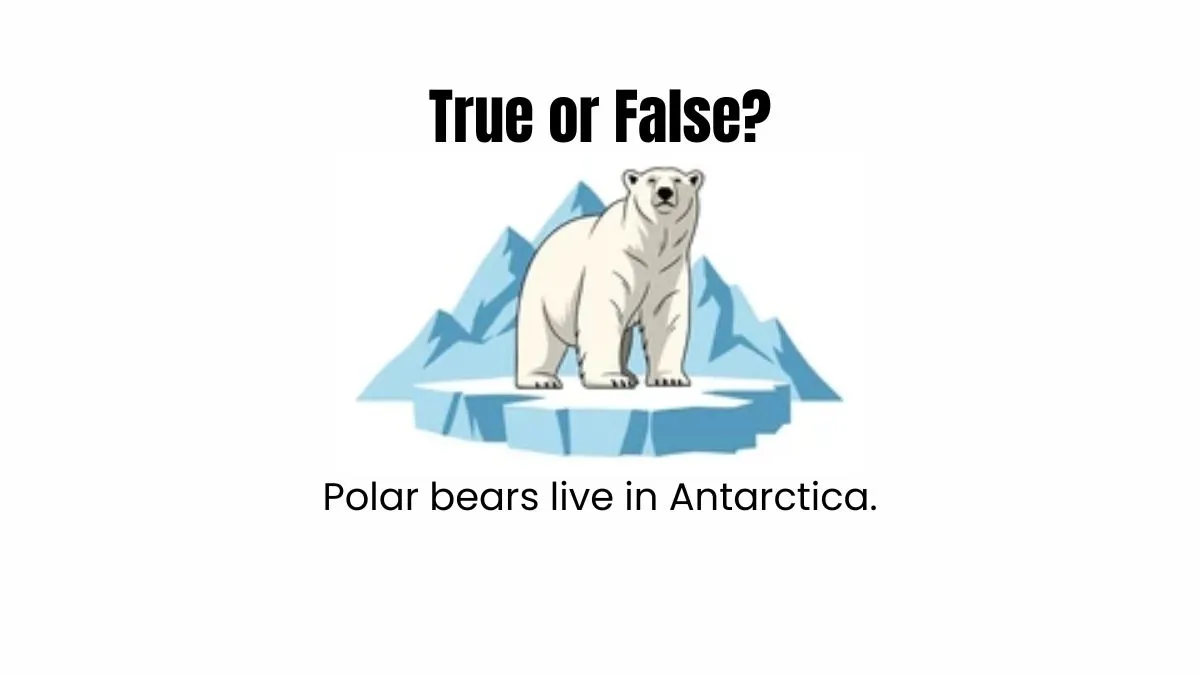
True or False: Polar Bears Live In Antarctica?
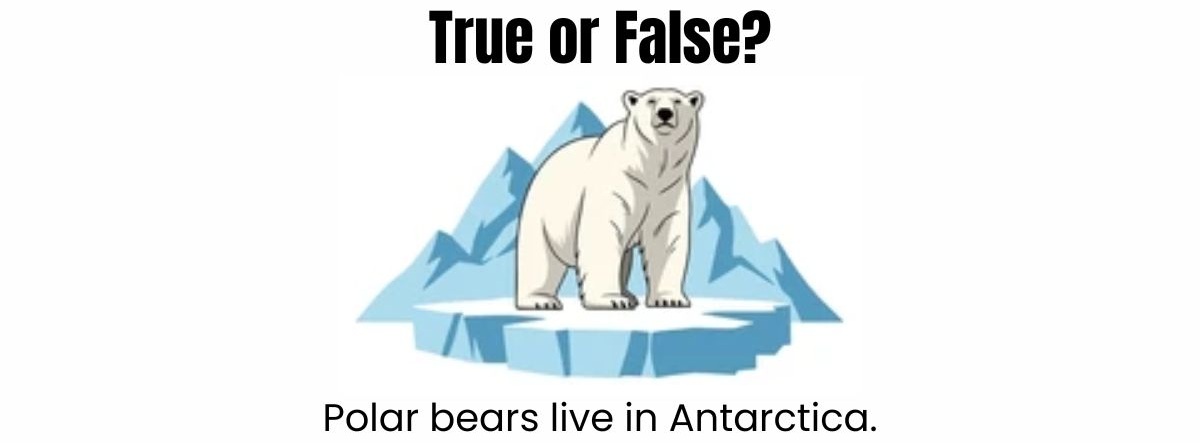
1. Polar bears live in Antarctica. True or False?
False. Polar bears do no live in Antarctica. Polar bears live in the Arctic (Northern Hemisphere). Penguins are native to the Antarctica (Southern Hemisphere).
2. No one lives in the Arctic region. True or False?
False. The Arctic region is a permanent home to approximately 4 million people, of whom 10 per cent are indigenous.
3. Polar regions experience 24-hour daylight and 24-hour darkness for months. True or False?
True. Due to Earth's 23.5 degree axial tilt, the polar regions experience 24-hour day light for months during their respective summers, while 24-hour darkness for months in their respective winters.
4. The Blood Falls is a waterfall in the Arctic. True or False?
False. The Blood Falls is a waterfall in Antarctica, which is completely red. This phenomenon occurs because the water contains iron oxide. This water has lots of iron that comes from under a glacier, and when it meets the air, it turns red.
5. There are no trees in Antarctica. True or False?
True. The extremely cold and harsh climate in Antarctica makes it impossible for regular trees and bushes to survive. However, some organisms like moss and algae survive in this icy environment.
6. The Aurora Borealis occurs in both the Arctic and Antarctica. True or False?
False. While auroras occur in both the Arctic and Antarctica but they have different names based on the hemisphere. Aurora Borealis (Northen Lights) occurs in the Arctic while Aurora Australis (Southern Lights) occurs in the Antarctica.
7. The coldest temperature ever recorded on Earth was in Antarctica. True or False?
True. At Antarctica's Vostok Station, the temperature dropped to a bone-chilling -89.2 degrees Celsius (-128.6 degrees Fahrenheit on 21 July 1983.
8. There is no land on the North Pole but only frozen water. True or False?
True. The North Pole located in the middle of the Arctic Ocean has no landmass. The sea ice floats on water. The USS Nautilus submarine was the first vessel to reach the North Pole by travelling under the ice on 3 August 1958.
9. There is an active volcano in Antarctica. True or False?
True. Mount Erebus is one of the southernmost volcanoes on Earth is located on Ross Island in Antarctica. It is an active volcano that occassionaly releases gases and lava, which freezes immediately in the frigid temperatures.
10. The Arctic is colder than Antarctica. True or False?
False. Antarctica is much colder than the Arctic because it is a big landmass surrounded by the ocean. Additionally, cold ocean current in Antarctica make it colder. Antarctica's tall mountains add to its extreme cold environment.



Comments
All Comments (0)
Join the conversation