Show Key Points
Electricity-free cooling technology offers a breakthrough solution to energy consumption and carbon emissions by utilising natural phenomena like radiative cooling and evaporation to lower temperatures without drawing power from the grid.
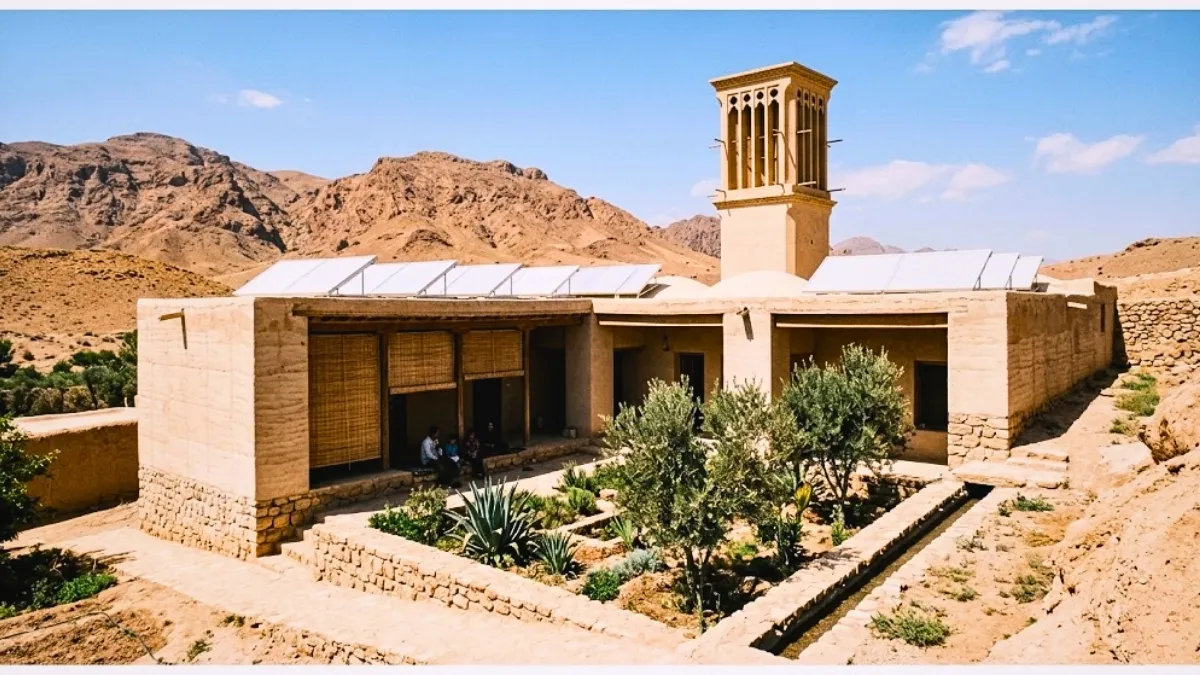
As global temperatures rise, the demand for air conditioning is skyrocketing to avoid a vicious cycle of energy consumption and carbon emissions. You can save money by using the Electricity-free cooling technology which is based on ancient wisdom by applying modern science.
What is Electricity Free Cooling Technology?
An electricity-free cooling system is often known as passive cooling, encompasses a range of technologies and design strategies that lower the temperature of a space or object without using mechanical systems or electrical power.
As a normal AC’s uses a compressor and chemical refrigerants but these systems are based on laws of thermodynamics to dissipate heat directly into the environment or the depths of space.
As conventional cooling systems account for nearly 20% of total electricity used in buildings globally. As we move ahead to net-zero emissions, the use of electricity free cooling technology is not just a green choice, it is a global necessity.
How Does It Work?
electricity free cooling technology generally based on two primary scientific pillars such as:
1. Sub-Ambient Radiative Cooling
Everything on Earth emits thermal radiation as the phenomena of modern material science. However, our atmosphere usually traps heat. Radiative cooling uses specialised surfaces such as high-tech films or paints which are designed to emit cold-space-bound infrared radiation through the atmospheric window. As a result these materials can actually become cooler than the surrounding air, even under direct sunlight.
2. Evaporative and Adsorption Cooling
This techanology uses the phase change of water to absorb heat when water evaporates, it consumes thermal energy from its surroundings and creates a cooling effect.
As an ancient technology we think of the "Zeed Pot" or pot-in-pot refrigerator, where water evaporating through porous clay cools the inner chamber. However in modern technology the advanced hydrogels that "sweat" to cool solar panels or building facades.
Electricity-Free Cooling by Nescod System by KAUST
Scientists at King Abdullah University of Science and Technology (KAUST) have unveiled Nescod (No Electricity and Sustainable Cooling on Demand), a sustainable refrigeration system that operates entirely without compressors or a power grid.
The mechanism in this system using endothermic dissolution means the system relies on a chemical process where a substance absorbs heat while dissolving. It uses Ammonium Nitrate (NH4NO3), an affordable salt common in fertilizers and when dissolved in water, it can plunge temperatures from 25°C to 3.6°C in just 20 minutes. This method is nearly four times more effective than using alternative salts like ammonium chloride.
Applications
The versatility of electricity-free cooling allows it to be used in high-tech urban environments and off-grid rural areas alike.
Cooling buidling Envelopes: by applying radiative cooling paints applied to rooftops can reduce indoor temperatures by several degrees, significantly lowering the Urban Heat Island effect in the cities.
Data Centers: Integrating passive heat sinks can reduce the massive energy load required to keep servers from overheating.
Wearable Techanology: the fabrics engineered with radiative cooling properties can keep athletes or outdoor workers cool without active fans.
Significance:
The shift to electricity-free cooling addresses three major environmental crises simultaneously:
- Carbon Footprint: to eliminate CO2 emissions which is associated with power generation for AC units, Fans, and Coolers.
- Refrigerant Gases: the most passive systems do not use HFCs (Hydrofluorocarbons), which are potent greenhouse gases in the world.
- Grid Resilience: it can reduces the peak load on electrical grids during heatwaves and summers by preventing blackouts.
-1778571379379.jpg)
Examples
-
The SkyCool Systems: A California-based company uses radiative cooling panels to enhance the efficiency of commercial refrigeration systems by saving businesses up to 15% on energy consumption.
-
The "Cool Ant" Project: An Indian design firm created a cooling installation made of terracotta tubes that uses water and natural flow of air to cool factory spaces without use of electricity.
-
Stanford’s Optical Surfaces: Stanford researchers have developed a multilayer optical material that is thinner than a wafer but reflects 97% of sunlight while simultaneously emitting heat back into space.
Electricity-free cooling technology is a cost-saving measure and provides a critical tool for fighting climate change by harmonising with the laws of physics so that we can stay cool while keeping the planet healthy and environmentally free.