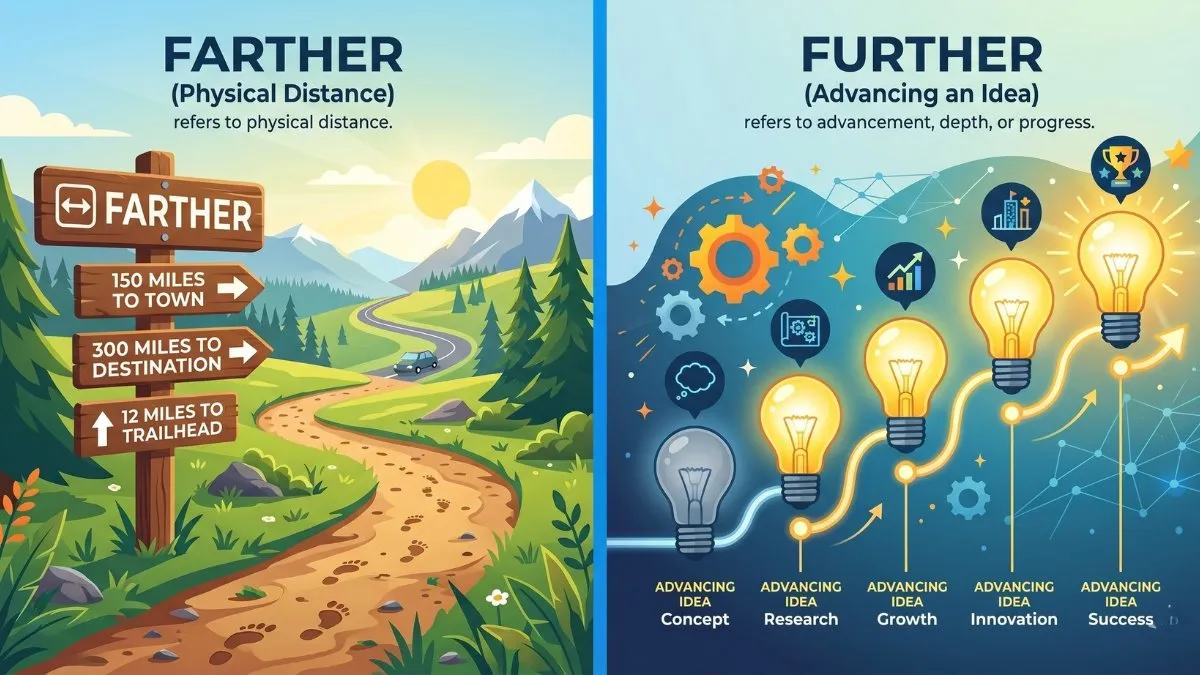
Many English speakers use the words "farther" and "further" as if they are the same. However, these two terms have distinct roles in formal grammar and clear communication.
The primary difference between farther and further is the type of distance they describe. Farther refers to physical, measurable distance like miles or kilometers while further refers to figurative distance, degree, or time. Understanding this separation helps to convey exact meaning and avoid common grammatical errors.
What is the main difference between Farther and Further?
The main difference between farther and further is that "farther" describes physical distance while "further" describes abstract or metaphorical distance. Use "farther" for literal lengths you can measure with a ruler or GPS. Use "further" for depth, degree, or when you mean "additional."
Key Differences Between Farther and Further
| Parameter | Farther | Further |
| Primary Definition | Physical or literal distance | Abstract, metaphorical, or additional degree |
| Measurability | Can be measured (miles, meters) | Cannot be easily measured |
| Root Word Basis | Based on the word "far" | Based on the word "forth" |
| Part of Speech | Adverb, Adjective | Adverb, Adjective, Verb |
| Verb Usage | Cannot be used as a verb | Can mean "to advance or promote" |
| Typical Example | "He ran two miles farther today." | "Let’s discuss this further tomorrow." |
| Academic Usage | Common in geography and physics | Common in logic, law, and business |
What is Farther?
Farther is the comparative form of the word "far." It talks about the real, physical space between two places. You should use "farther" when you want to talk about how long something is with a ruler, or to find out how far a car has gone according to its odometer.
The word originated from Middle English as a variant form of "further." As time went on, the two words started to have different uses in English. Now, "farther" is only used for talking about distance and movement.
What is Further?
Further relates to the word "forth." It means to move ahead in time, level, or strength. It includes scenarios where there isn't any actual travel. For instance, if you want to learn more about a topic, you are looking "further" into it.
Unlike "farther," "further" can also be used as a verb. To "further" something means to help it grow or do better. You might further your job or further a political cause.
Key Differences Between Farther and Further
The main difference between these two words is in its tangibility. When talking about how far it is from New York to London, you say "farther." But if you're talking about how deep a conversation is, you use "further."
Another big difference is that "further" can also mean "more." For instance, saying "further instructions" is right because instructions are not something you can measure in distance.
Saying "farther instructions" would be incorrect. In the United States, grammar experts follow these rules very carefully. In the United Kingdom, people often say "further" for both physical and more abstract distances. Still, for international tests and published works, it's best to keep them separate.
Use Cases
In everyday life, "farther" usually appears when talking about travel, delivery, and sports. For example, a marathon runner might try to run farther than they did in their last race. A logistics manager might want a warehouse that isn't any farther from the port than the one they have now. Here, farther talks about how far apart two places are.
"Further" is used more in work, legal, and school-related situations. A lawyer might request further proof. A teacher might suggest further reading for a history class. In a business setting, you might hear a manager say, "We need to push this project further."
Check out some more interesting articles from the general knowledge section to boost your knowledge of national and international topics. Stay connected with Jagran Josh for more topics like this.
ALSO READ: