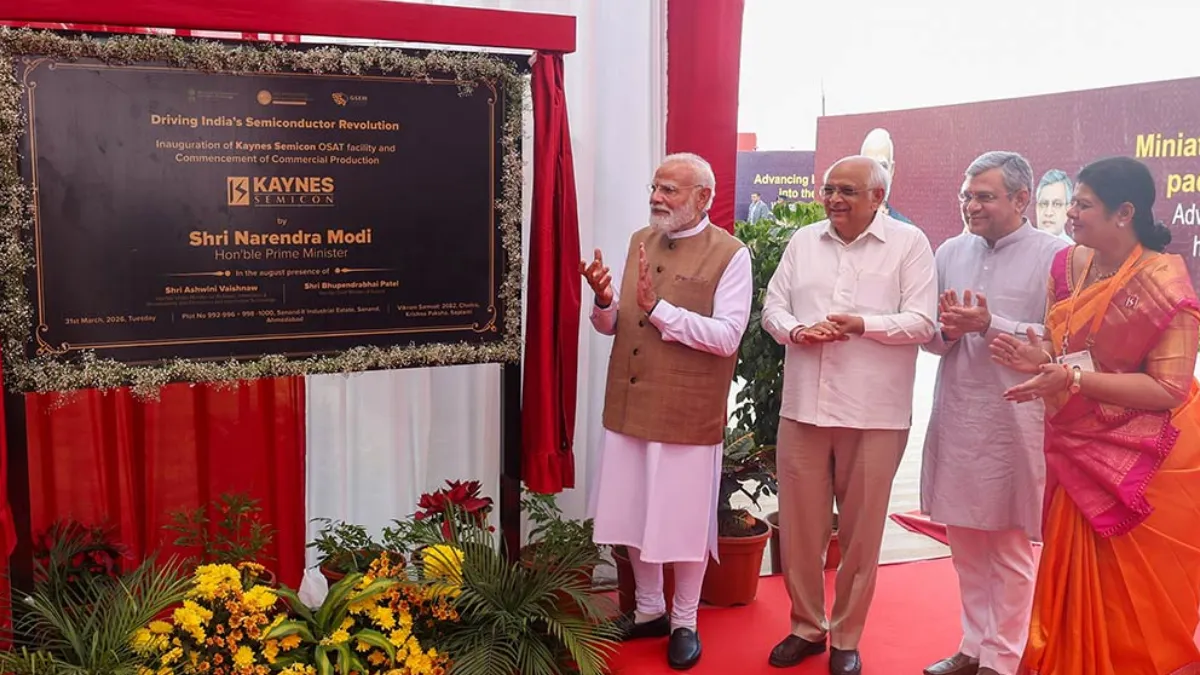
India has inaugurated the Kaynes Semicon semiconductor plant in Sanand, Gujarat, on March 31, 2026, by the country’s Prime Minister, Narendra Modi, which will further enhance the capabilities of the country in the field of semiconductor manufacturing.
This Outsourced Semiconductor Assembly and Test (OSAT) facility is an important milestone under the India Semiconductor Mission.
Kaynes Semicon Plant Overview
Kaynes Semicon, a wholly owned subsidiary of Kaynes Technology India Ltd., has an investment of ₹3,307 crores, producing 6 million chips per day, focusing on Assembly, Testing, Marking, and Packaging of Intelligent Power Modules, which are used in electric vehicles, industrial power electronics, renewable energy, and white goods. Commercial operations have begun, with initial orders already shipped to partners like Alpha & Omega Semiconductor.
How was the Semiconductor Plant Approved and Funded?
The Union Cabinet has approved the project in phases, commencing from June 2023, followed by the final approval in February 2024 and December 2024, respectively.
Under the incentive scheme of the India Semiconductor Mission, the project will receive 50% support from the central government (₹1,653.5 crores), 20% from the state government of Gujarat (₹661.4 crores), and 30% from the company itself (₹992.1 crores). A Fiscal Support Agreement has been signed with the Mission in January 2026.
Strategic Significance
In his address, the PM mentioned the rapid growth of the ecosystem, saying, "I just returned from the start-up of the Micron plant, which was just one month ago."
Sanand will become a semiconductor hub, home to four out of the ten approved semiconductor plants in the country, which will reduce the country’s dependency on imports, as currently, 95% of the country’s requirement is met through imports, and will further enhance the ‘Make in India’ drive in the electronics sector, which will be integrated into the global supply chain, taking the total approved investments under the Semiconductor Mission to over ₹1.52 lakh crores.
Kaynes aims to scale up mass production in the early part of 2026, which will be 60% of the first phase capacity of key contracts, while the cluster in Gujarat, including the Tata-PSMC fab in Dholera, will drive the growth of the ancillary industry.
Also Read: India's First Digital Census 2027 Notification Released: All You Need to Know



Comments
All Comments (0)
Join the conversation