Word of the Day: This Century-Old Word Describes a Job Where You Get Paid to Do Nothing
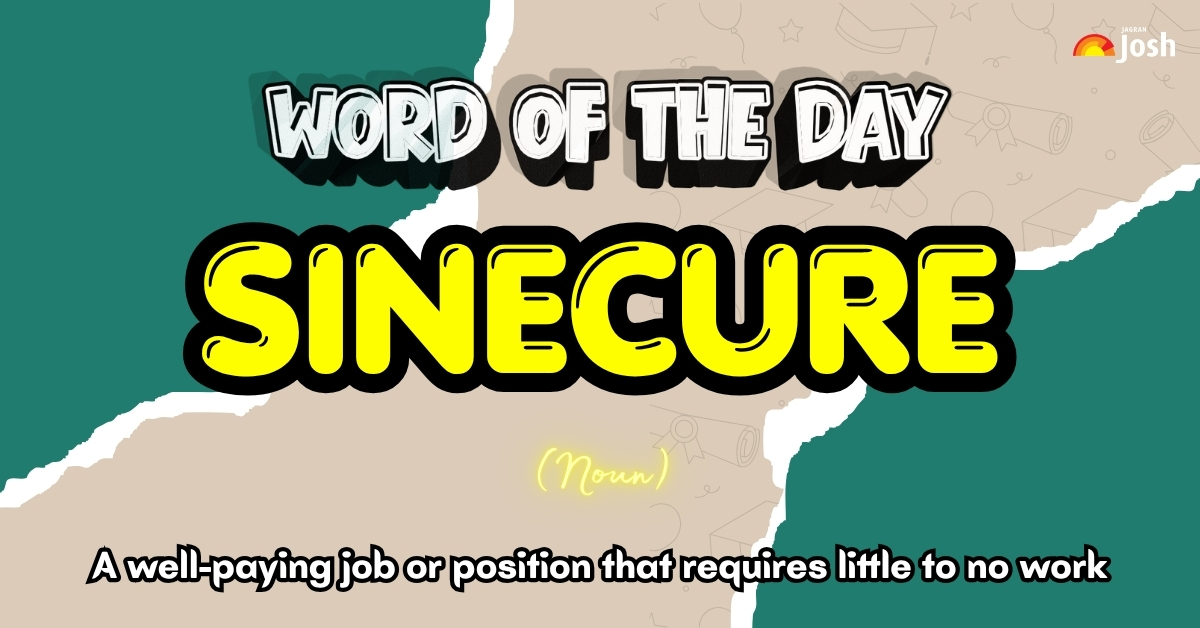
Word of the Day: 'Sinecure' is the featured word of the day. Comprehending the definition of 'sinecure' is crucial for acquiring advanced English vocabulary commonly encountered in international news and competitive examinations.
-1782198503967.webp)
Imagine you stroll into the office once a month, scribble your name on a form, and walk out with a pay cheque that makes your friends jealous. Too good to be true? Nope, that's a sinecure for you. It's the kind of gig where you get paid real money for doing almost nothing. So where did this word come from, why do people still toss it around, and how did these cushy jobs even become a thing? Let’s understand.
Sinecure Meaning & Definition
A sinecure (pronounced sigh-neh-kyoor) is a noun. It describes a job, office, or position that pays a salary but involves minimal duties or responsibilities.
| Feature | Details |
| Type | Noun |
| Pronunciation | Sigh-neh-kyoor or Sih-neh-kyoor |
| Root | Latin (sine cura) |
Essentially, it is a "cushy" job. Historically, these roles were given as political favours or rewards. Today, people use the word to describe any role where someone gets paid well to do almost nothing. For school students, think of it like being appointed as the "chief pencil sharpener" for a class that only uses pens, yet still getting full credit for helping.
Where Does the Word 'Sinecure' Come From?
The word comes from the Latin phrase sine cura, which literally translates to "without care". It originated in the medieval church.
In the Middle Ages, a sinecure was a church position held by a priest who received money from a parish but did not have to actually take care of the people's souls. Because they had no spiritual "care" or duties to perform, the job was "without care".
Over the centuries, the term left the church and entered the world of politics and business. Governments used to create these empty titles to give money and power to friends of the king without making them work.
How to Use 'Sinecure' in a Sentence? (With Real Examples)
Using this word is easy once you realise it always refers to a specific job or position. It highlights the unfairness of getting paid for doing nothing.
- Examples: The retired politician was given a sinecure on the company's board.
- Many people viewed the director's position as a well-paid sinecure.
- He thought the night watchman job would be a sinecure, but he had to patrol constantly.
- She realised her new role was a sinecure when she spent all day reading books.
- The king gave his cousin a sinecure in the palace library.
- No one wanted hard labour; everyone was looking for a comfortable sinecure.
- His position as a consultant turned out to be a total sinecure.
- The uncle secured a sinecure for his nephew at the family firm.
- Being the honorary captain was a sinecure with no real duties on the field.
- She resigned because she wanted a challenging career, not a boring sinecure.
Sinecure - Synonyms and Antonyms
To better understand the word, let us look at its opposites and similar words.
Synonyms (Similar Words):
- Soft option: An easy alternative.
- Easy money: Income that requires little effort.
- Cushy job: A very easy position.
- Sitting duck job: Slang for a role with no effort.
Antonyms (Opposite Words):
- Drudgery: Hard, boring, and continuous work.
- Labour: Heavy physical or mental exertion.
- Slavery: Hard work under complete control.
- Challenging post: A job requiring immense effort and skill.
Did You Know?
The British government used to have an official sinecure called the "Groom of the Stool". This person's actual job was to assist the king in his private bathroom. While it sounds unpleasant, it was highly desired because it gave intimate access to the king, leading to massive political influence for doing very little real work.

Kriti Barua is a skilled digital journalist and communications professional with 4+ years of experience, currently writing for the General Knowledge section at Jagran New Media. She has established herself as a subject matter expert in History, Geography, Trending National and International News, Sports, Science, and Defence, producing clear, reliable, and search-optimised content that connects with readers worldwide.
Kriti holds a BA degree from Delhi University and a one-year diploma in TV Production and Journalism, an academic background that adds research depth and strong storytelling instincts to her writing. Her experience spans brand writing, content marketing, and digital media, giving her a sharp understanding of what makes content both helpful to readers and visible in search.
At Jagran New Media, she applies this expertise to national and international news coverage, query-based articles, and in-depth pieces across her specialist subject areas. Her content is defined by easy language, factual accuracy, strong keyword strategy, and reader-friendly storytelling.


