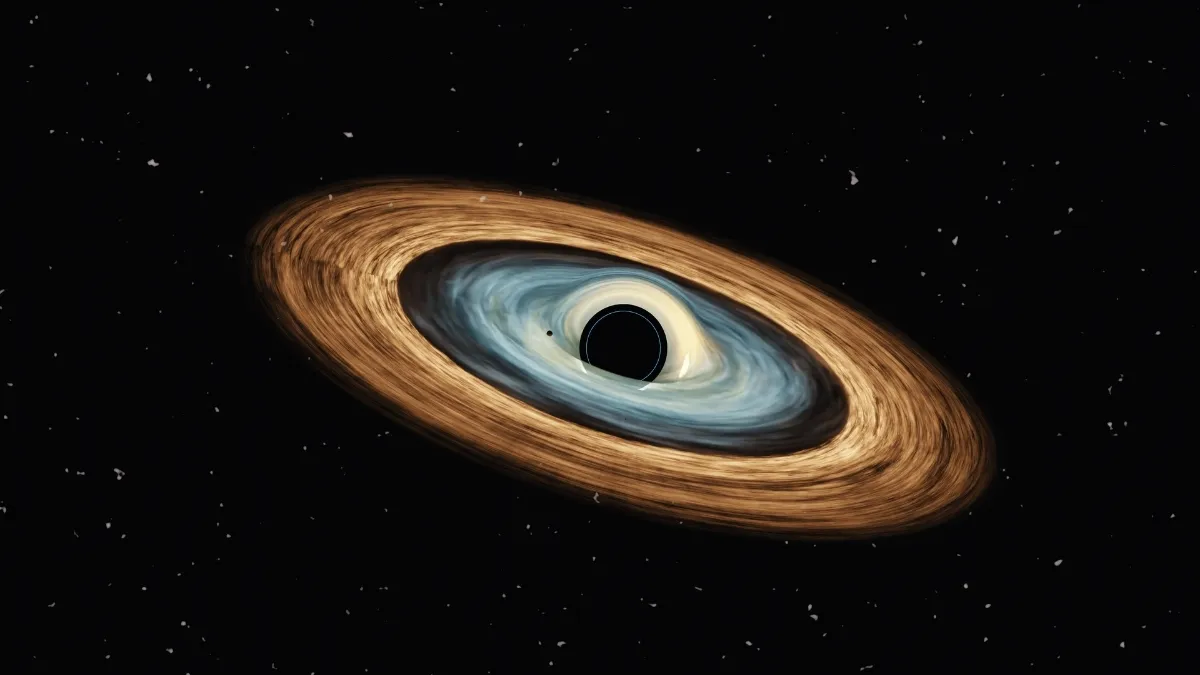
Black holes are some of the most forceful and enigmatic phenomena in our vast universe, but they are not actually hollow.
In other words, black holes are the remaining mass after the collapse of a star in its later stages, in which its large quantity of mass ends up occupying a relatively small area.
Thus, the gravitational pull becomes extremely intense such that light cannot escape from it.
It’s due to this reason that black holes appear absolutely black, earning their name of "black holes."
But why are Black Holes so powerful? Find out in this article along with 6 interesting facts about Black Holes.
Why are Black Holes So Powerful?
Black holes get their power from the extreme density of matter. They are created when massive stars collapse.
This collapse packs an amount of mass into a tiny volume. Gravity then overwhelms all fundamental forces. The gravitational pull becomes so strong that not even light can escape.
This power is most evident at the event horizon. The event horizon is the point of no return surrounding the hole.
Black holes don’t simply suck things in like a vacuum. Instead, they rip apart any matter that comes too close, accelerating it to extreme speeds. As this material spirals inward, it becomes superheated. It glows brilliantly.
Sometimes it even flings out jets of gas and radiation. These jets can influence the evolution of galaxies. The true extent of a hole's power remains a mystery. It is hidden at its core, known as the singularity.
Check Is There Sound in Space?
Why Are They Called Black Holes?
The term " hole" describes their most defining characteristic. They emit no light. They are invisible to the eye.
Matter is packed so densely that gravity overwhelms all other forces. The intense gravitational pull is so strong that even light cannot escape once it crosses the event horizon.
Because light is trapped within their boundaries, these regions appear as empty voids. They are against the backdrop of space. Black holes don't suck things in like a vacuum. Their mouths are effectively dark.
No radiation can get out to reach our telescopes. We only see them by detecting the glowing gas swirling around them. We can also see the gravity they exert on stars.
Read Quote of the Day by Maya Angelou here.
Types of Black Holes
Based on scientific understanding, there are four categories of black holes. They are distinguished by their mass and formation mechanisms.
-
Stellar-mass Black Holes: Formed from the collapse of massive stars (around 3 to 100 times the sun's mass) at the end of their life cycle.
-
Supermassive Black Holes: Millions or billions of times more massive than the Sun, located at the center of most galaxies. They grow by consuming large amounts of gas and merging with other black holes.
-
Intermediate-Mass Black Holes (IMBHs): Thesebridge the gap between stellar and supermassive sizes, with masses from hundreds to thousands of solar masses. They are rare. They likely form in star clusters.
-
Primordial Black Holes: Theoretical black holes formed after the Big Bang. They could be extremely small, ranging down to the size of a nucleus. Scientists believe these four types may grow by eating gas, planets, or even merging with black holes.
6 Interesting Facts About Black Holes You Should Know
Black holes are made of space and time. They serve as laboratories. Gravity is so absolute that it can warp the fabric of the universe. It tests the limits of general relativity and quantum mechanics. Read 6 interesting facts about Black holes below:
-
Gaia BH1, the closest to our planet, is about 1500 light-years away.
-
As of 2025, the farthest known black hole is located in a little red dot galaxy named CAPERS-LRD-z9. It is observed 500 million years after the Big Bang. It is 13.3 billion light-years away.
-
Phoenix A* is currently considered the largest known black hole. It has an estimated mass of 100 billion solar masses.
-
The smallest known black hole detected so far is in the system G3425, with a mass of about 3.6 to 3.8 times that of the Sun.
-
All black holes tend to spin.GRS 1915+105 is generally recognized as a spinning stellar-mass black hole. It is discovered rotating at over 1,000 to 1,150 times per second.
-
If the Sun were replaced by a hole of the same mass, the gravitational force on Earth and the other planets would remain identical. The system's orbits would continue as normal. Gravity depends on mass and distance, not the object's size.
Do you know Which is the First Country to Lose All Its Glaciers?
Conclusion
Black holes represent some of the most potent and enigmatic entities in the cosmos, offering insight into how the effects of gravity can be distorted within an environment far beyond anything imaginable.
Although their internal structure cannot be fully comprehended yet, black hole research aids us in advancing our comprehension of gravity, energy, and galaxy formation.
Through analyzing how they come into being, what they are composed of, and how they react, we gain knowledge not just on the extremes of the cosmos, but also on the rules governing the entire universe.