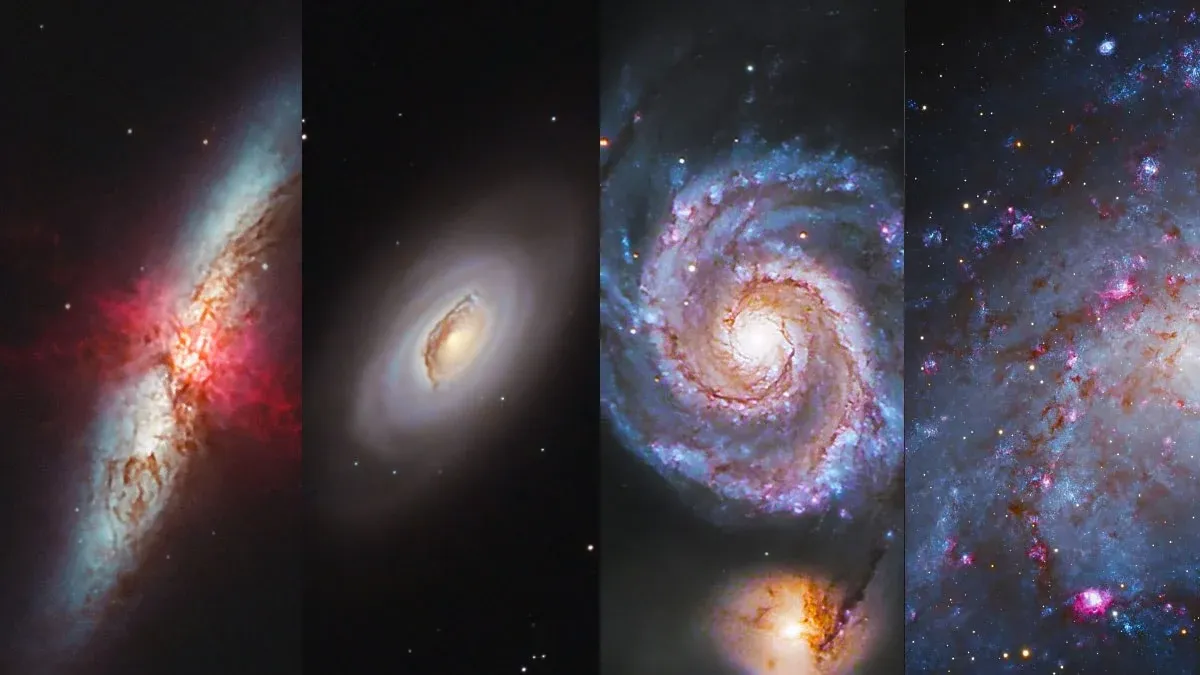
Galaxies are vast gravitational structures that harbor billions to trillions of stars, as well as, interstellar gas, dust, and nebulae as well as the dark matter that binds them together. Our solar system is on our own Milky Way which is one such galaxy.
In 1926, Edwin Hubble came up with a classification scheme known as the tuning fork which classifies galaxies as ellipticals, spirals (with barred forms), and irregulars depending on their visual appearance, and the transition between these types is called the lenticulars.
This system has been central to astronomy, but recent observations have shown that there are subtypes such as dwarfs. In the observable universe, there are approximately 2 trillion galaxies, each with different environments, such as clusters and voids.
Hubble Classification System
The tuning fork diagram presented by Hubble organizes galaxies into a scale: ellipticals (E0 to E7, round to elongated) compose one prong, spirals (S0 to Sc) and barred spirals (SB0 to SBc) the other, and the irregulars are on the side. The galaxies which are at the junction of the fork are the lenticular galaxies (S0), which have a disk, a bulge but no spiral arms.
The subtypes of the spiral extend: Sa (tight arms, big bulge) to Sc (loose arms, small bulge), and indicate the reduction of dominance of the bulge.
Refinements by Allan Sandage introduced intermediate classes and observed peculiarities due to interactions. This morphological scheme is associated with physical properties such as the star formation rates.
Types of Galaxies
A spiral galaxy has a bright core of older stars and a thin disk with winding arms, which contain a lot of gas and dust that give rise to the continuous birth of stars.
They constitute approximately 60 percent of bright galaxies, and the arms are formed by density waves which squeeze gas. Normal spirals are opposed to barred spirals (two-thirds of spirals) that have a central bar that directs gas to the core, as in our barred Sb Milky Way.
The most important ones are Andromeda (M31, Sa, closest major spiral) and Pinwheel (M101, Sc).

Source: Astrobackyard
Three types of galaxies
The galaxies that are elliptical are smooth and featureless between almost spherical (E0) and extremely elongated (E7) ones featuring old, reddish stars with little gas or dust. They accommodate few star formations and tend to be the brightest and largest, dominating galaxy clusters. They were formed by mergers and are boxy or diskier in closer examination. M87 of the Virgo Cluster is a giant elliptical that is an active black hole.
Irregular Galaxies
Irregular galaxies are not symmetrical; they have chaotic shapes, which are usually distorted by gravitational interaction or mergers. They are dusty and gaseous, and are bursting with newly formed blue stars and supernovas, contributing to 15-25% of galaxies.
There are subtypes Magellanic irregulars (dwarf-like, e.g., Large Magellanic Cloud) and peculiar interacting pairs. The Small Magellanic Cloud shows how they are close to spirals, such as the Milky Way.
Other Types and Special Cases
Lenticular galaxies (S0) merge elliptical bulges with spiral disks, although they do not have arms, which change through the loss of gas.
Dwarf galaxies, dim and very many (90% of the total number of galaxies), are dwarf ellipticals, dwarf spheroidals and dwarf irregulars that revolve around larger ones. Peculiars include mergers (e.g., Antennae Galaxies), and active ones such as quasars which are fed by supermassive black holes.



-1776494811841_t.webp)