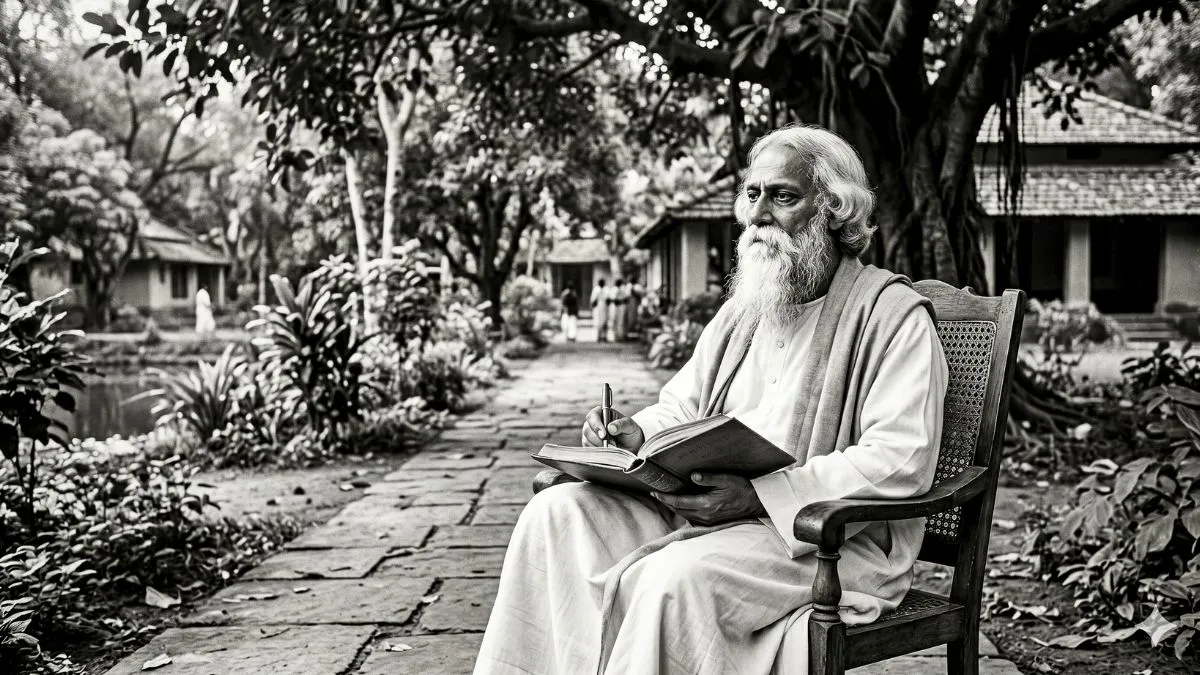
Rabindranath Tagore was a poet, artist, and thinker who transformed modern literature. He was the first non-European to be awarded the Nobel Prize for Literature in 1913. His teachings are timeless and speak to the nature of love, nature, and the human spirit. On the occasion of his birth anniversary, which is celebrated as Rabindra Jayanti, let us explore 11 quotes by him on life and wisdom.
Rabindranath Tagore: Key Facts at a Glance
| Category | Detail |
| Birth Date | May 7, 1861 |
| Major Award | Nobel Prize in Literature (1913) |
| Most Famous Work | Gitanjali (Song Offerings) |
| National Anthems | Composed Jana Gana Mana for India and Amar Shonar Bangla for Bangladesh |
| Education Legacy | Founded Visva-Bharati University in Shantiniketan |
| Main Philosophy | Universalism and harmony with nature |
Who was Rabindranath Tagore?
Rabindranath Tagore was a polymath from Bengal who revolutionized Indian literature and music. Polymath: One who is learned in many fields. He composed poems, stories, and plays which are read throughout the world today.
Tagore was the first Asian person to win a Nobel Prize. He abandoned mechanical ways of writing. Instead, he spoke in layman's terms about profound human emotions. His work contributed to the introduction of Indian culture to the Western world. He was also a close friend of Albert Einstein and had frequent conversations with Einstein about science and spirituality.
Why are quotes by Rabindranath Tagore still relevant?
The quotes of Rabindranath Tagore are about the harmony between man and nature. He preaches the doctrine of inner freedom and universal love. Here are his 11 most important quotes on life. They assist readers in making the link between personal development and the natural environment.
11 Quotes by Rabindranath Tagore on Life and Wisdom
1. "Clouds come floating into my life, no longer to carry rain or usher storm, but to add color to my sunset sky."
Meaning:
This quote demonstrates his positive attitude towards old age and life's difficulties. He felt that even in hardships, one can make his/her life more beautiful.
2. "Faith is the bird that feels the light when the dawn is still dark."
Meaning:
Tagore frequently used nature to explain hope. This quote implies that belief can help individuals perceive a better future before it happens.
3. "Let your life lightly dance on the edges of Time like dew on the tip of a leaf."
Meaning:
He urged people to live in the here and now. He believed that man should not be burdened with the past or the future.
4. "Where the mind is without fear and the head is held high."
Meaning:
This is his most famous line from the poem Gitanjali. It describes his vision for a free and independent nation.
5. "The highest education is that which does not merely give us information but makes our life in harmony with all existence."
Meaning:
He believed that school should teach us how to live with others and the environment.
6. "I slept and dreamt that life was joy. I awoke and saw that life was service. I acted and behold, service was joy."
Meaning:
This quote explains his belief that helping others leads to true happiness.
7. "You cannot cross the sea merely by standing and staring at the water."
Meaning:
This is a call to action. He believed that ideas are only useful if people work to make them real.
8. "Love is an endless mystery, for it has nothing else to explain it."
Meaning:
He saw love as a fundamental force of the universe that does not need logic.
9. "Art is the response of man's creative soul to the call of the Real."
Meaning:
He believed that artists do not just copy the world but respond to its beauty.
10. "Death is not extinguishing the light; it is only putting out the lamp because the dawn has come."
Meaning:
This quote reflects his spiritual belief that death is a transition to a new beginning.
11."Everything comes to us that belongs to us if we create the capacity to receive it."
Meaning:
He taught that personal growth is the key to attracting good things in life.
What is Rabindranath Tagore's most famous book?
His most famous book is Gitanjali, which means "Song Offerings." It is a collection of poems that explore the relationship between the poet and the divine. This work won him the Nobel Prize in Literature in 1913.
Which national anthems did Tagore write?
Tagore is the only person to have written the national anthems for two different countries. He wrote Jana Gana Mana for India and Amar Shonar Bangla for Bangladesh.
What does the name "Gurudev" mean?
Mahatma Gandhi gave Tagore the title "Gurudev." In Sanskrit, this means "divine teacher." Tagore and Gandhi had a deep respect for each other, even when they disagreed on politics.
Why is Shantiniketan famous?
Shantiniketan is a town in West Bengal where Tagore started his university. It is famous for its unique style of education that takes place in nature. It is now a UNESCO World Heritage site.
Check out some more interesting articles from the general knowledge section to boost your knowledge of national and international topics. Stay connected with Jagran Josh for more topics like this.