North Korea Changes Flag for the First Time, Revises Constitution, Recognises South Korea: Know Impact on the Historic Conflict
The revised design makes the flag shorter and less elongated, while retaining its familiar red, white and blue colours and central red star. According to Article 166 of North Korea's revised constitution, published on the state-run Naenara website, the height-to-width ratio has changed from 1:2 to 1:1.65.
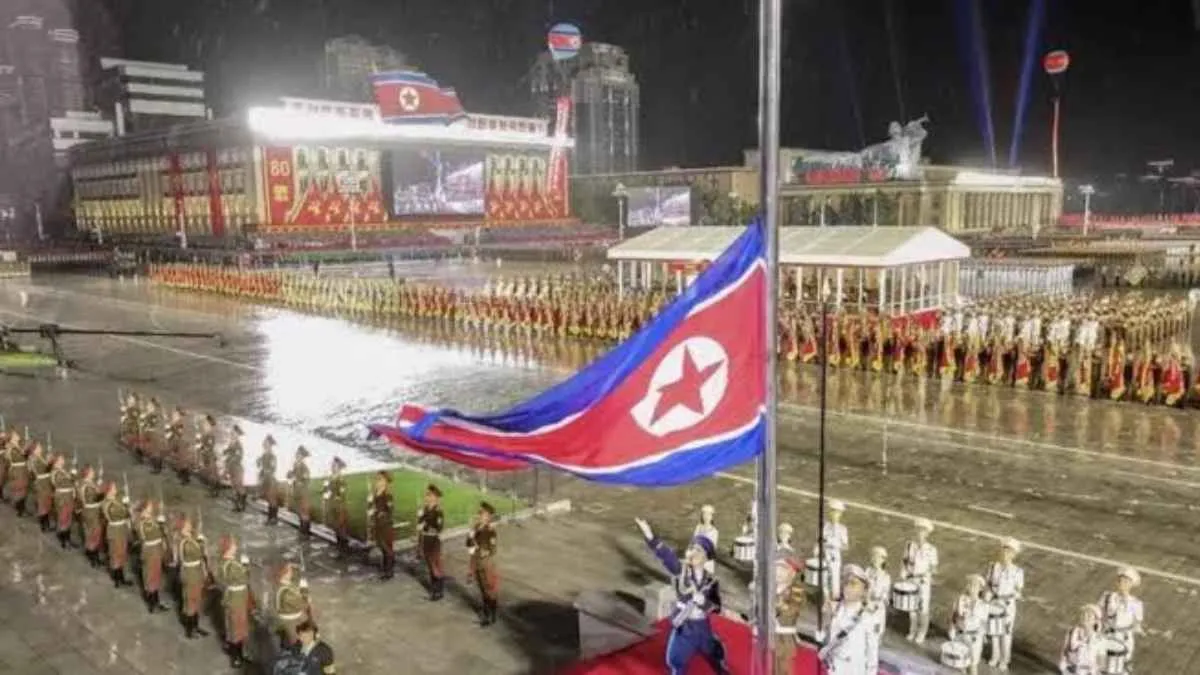
A national flag is more than a piece of coloured fabric. It represents a country's history, political beliefs and identity. In North Korea, where state symbols are closely connected to the ruling leadership, even a small alteration can carry political significance. Leader Kim Jong Un has today changed the proportions of the country's national flag for the first time since its adoption in 1948.
The revised design makes the flag shorter and less elongated, while retaining its familiar red, white and blue colours and central red star. According to Article 166 of North Korea's revised constitution, published on the state-run Naenara website, the height-to-width ratio has changed from 1:2 to 1:1.65.
The modification has attracted attention because it comes amid Kim's efforts to redefine North Korea's political identity and move away from historical influences associated with the Soviet Union.
Why Has Kim Jong Un Changed the Flag?
North Korea adopted its national flag in 1948, following the division of the Korean Peninsula after World War II. Its original design emerged during a period when the Soviet Union exercised considerable influence over the newly established communist state.
Soviet officials reportedly presented the design to Kim Il Sung, North Korea's founding leader and grandfather of the current ruler. The flag subsequently became an important symbol of the country's revolutionary history.
North Korean propaganda later credited Kim Il Sung with designing the national flag, reinforcing its association with the founding leadership.
The latest adjustment does not remove the Soviet-era design completely. Instead, it changes its proportions, giving the flag a slightly different appearance.
What Do North Korea's Flag Colours Mean?
The flag features a broad red central stripe, narrow white bands, blue stripes along the top and bottom, and a red five-pointed star inside a white circle.
According to North Korea's official interpretation, red represents revolutionary struggle and sacrifices made during resistance against Japanese colonial rule between 1910 and 1945.
White symbolises national traditions and purity, while blue represents sovereignty, peace and international friendship. The red star represents socialism and revolutionary ideology.
Is North Korea Moving Away From Its Past?
The flag revision follows wider political changes under Kim. In 2023, he abandoned the longstanding policy of peaceful reunification with South Korea and described the two countries as hostile states.
In 2024, references to the Korean Peninsula were also removed from the national anthem.
Together, these developments suggest that Kim is reshaping North Korea's national identity while retaining symbols central to its political system.
North Korea Redraws Boundary and Recognies South Korean boundaries
North Korea has also unveiled crucial changes to its national identity and constitutional framework, by officially defining South Korea as a individual neighboring country. Under the revised rule, North Korean territory consists of land bordering China and Russia to the north and South Korea to the south, together with its linked territorial waters and airspace. However, the constitutional text does not names precise land or maritime boundary coordinates. The revised document also scraps previous constitutional references to national reunification. This showcases an official departure from the previous constitutional framework, which included reunification as a national goal.
Affect on North Korea-South Korea Conflict
North Korea's decision to formally recognise South Korea as a separate neighbouring state and remove references to national reunification from its constitution marks a significant shift in relations between the two countries. The constitutional revision institutionalises leader Kim Jong Un's policy of treating the two Koreas as hostile states and could make efforts to reduce tensions on the Korean Peninsula more difficult.
North Korea released the full text of its revised constitution on its state propaganda website, Naenara. The document confirms changes adopted during the first session of the 15th Supreme People's Assembly on March 23, 2026.
The most significant change appears in Article 2, which defines North Korea's territory as bordering China and Russia in the north and the Republic of Korea (South Korea) in the south. It also includes the country's associated territorial waters and airspace.
The revised constitution removes earlier provisions referring to national reunification, peaceful reunification and national unity. This reflects Kim's decision to abandon the longstanding objective of bringing the Korean Peninsula under a single political system.
By officially defining South Korea as a separate country, Pyongyang is reinforcing its position that relations between the two governments should no longer be viewed through the framework of national reconciliation. This could reduce opportunities for diplomatic engagement and increase the possibility of military misunderstandings.

At Jagran Josh, she specialises in writing explainers and analytical stories on international news and current affairs. Over the years, she has developed strong expertise in leveraging digital and multimedia tools, along with SEO best practices, to enhance the speed, reach, and impact of her stories.