List of GI Tag Products in Tripura State of India
Discover the list of GI tag products in the Tripura state of India. Explore all 5 GI-tagged products of Tripura, their history, significance, year of registration, and key facts.
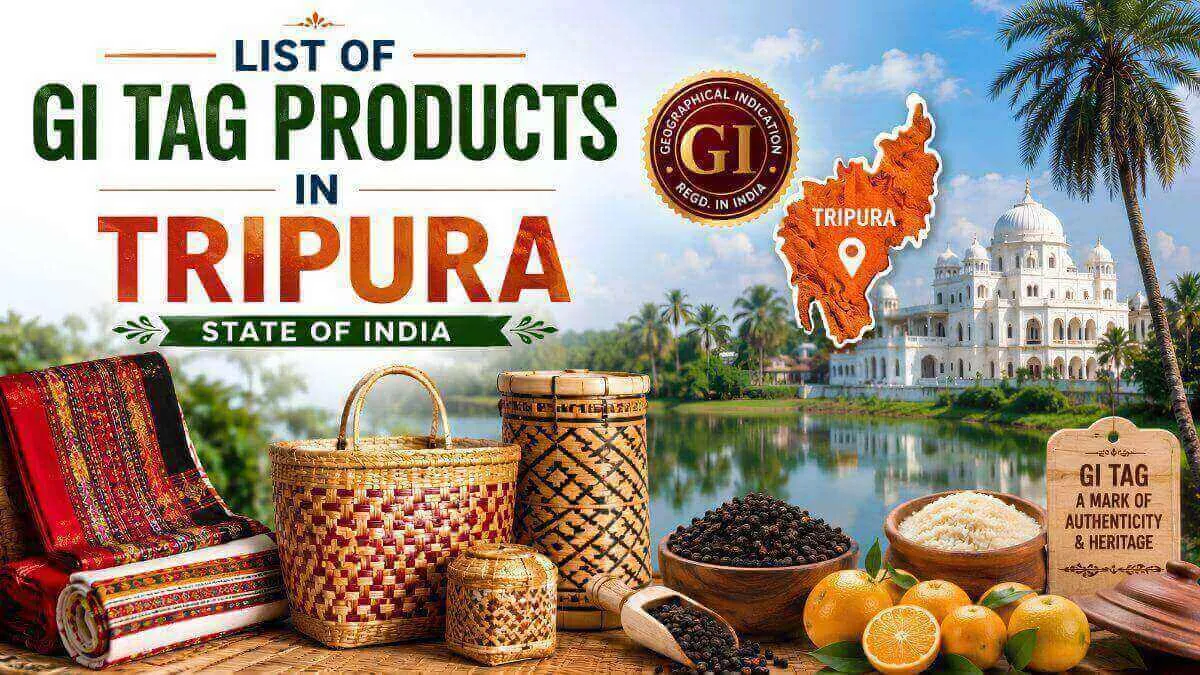
List of GI Tag Products in Tripura State of India
Tripura has 5 GI-tagged products as of June 2026. These are Tripura Queen Pineapple, Risa, Rignai (also called Pachra), Matabari Peda, and the latest addition, Tripura Sarinda. The GI tag is given by the Government of India to protect special products that are made or grown in a particular place and have a unique quality linked to that place.
Key Takeaways
-
As of June 2026, there are 5 GI-tagged products in Tripura.
-
The Tripura Sarinda, a traditional stringed musical instrument, was the latest one to be given the GI tag in June 2026.
-
Tripura Queen Pineapple was the first GI-tagged product from the Tripura state of India, which was received in 2018 through NERAMAC.
-
Risa, Rignai (Pachra), and Matabari Peda received their GI tags in March 2024.
-
GI tags in India are governed by the Geographical Indications of Goods (Registration and Protection) Act, 1999, administered by the Controller General of Patents, Designs, and Trademarks under the Government of India.
-
A GI tag protects the product from being copied or misused by sellers from other regions.
Tripura's traditional Sarinda has received the Geographical Indication (GI) tag.
— DD News (@DDNewslive) June 16, 2026
The traditional stringed musical instrument is an integral part of the cultural heritage of the state's indigenous communities and is renowned for its distinctive craftsmanship.#GITag@MIB_India… pic.twitter.com/hA74FWhEkk
What is a GI Tag?
The GI, which stands for Geographical Indication. The product with a GI tag is special because of the place they come from. The quality, taste, design or any other characteristic of that product is related to the specific region.
For instance, pineapples from Tripura can only be marketed as "Tripura Queen Pineapple" and not otherwise. No one in any other state or country can use that name for their pineapples. This will help the farmers and artisans of Tripura avoid unfair competition.
In India, GI tags are given under the Geographical Indications of Goods (Registration and Protection) Act, 1999. This law was brought into force on 15 September 2003. The office that handles GI tag registration in India is the Geographical Indication Registry, which works under the Controller General of Patents, Designs, and Trademarks, Government of India.
List of All GI Tag Products in Tripura
| S.No. | GI Product Name | Product Category | Year of GI Tag |
| 1 | Tripura Queen Pineapple | Agriculture | 2018 |
| 2 | Tripura Risa | Textiles / Handicraft | March 2024 |
| 3 | Tripura Rignai (Pachra) | Textiles / Handicraft | March 2024 |
| 4 | Matabari Peda | Food (Dairy-based Sweet) | March 2024 |
| 5 | Tripura Sarinda | Musical Instrument / Handicraft | June 2026 |
Note: Risa and Rignai (Pachra) together form part of the traditional tribal attire of Tripura's indigenous communities. Some sources count them as one entry, giving Tripura a total of 4 distinct GI-tagged products.
Detailed Information on Each GI Tag Product of Tripura
1. Tripura Queen Pineapple
The Queen Pineapple is the state fruit of Tripura. It is one of the most well-known agricultural products of Northeast India. Tripura is among the largest pineapple-growing states in the country. The Queen variety is special because of its sweet taste, golden-yellow colour when ripe, unique aroma, and low fibre content. All these qualities come from the hilly land and humid weather of Tripura.
The GI tag for Tripura Queen Pineapple was secured through the efforts of the North Eastern Regional Agricultural Marketing Corporation (NERAMAC) in 2018. It was part of a group of 13 fruits and vegetables from Northeast India that received the GI tag at the same time.
After getting the GI tag, the pineapple has started reaching international markets. Tripura has already exported Queen Pineapples to some countries such as Oman and efforts are under way to make it to the European market including Holland.
The Government of India also initiated the Mission Queen Pineapple, Tripura in 2026 with an investment of Rs 236 crore to boost pineapple cultivation and ensure competitive prices for farmers.
Why it is special:
-
Cultivated in the hilly land of Tripura state and not much use of chemical fertilizer is obtained.
-
Has a golden colour and rich flavour with a distinct aroma
-
The name is protected as a GI and only pineapples grown in Tripura can bear this name.
2. Tripura Risa
Risa is a handwoven cloth made by tribal women of Tripura using loin looms. It is one of the three main pieces of traditional dress worn by Tripuri tribal women, the other two being Rignai and Rituku.
Risa is used as an upper garment by women. It is also worn as a stole, a headdress, or given as a gift to show respect and love to someone. Men also use Risa as a turban at weddings and festivals. Young boys and girls wear it as a scarf during winters. Even babies benefit from it as their mothers use it as a sling to carry them on their backs.
What makes Risa truly beautiful is its design. Tribal women use multicoloured warp and weft threads on the loom to create bright and stylish patterns. Almost all 19 indigenous tribal communities of Tripura weave Risa, and each community has its own unique design.
At around 12 to 14 years of age, a young Tripuri girl receives her first Risa at a ceremony called 'Risa Sormani'. Risa is also worn during religious festivals like Garia Puja.
The GI tag for Risa was obtained by the Killa Mahila Cluster of Gomati district, which was promoted by the Tripura Rural Livelihood Mission (TRLM). It was officially awarded in March 2024.
3. Tripura Rignai (Pachra)
Rignai is another important piece of traditional dress from Tripura. Tribal women wear Rignai as a lower garment, similar to a saree in the rest of India. The word "Rignai" literally means "to wear."
Rignai is produced by tribal women by handlooms at their homes. It is produced by the use of local materials and traditional skills by the artisans. Recently, Rignai is gaining popularity not only in Tripura but in metropolitan cities too as it is very attractive for the urban people for its stylish traditional pattern.
Rignai is also presented as a gift to guests or special persons as a symbol of love and respect. It has significant cultural importance and is an indication of the rich textile culture of the tribal communities of Tripura.
In March 2023, the Mahila Cluster Bahumukhi Samabaya Samity Limited applied for the GI tag for Rignai (Pachra). GI tag was officially awarded in March 2024 for a period of 10 years till March 2033.
4. Matabari Peda
Matabari Peda is a sweet made from milk and sugar. It is the famous prasad (religious offering) of the Tripura Sundari Temple, which is located in Udaipur, Gomati district of Tripura. This temple is one of the 51 Shakti Peethas of Hinduism and is about 524 years old. The temple is also called "Matabari" by locals.
The Peda has a unique taste and deep cultural importance because it is connected to the religion and traditions of the people of Tripura. The demand for Matabari Peda has grown so much that it is now available online and through social media platforms.
The GI tag for Matabari Peda was awarded in March 2024. The applicants who worked to get this recognition were Matabari Mahila Cluster Level Bahumukhi Samabay Samiti and Dewanbari Mahila Cluster Bahumukhi Samabay Samity, both supported by the Tripura Rural Livelihood Mission (TRLM).
5. Tripura Sarinda (Latest GI Tag, June 2026)
The Tripura Sarinda is a traditional stringed musical instrument of the tribal communities of Tripura. It is a bowed string instrument, meaning it is played with a bow, similar to how a violin is played. The Sarinda has a unique sound and is deeply connected to the folk music and cultural life of the indigenous people of the state.
Tripura Chief Minister Dr. Manik Saha announced the GI tag for the Tripura Sarinda on 16 June 2026. He called it "A Proud Moment for Tripura's Rich Cultural Heritage."
The GI recognition for the Sarinda is expected to:
-
Help protect the instrument from being copied
-
Give more visibility to the artisans and musicians who make and play it
-
Promote Tripura's folk traditions at the national and international level
-
Create better livelihood opportunities for craftsmen connected to this instrument
With this addition, Tripura now proudly holds 5 GI-tagged products in the official GI registry of India.
Why Does Tripura Need GI Tags?
Tripura is a small state in the North East region of India, but is rich in culture and nature. The local tribes have been crafting distinctive clothing, candy and musical instruments for centuries. These products without the GI tag could be copied by anybody, anywhere in the world, and could be sold by the same name.
GI tag overcomes this issue. It provides legal security to these products so that no other person can use the name except the original makers of Tripura. This also benefits farmers, weavers and craftsmen in getting a better price for their work since people prefer buying GI-tagged products.
The Government of India's ‘Vocal for Local' movement has also had a significant impact on the states like Tripura registering for more GI tags.
Quick Revision Table for Competitive Exams
| Product | Type | Key Fact |
| Tripura Queen Pineapple | Agriculture | State fruit of Tripura; GI tag in 2018 via NERAMAC |
| Tripura Risa | Textile | Handwoven on loin loom by tribal women; part of traditional 3-piece attire |
| Tripura Rignai (Pachra) | Textile | Lower garment of Tripuri women; GI in March 2024 |
| Matabari Peda | Food | Prasad of Tripura Sundari Temple (Shakti Peetha); GI in March 2024 |
| Tripura Sarinda | Musical Instrument | Stringed folk instrument; GI in June 2026 |

Prabhat Mishra is a Subject Matter Expert and digital journalist with an extensive background in the competitive exam landscape and over 4 years of experience in education, national and international news, and current affairs. Over his tenure with top knowledge platforms like Mentorship India, IAS BABA, IAS SARTHI, and now Jagran Josh, he has a deep understanding of government exams like UPSC and State PCS, including UP and Bihar, as he has already qualified for the UPPCS 2022 Mains and Bihar 68th Mains. With his core expertise in history, polity, geography & current affairs, he specialises in creating well-researched, aspirant-centric content and simplifying complex topics for competitive examinations.


