GK Questions On Solar System With Answers
Test your space knowledge with this fun and educational Solar System GK Quiz! 20 simple, interesting multiple-choice questions. Discover amazing facts about the planets, their unusual atmospheres, moons and the Sun.
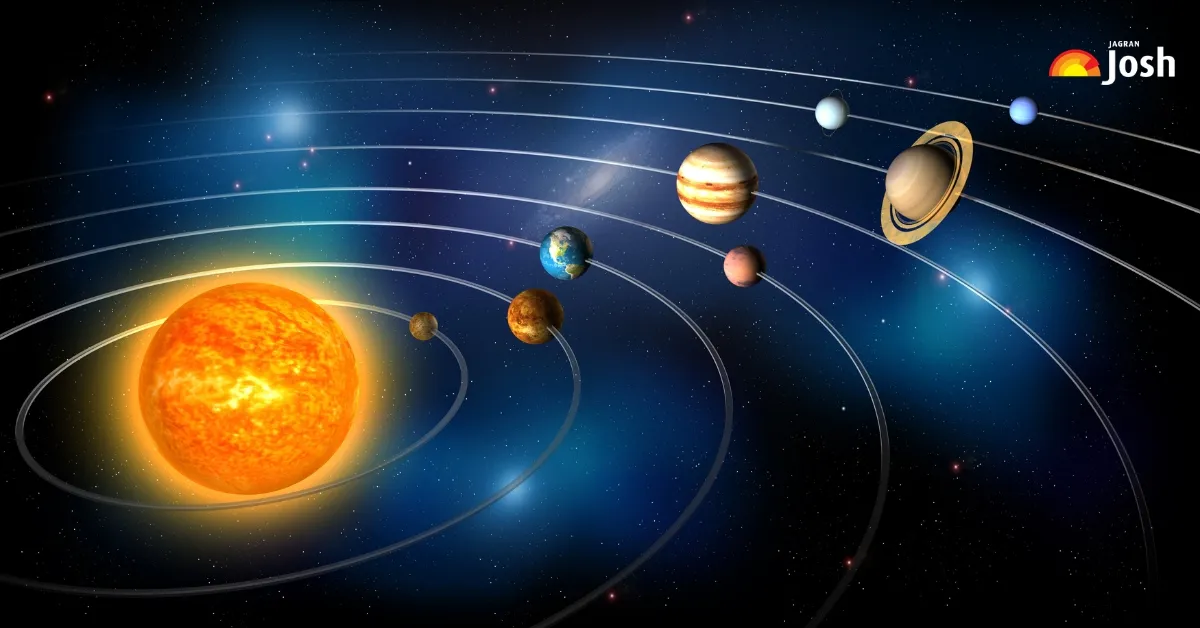
Have you ever looked into the stars in the night sky and asked yourself questions like “What else is out there?” The universe or our solar system consists of eight planets that go round a very big and bright star called the Sun. Each of these planets has its own moons and is made up of gases that form the atmosphere of that particular planet. But now here comes the point of discussion. Can you answer all the questions related to our solar system?
GK Quiz On Solar System
Here are 20 multiple-choice questions on the solar system:
Q1. Which planet is the closest to the Sun in our solar system?
a) Venus
b) Mercury
c) Mars
Ans.: b) Mercury
Explanation: It is known that Mercury is the planet closest to the Sun; therefore, one would assume that this makes Mercury the hottest planet, which is not true! This planet revolves around the sun in just 88 days.
Q2. What is famously known as the hottest planet in our solar system?
a) Mercury
b) Venus
c) Jupiter
Ans.: b) Venus
Explanation: Despite being closer to the sun, Venus is actually much hotter than Mercury. The reason behind this phenomenon is the extremely dense atmosphere of Venus that is rich in carbon dioxide gas. This serves as a blanket trapping the heat within.
Q3. Which planet is nicknamed the "Red Planet" because of its reddish soil?
a) Mars
b) Saturn
c) Neptune
Ans.: a) Mars
Explanation: Mars appears red even from Earth due to the presence of iron oxide in its soil. This is simply another name for rust. Many robots in space are currently being sent to Mars to find out whether water ever existed on Mars.
Q4. Which planet is the biggest of them all, weighing more than double all the other planets combined?
a) Saturn
b) Neptune
c) Jupiter
Ans.: c) Jupiter
Explanation: Jupiter is an absolute giant. It is a gas giant planet, meaning it doesn't have a solid ground you could walk on. It is so big that over 1,300 Earths could fit inside it easily!
Q5. Which planet is famously known for having the most beautiful and brightest rings around it?
a) Uranus
b) Saturn
c) Jupiter
Ans.: b) Saturn
Explanation: Other planets have rings too, but Saturn's rings are the most spectacular. These rings are not solid hoops; they are actually made of billions of pieces of ice, rocks, and dust floating together in space.
Q6. Which unique planet spins completely on its side, making it look like a rolling ball?
a) Uranus
b) Neptune
c) Mercury
Ans.: a) Uranus
Explanation: Most planets spin like top toys, but Uranus is tilted so much that it actually rolls on its side as it goes around the sun. Scientists think a huge space rock crashed into it long ago and knocked it over.
Q7. What are the two main gases that make up almost the entire Sun?
a) Oxygen and Nitrogen
b) Hydrogen and Helium
c) Carbon Dioxide and Methane
Ans.: b) Hydrogen and Helium
Explanation: The sun is a giant ball of burning gas, mostly hydrogen. The extreme pressure turns hydrogen into helium through a process that creates a massive amount of light and heat, which keeps us warm on Earth.
Q8. What is the name of the biggest moon in our entire solar system, which belongs to Jupiter?
a) Titan
b) Ganymede
c) The Moon
Ans.: b) Ganymede
Explanation: Ganymede is the largest moon, which is even larger than the planet Mercury. If it were revolving around the Sun rather than Jupiter, Ganymede would have been considered a separate planet.
Q9. Which planet is often called Earth's twin because they are almost the exact same size?
a) Mars
b) Venus
c) Neptune
Ans.: b) Venus
Explanation: Venus has many features that resemble Earth's when considering their sizes and masses. However, it differs entirely from the Earth in terms of its internal environment, which consists of poisonous gases and extremely high temperatures.
Q10. What is the name of the huge, stormy red spot that has been swirling on Jupiter for hundreds of years?
a) The Great Red Spot
b) The Giant Eye
c) The Crimson Storm
Ans.: a) The Great Red Spot
Explanation: It is known as the Great Red Spot, which is a huge hurricane twice the size of Earth. This hurricane has been going on since people began using telescopes to study Jupiter many years ago.
Q11. Which celestial object was changed from a regular planet to a "dwarf planet" in the year 2006?
a) Pluto
b) Ceres
c) Eris
Ans.: a) Pluto
Explanation: For many years, children have been taught that there were nine planets, one of which was Pluto. However, the scientists concluded that Pluto was too small and too many asteroids travelled on its path to be categorised as a planet.
Q12. Where is the main Asteroid Belt located in our solar system?
a) Between Earth and Mars
b) Between Mars and Jupiter
c) Beyond Neptune
Ans.: b) Between Mars and Jupiter
Explanation: This belt of asteroids is actually a giant ring consisting of millions of rock bodies that have remained after the formation of the Solar System. It represents a definite border between the rocky inner planets and the gas giants.
Q13. Which gas gives Uranus and Neptune their beautiful blue and cyan colours?
a) Oxygen
b) Methane
c) Hydrogen
Ans.: b) Methane
Explanation: Both of these chilly outer planets have methane gas in their atmospheres. Methane absorbs the red light coming from the distant sun and reflects back a lovely blue colour to our eyes.
Q14. Roughly how long does it take for light from the Sun to travel through space and reach Earth?
a) 8 seconds
b) 8 minutes
c) 8 hours
Ans.: b) 8 minutes
Explanation: Space is very vast! Though light travels at the speediest rate in the universe, the distance covered by sunlight in travelling from the sun to earth is such that it takes 8 minutes 20 seconds.
Q15. Which planet has the fastest and most violent winds in the solar system, reaching up to 2,000 kilometres per hour?
a) Jupiter
b) Saturn
c) Neptune
Ans.: c) Neptune
Explanation: Neptune is the most distant planet from the Sun, and it is one of the darkest and coldest planets. It seems strange that despite having minimal solar energy input, Neptune has the wildest and fastest winds ever recorded.
Q16. How many moons does the planet Mars have orbiting around it?
a) Zero
b) Two
c) One
Ans.: b) Two
Explanation: While Earth has only one moon, Mars has two tiny ones named Phobos and Deimos. They look like lumpy potatoes because they don't have enough gravity to pull themselves into perfect ball shapes.
Q17. Which planet has the largest volcano in the solar system, called Olympus Mons?
a) Mars
b) Earth
c) Venus
Ans.: a) Mars
Explanation: Olympus Mons is a giant volcano on Mars. It is thrice the height of Mount Everest, the tallest mountain on Earth. It grew so huge due to the lack of moving tectonic plates on Mars unlike on Earth.
Q18. What keeps all the planets stuck in their orbits around the Sun instead of flying off into deep space?
a) Magnetism
b) Gravity
c) Solar Wind
Ans.: b) Gravity
Explanation: Gravity is an invisible force that tends to pull things. Since the sun is very heavy, the force of its gravity pulls on the planets. Gravity ties them together in circles around the sun.
Q19. Which moon is famous for having thick clouds and liquid lakes of methane on its surface?
a) Titan
b) Europa
c) Lo
Ans.: a) Titan
Explanation: Titan is the largest moon of Saturn. It is the only moon in our solar system that possesses a dense atmosphere. Titan has clouds, rainfall, and lakes, but not with water; rather, it consists of freezing chemicals!
Q20. Which two planets in our solar system have absolutely zero moons?
a) Mercury and Venus
b) Mars and Mercury
c) Venus and Mars
Ans.: a) Mercury and Venus
Explanation: There are one or more moons present in most planets; however, there are none for either Mercury or Venus. The reason for this is that they are very close to the Sun, which has enough gravitational force to remove the Moon from them.

Kriti Barua is a skilled digital journalist and communications professional with 4+ years of experience, currently writing for the General Knowledge section at Jagran New Media. She has established herself as a subject matter expert in History, Geography, Trending National and International News, Sports, Science, and Defence, producing clear, reliable, and search-optimised content that connects with readers worldwide.
Kriti holds a BA degree from Delhi University and a one-year diploma in TV Production and Journalism, an academic background that adds research depth and strong storytelling instincts to her writing. Her experience spans brand writing, content marketing, and digital media, giving her a sharp understanding of what makes content both helpful to readers and visible in search.
At Jagran New Media, she applies this expertise to national and international news coverage, query-based articles, and in-depth pieces across her specialist subject areas. Her content is defined by easy language, factual accuracy, strong keyword strategy, and reader-friendly storytelling.