Why does your body keep moving forward when a vehicle suddenly stops? Newton's Laws of Motion Explained
Ever wondered why you jerk forward when a car or bus or any vehicle, for that matter, suddenly stops? That is Newton's First Law of Motion at play! Let us decode in detail Newton's three Laws of Motions with real-life examples.
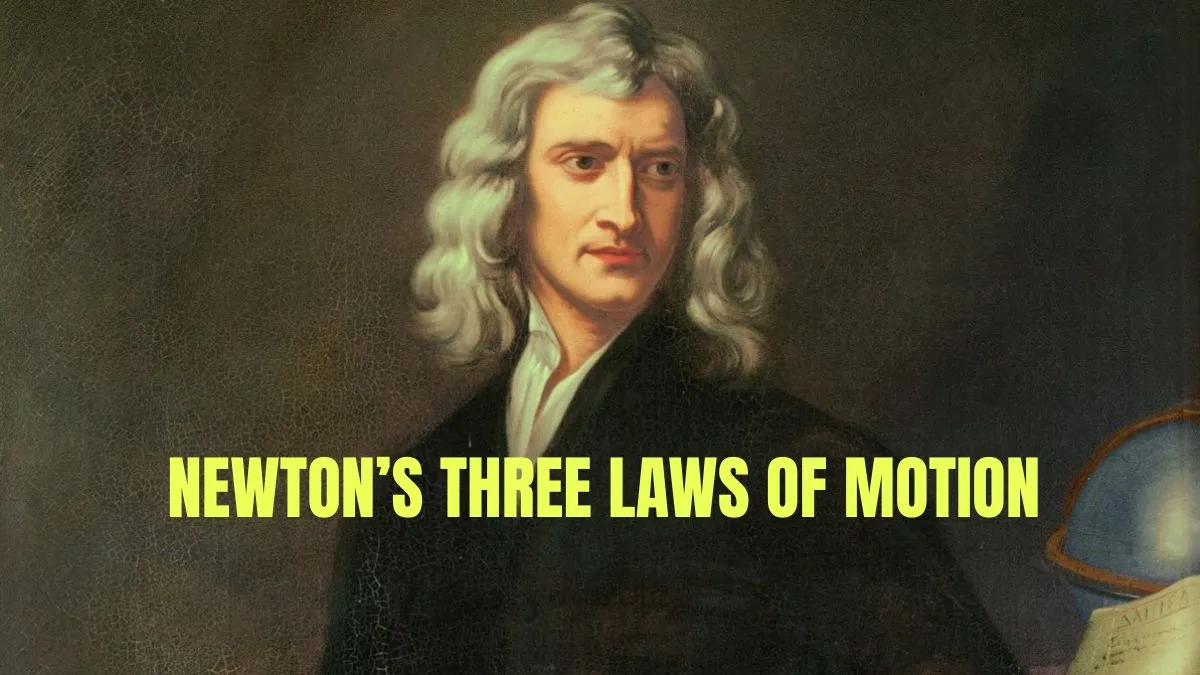
Sir Isaac Newton was an English polymath who was a mathematician, physicist, astronomer, alchemist, theologian, author, and inventor. Newton is known for his theory on gravitation. Newton discovered gravity when he saw an apple falling from a tree. It was this incident that made Newton realise that gravity is universal. He realised that the same invisible pull that makes objects fall on the ground keeps the Moon in orbit.
Apart from the Law of Universal Gravitation, some of the groundbreaking discoveries of Sir Isaac Newton were the Laws of Motion, Calculus, the Theory of Light and Colour, and the Reflecting Telescope. In this article, we will deep dive into Newton's Three Laws of Motion with real-life examples that you will remember.
Newton's Three Laws of Motion
Why does your body keep moving forward when a vehicle suddenly stops? Ever wondered why you jerk forward when a car or bus or any vehicle, for that matter, suddenly stops? That is Newton's First Law of Motion at play! Let us briefly understand Newton's three Laws of Motions:
Newton's First Law of Motion: Law of Inertia
The first law of motion states that an object or body at rest will remain at rest, and an object or body in motion will continue to be in motion at a constant speed and direction unless an external forces acts upon it.
If net external force is 0, then motion does not change.
Real-life applications of Newton's First Law of Motion
Let's visit our case in the beginning of this article.
- Why does your body keep moving forward when a vehicle suddenly stops? That is because of inertia. Your body keeps moving forward at the exact speed it was moving before the brakes were applied or a seatbelt applies a restraining force.
Other examples include:
- If you suddenly faced with an external force, anything in your hand say a coffee in your cup will spill forward.
- A moving ball keeps rolling unless something stops it in its tracks.
- If your skateboard hits a rock or you trip, your body continues to fall forward at the same speed you were riding your skateboard.
Newton's Second Law of Motion: Law of Acceleration
The second law of motion states that the acceleration of an object is directly proportional to the net force acting on it and inversely proportional to its mass.
The law is expressed as F = ma
Where:
F = Net force applied (in Newtons, N)
m = Mass of the object (in kilograms, kg)
a = Acceleration (in meters per second squared, m/s²)
This law explains that if you push an object, it will accelerate in the direct of the push. The harder the force, the faster the object's speed will change. Whereas, if you apply the exact force to a heavier object (more mass), the object will move slower.
Real-life applications of Newton's Second Law of Motion
- Pushing an empty cart is easier than a fully loaded cart. The empty cart has lower mass while the loaded cart has higher mass. The same amount of force applied will make the empty cart move faster than a loaded one.
- If you kick a football, the amount of force applied will generate more velocity. If you kick it with more force, the ball will accelerate in the direction of the kick and travel much further.
- Throwing a tennis ball is easier than throwing a heavier basketball. The latter requires more force to achieve the same speed due to its mass.
- If you push a car and a bike with the exact force, the bike will accelerate much faster as it has far less mas than a car.
Newton's Third Law of Motion: Law of Action and Reaction
The third law of motion states that for every action, there is an equal and opposite reaction.
Real-life applications of Newton's Third Law of Motion
- When you walk, your foot pushes backward against the ground (action), and in return the ground pushes your foot forward with the exact same force (reaction).
- A rocket engine shoots hot exhaust air downward at incredible force, as a result, the expanding gas pushes upward on the rocket giving a massive thrust to lift it into space.
- When a bullet is fired, the gunpower explosion forces the bullet of the barrel at high velocity. The same force pushes backward into the shooter's shoulder, also known as 'recoil'.
- When you swim, you use your hands to push water backward and the water pushes your body forward in the opposite direction.

Roopashree Sharma is an experienced broadcast journalist with over 7 years of experience, specialising in beats including geopolitics, defence, and general awareness. She has worked in the roles of correspondent and producer for leading media houses, including Zee, WION, and Economic Times. Currently serving as Deputy Manager – Editorial at Jagran New Media, she produces explainer articles and videos for the General Knowledge (GK) section of the Jagran Josh (English) portal. For inquiries, contact her at roopashree.sharma@jagrannewmedia.com.


