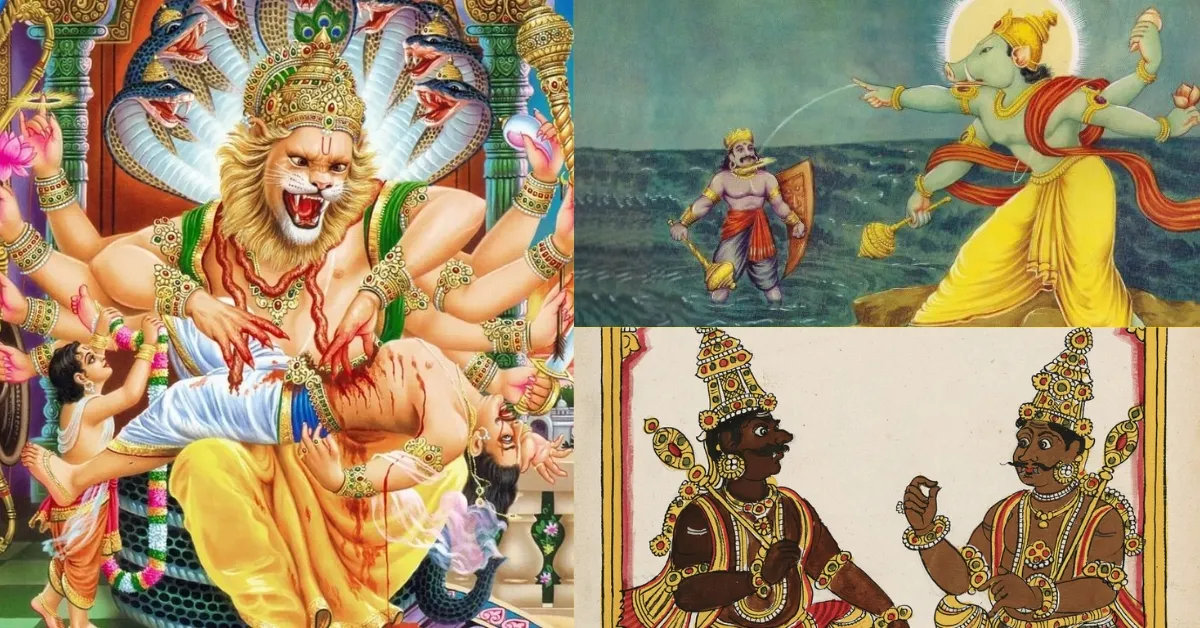
Dawn…Curse…and the birth of two powerful tyrant demons. Today, we're going to learn about the testament of immense devotion of Prahalad. The festival of Holi celebrates the victory of good over evil, but there's more than that.
In this article, we'll gaze upon the story of how the Varaha avatar and the Narsimha avatar came into existence. And who was Hiranyakashipu, the tyrant demon king who lost his life in the hands of Lord Narsimha?
And about the great devotee of Lord Vishnu, Prahalad, whose devotion was so potent it forced the infinite to take a finite, fearsome form to protect him.
ALSO READ| All You Need to Know About Prahlada – The Great Devotee of Vishnu
Who was Hiranyakashipu?

The story begins with Diti, the wife of Sage Kashyap. At dawn, while Kashyap was deep in meditation, Diti, longing for children, went to him and insisted that they be together.
He warned her that choosing this time could result in the birth of powerful and dark-hearted sons, but she did not listen.
By choosing the twilight hour, a sacred time meant for prayer and spirits, Diti upset the cosmic balance. Kashyap finally agreed, and as a result, their sons Hiranyakashipu and Hiranyaksha were born.
These two demons were so powerful that they challenged all the gods and plunged the three worlds into an era of unprecedented terror.
> The First Conflict: Hiranyaksha and the Varaha Avatar
As the brothers became stronger, their power started to threaten the universe. The older brother, Hiranyaksha, was especially aggressive.
He boldly defied the gods by capturing the Earth, known as Goddess Bhumi, and pulling her into the deep Garbhodaka Ocean.
To bring back the Earth and restore order, Lord Vishnu took his third form as Varaha, a giant divine boar. He fought a fierce battle underwater.
In the end, Lord Varaha defeated the demon with his tusks, then lifted the Earth on his snout and carefully returned her to her place.
> The Rise of Hiranyakashipu: The "Unkillable" King
Driven by grief and a strong desire for revenge, Hiranyakashipu vowed to become more powerful than any god.
He spent thousands of years in hard penance to please Lord Brahma. When Brahma finally appeared, the demon asked for a clever boon that he believed would make him immortal. He asked that he could not be killed:
- By any man or animal.
- By any weapon.
- During the day or at night.
- Indoors or outdoors.
- On the earth or in the sky.
With this "bulletproof" contract, he declared himself the Supreme God and banned the worship of Vishnu worldwide.
> Prahlad: The Heart of Devotion
Strangely enough, the biggest danger to the king came from within his own family. His son Prahlad was deeply devoted to Lord Vishnu from birth.
Even though his father threatened and tortured him, and his aunt Holika famously tried to burn him alive, Prahlad was never harmed. He kept chanting "Om Namo Narayana", which pushed the king closer and closer to madness.
> The Shattered Pillar and the Narasimha Avatar
The story reached its climax when Hiranyakashipu, pointing to a stone pillar, mockingly asked, "If your God is everywhere, is he in this pillar?" When Prahlad said yes, the king smashed the column.
Out of the shattered stone emerged Narasimha, an avatar with the head of a lion and the body of a man (neither man nor beast). To honour Brahma's boon while still delivering justice, Narasimha:
- Carried the king to the threshold of the palace (neither indoors nor outdoors).
- Placed him on his thighs (neither on earth nor in the sky).
- Attacked at twilight (neither day nor night).
- Used his claws (not a man-made weapon).
The tyrant was defeated in one swift action, showing that even if evil tries to escape, divine justice always wins.
IN CASE YOU MISSED| Who is Holika? Know All About the Sister of Demon King Hiranyakashipu
A Quick Glance
The younger brother, Hiranyaksha, whose name means "Golden-Eyed", was the first to challenge the cosmic order by abducting the Earth.
| Feature | Details |
| Name | Hiranyaksha |
| Lineage | Son of Sage Kashyapa and Diti |
| Sibling | The younger brother of Hiranyakashipu and Holika |
| Primary Antagonist of | Varaha Avatar (The Divine Boar) |
| Key Crime | Abducted Goddess Bhumi (Earth) and hid her in the cosmic ocean. |
| Death | Slain by Varaha's tusks after a thousand-year battle. |
| Symbolism | Represents unbridled greed and the exploitation of nature. |
In contrast, the elder brother, whose name means "Clothed in Gold", turned into a clever tyrant who tried to cheat death by finding legal loopholes.
| Feature | Details |
| Name | Hiranyakashipu |
| Lineage | Son of Sage Kashyapa and Diti |
| Primary Antagonist of | Narasimha Avatar (The Half-Man, Half-Lion) |
| The Great Boon | Granted by Lord Brahma; could not be killed by man/beast, indoors/outdoors, day/night, or any weapon. |
| Role in Holi | Ordered his sister Holika to kill his son Prahlad in a fire. |
| Fate | Killed by Narasimha on the threshold of his palace at twilight. |
| Symbolism | Represents extreme ego (Ahankar) and the illusion of human immortality. |
Conclusion: Who Were Hiranyakashyap and Hiranyaksh?

Source: Free Press Journal
In addition to the physical conflicts, the Bhagavata Purana (specifically Canto 3, Chapters 15–16) presents a significant cosmic narrative underlying the rivalry between the demons and Lord Vishnu.
According to the text, Hiranyaksha and Hiranyakashipu were not inherently malevolent; rather, they were originally Jaya and Vijaya, the celestial gatekeepers of Vaikuntha, the supreme abode of Lord Vishnu.
| Lifetime | Incarnations (Jaya & Vijaya) | The Divine Avatar (Vishnu) | Primary Scripture/Source |
| Satya Yuga | Hiranyaksha & Hiranyakashipu | Varaha & Narasimha | Bhagavata Purana, Canto 3 |
| Treta Yuga | Ravana & Kumbhakarna | Lord Rama | Ramayana / Vishnu Purana |
| Dvapara Yuga | Shishupala & Dantavakra | Lord Krishna | Mahabharata / Bhagavata Purana |
The narrative recounts that the Four Kumaras, mind-born sons of Brahma who appeared as eternal children, arrived at the gates of Vaikuntha to visit Lord Vishnu.
Fulfilling their responsibilities, Jaya and Vijaya prevented the sages from entering at the seventh gate. Offended by this act, the Kumaras pronounced a curse that the gatekeepers would lose their divinity and be born on Earth as mortals.
When Lord Vishnu appeared to mediate, he offered his loyal servants a choice to mitigate the curse:
- They could be born seven times as his devotees.
- They could be born three times as his sworn enemies.
Motivated by a desire to return to their Lord expeditiously, Jaya and Vijaya selected the path of enmity. Their initial incarnation was as the brothers Hiranyaksha and Hiranyakashipu.
According to the Vishnu Purana, they were destined to be slain by the Lord in each lifetime to attain liberation (Moksha).
WHAT'S NEXT | Different Names of Holi in India



Comments
All Comments (0)
Join the conversation