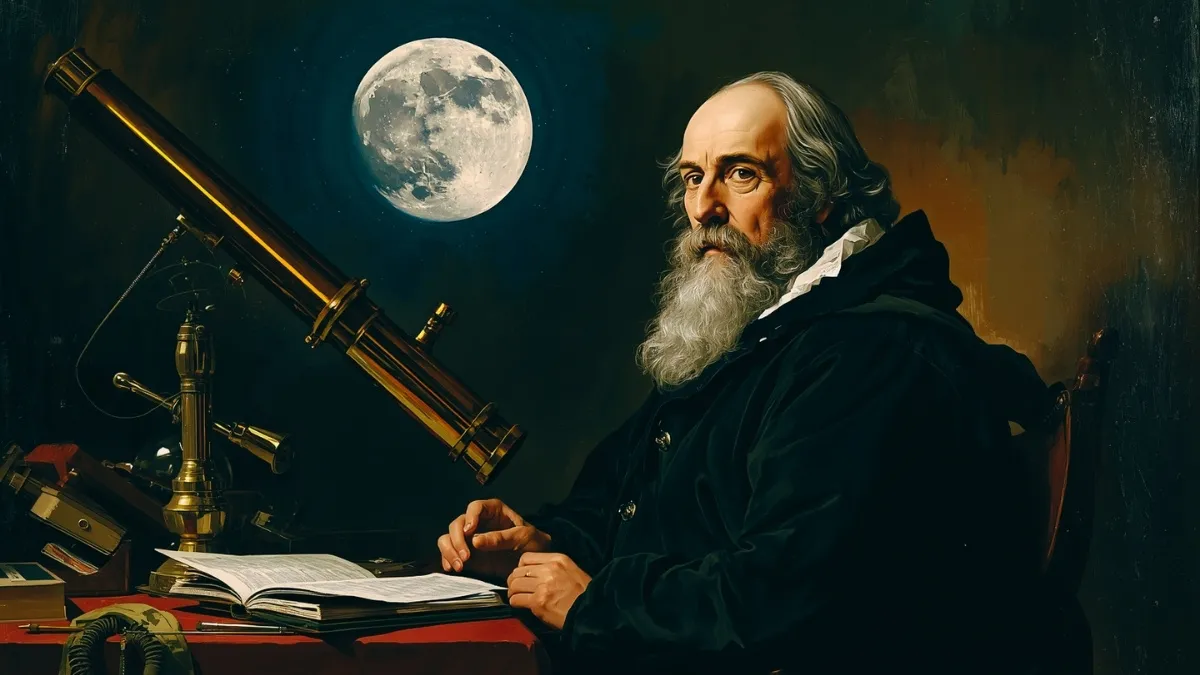
Earth's sole natural satellite is the Moon, which is one of the brightest celestial objects in the sky.
The Moon influences Earth in various ways, such as the occurrence of oceanic tides, climate stability, and the length of a day.
The moon has been a very significant part of human history in all aspects – cultural, scientific, and exploration-based.
According to NASA, the Moon is approximately 384,400 km far from us, and it remains an important object of research in space science.
Throughout the last several thousand years, people have studied the moon using their naked eyes, but it was not until later that scientific study of the moon began.
Ancient civilizations were aware of the existence of the Moon, one particular scientist made history by observing the Moon closely using a telescope.
Who Discovered the Moon?
Italian astronomer Galileo Galilei was the person who discovered the Moon. He made the very first scientific telescopic discovery about the Moon's surface in late 1609 and early 1610.
Having studied the Moon using his telescope, Galileo noticed that there were mountains, valleys, and craters on its surface, meaning that it was not a perfectly smooth sphere.
Galileo's discoveries are mentioned in his book Sidereus Nuncius or Starry Messenger, written in 1610.
By making these discoveries, Galileo proved that all heavenly objects were not perfectly smooth. It was probably the most significant scientific breakthrough made by him in astronomy.
English astronomer Thomas Harriot had used a telescope to observe the Moon some months before Galileo – in July 1609. However, unlike Galileo, he did not share the results of his research with the world, which is why Galileo got all the fame from it.
By observing the Moon and discovering several new planets orbiting around Jupiter, Galileo managed to prove that celestial bodies are physical spheres like our planet.
When was the Moon Discovered?
The Moon has been known to mankind since the earliest times because it could be observed directly with the naked eye.
But the discovery of various physical properties on the lunar surface was made from 1609 to 1610 by Galileo Galilei.
In 1609, Galileo designed telescopes and used them for studying the Moon. In 1610, Galileo released Sidereus Nuncius, which detailed his findings from his observation of the Moon and other outer space elements through a telescope. This publication marked a milestone in the field of astronomy and initiated extensive research on celestial bodies.
Where did the Moon Originally Come From?
According to scientists, the Moon was formed about 4.5 billion years ago, following the creation of the Earth itself.
The most widely accepted hypothesis regarding the Moon's origin is called the Giant Impact Hypothesis, which tells that an object about the size of Mars smashed into the Earth sometime in its early life.
The theory maintains that the collision caused massive debris of rocks and soil to be released from the surface of the planet into space, where it finally accumulated and formed the Moon.
It has been supported by the evidence obtained during space missions, with Moon rocks having much in common with the composition of the Earth's crust.
For millions of years now, the Moon has been continuously orbiting around the planet and contributing to Earth's stability through gravity, causing ocean tides, stabilizing its rotation and weather patterns.
Check: Who is Known as the Father of Modern Science?
Conclusion
The first scientific discoveries about the appearance of the surface of the Moon were made by Galileo Galilei using a telescope in 1609 and 1610.
This discovery revolutionized the field of astronomy and provided evidence that the Moon is not a perfectly round body, but instead a textured surface. The Moon is an important satellite of our planet.