Which Is The Only Planet That Rotates Clockwise?
Most planets spin anticlockwise, but one unique planet rotates in the opposite direction. This mysterious planet has a day longer than its year and sees the Sun rising in the west. Let’s look into the science behind this backward spin.

Key Points
- Venus rotates clockwise, opposite most planets, a phenomenon called retrograde rotation.
- A day on Venus is longer than its year, and the sun rises in the west.
- Scientists believe a collision or atmospheric drag caused Venus's unusual spin.
In our solar system, nearly all planets follow a specific pattern. As they move around the Sun, they also spin on their own axes. Most of these planets rotate in an anticlockwise direction. This shared movement began billions of years ago.
When the solar system formed from a giant cloud of gas and dust, the entire disc started spinning in the same direction. This original momentum has carried on for most of the planets ever since.
However, there is an interesting exception to this rule. Did you know there is a planet that defies this universal pattern? This mysterious world rotates in a clockwise direction.
Because of this, the Sun would seem to rise in the west and set in the east. Additionally, this planet spins so slowly that one single day actually lasts longer than its whole year.
In this article, we will examine the unique features of this strange planet. We will also explore the scientific theories that explain its unusual behaviour.
ALSO READ| List of Planets with Rings
What Is The Only Planet That Rotates Backwards?
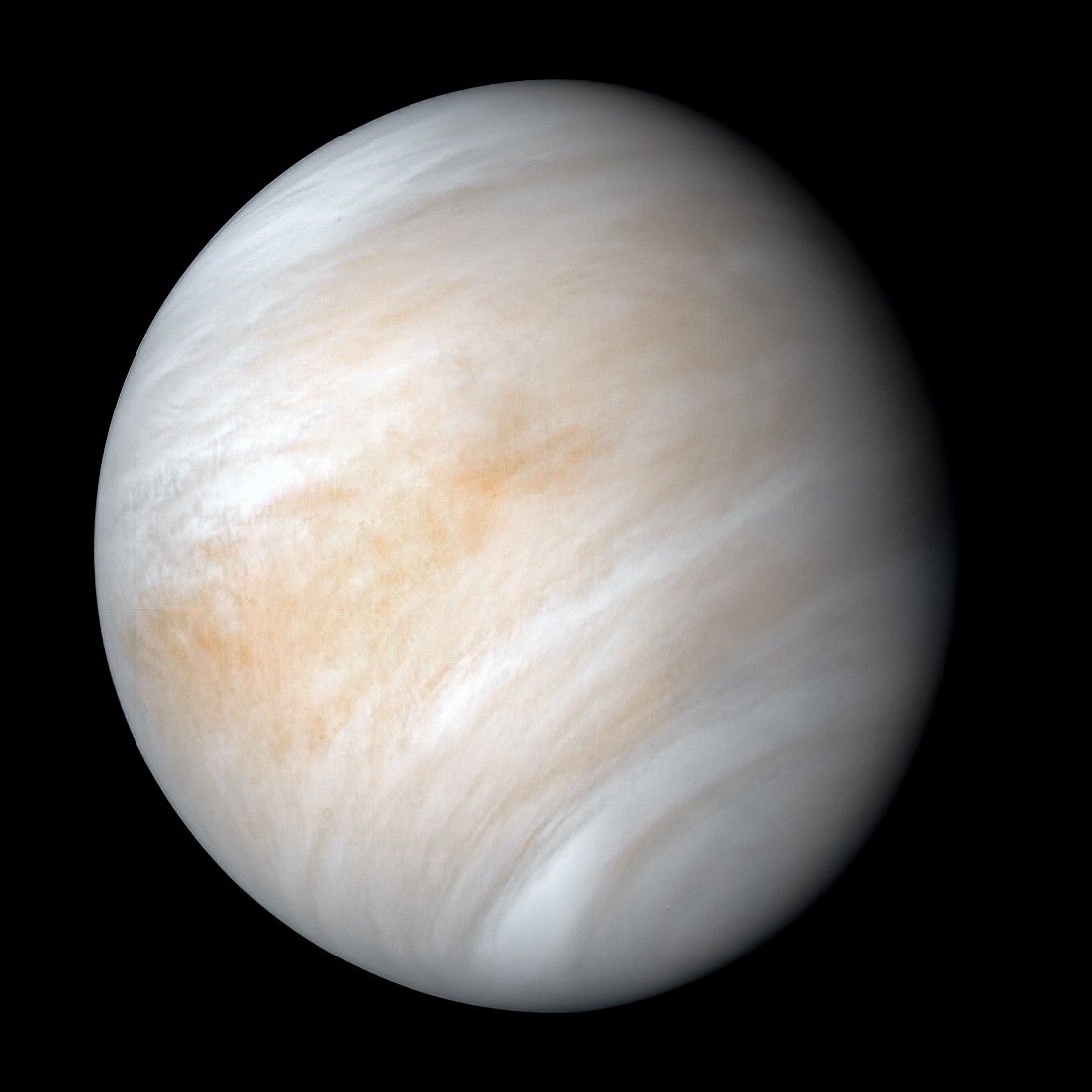
Source: NASA
In our solar system, nearly every planet spins in the same direction as the Sun. However, Venus is a notable exception; it rotates in a clockwise direction. This unusual backward movement is called "retrograde" rotation.
Scientists think this occurred because of a huge event billions of years ago. The most common theory is that a giant object, possibly the size of a small planet, crashed into Venus and changed its original path.
Another theory suggests that the planet's thick atmosphere created a "braking" effect over time, eventually slowing its spin. As a result, the Sun on Venus rises in the west and sets in the east. The planet rotates so slowly that a single day lasts longer than its entire year.
10+ Lesser-Known Facts About Venus
- It is nearly identical to Earth in size and mass, but has a surface environment that would be lethal to humans.
- Despite being further from the Sun than Mercury, Venus is the hottest planet, with surface temperatures reaching 470°C.
- Standing on Venus would feel like being 3,000 feet underwater; its atmospheric pressure is 90 times higher than Earth's.
- The planet is permanently covered in thick clouds made of sulphuric acid, which reflect sunlight and make it appear bright.
- On the high mountain peaks of Venus, it is believed to "snow" metallic minerals like galena and bismuth glance.
- Venus has more volcanoes than any other planet in the solar system. Over 1,600 major ones have been discovered.
- Along with Mercury, Venus is one of the only two planets in our solar system that have no moons.
- It is the second brightest object in our night sky after the Moon and can sometimes be seen during broad daylight.
- While the planet rotates slowly, its upper atmosphere moves at 360 km/h, circling the entire planet in just four days.
- It takes Venus 225 Earth days to orbit the Sun, but 243 Earth days to complete just one rotation on its axis.
- The Babylonians were tracking the path of Venus as early as 1600 BC, making it one of the first planets ever studied.
IN CASE YOU'RE INTERESTED| Which Is the Largest Planet in the Solar System?
Why Do Planets Move In An Anti-Clockwise Direction?
The consistent movement of our planets in the same direction is not a coincidence. It stems from the way the solar system formed over 4.5 billion years ago.
i) The Solar Nebula
Our solar system began as a large, spinning cloud of gas and dust called the solar nebula. Gravity caused this cloud to collapse inward, and as it did, it started to spin faster, similar to how an ice skater pulls in their arms to spin more quickly.
ii) Conservation of Angular Momentum
A fundamental law of physics, known as the Conservation of Angular Momentum, ensured that the original direction of the cloud's spin was maintained.
- The Disc Formation: As the cloud spun, it flattened into a pancake-like disc.
- The Shared Direction: Since all the material in this disc moved in the same direction, the planets that formed from it inherited that same motion.
iii) Why Anticlockwise?
The choice of "anticlockwise" is just a matter of perspective. From above the Sun's North Pole, the original cloud was spinning in that direction. If it had started spinning the other way, our solar system would be moving clockwise.
Conclusion: Why Does Venus Rotate in a Clockwise Direction?
In conclusion, Venus is one of the most interesting mysteries in our solar system. While most planets spin anticlockwise, Venus's clockwise rotation makes it stand out as a true cosmic rebel.
Scientists think this "backward" spin probably resulted from a major collision with a large celestial body or the ongoing pull of its thick atmosphere and the Sun.
It might have been a one-time violent event or a gradual change over billions of years. This unique rotation shapes the planet's extreme nature.
Understanding Venus helps us learn how planets develop and shows us that even in a well-ordered solar system, there is always room for a captivating exception.
WHAT'S NEXT| Which Planet is Called the Morning and Evening Star?

Kriti Barua is a skilled digital journalist and communications professional with 4+ years of experience, currently writing for the General Knowledge section at Jagran New Media. She has established herself as a subject matter expert in History, Geography, Trending National and International News, Sports, Science, and Defence, producing clear, reliable, and search-optimised content that connects with readers worldwide.
Kriti holds a BA degree from Delhi University and a one-year diploma in TV Production and Journalism, an academic background that adds research depth and strong storytelling instincts to her writing. Her experience spans brand writing, content marketing, and digital media, giving her a sharp understanding of what makes content both helpful to readers and visible in search.
At Jagran New Media, she applies this expertise to national and international news coverage, query-based articles, and in-depth pieces across her specialist subject areas. Her content is defined by easy language, factual accuracy, strong keyword strategy, and reader-friendly storytelling.