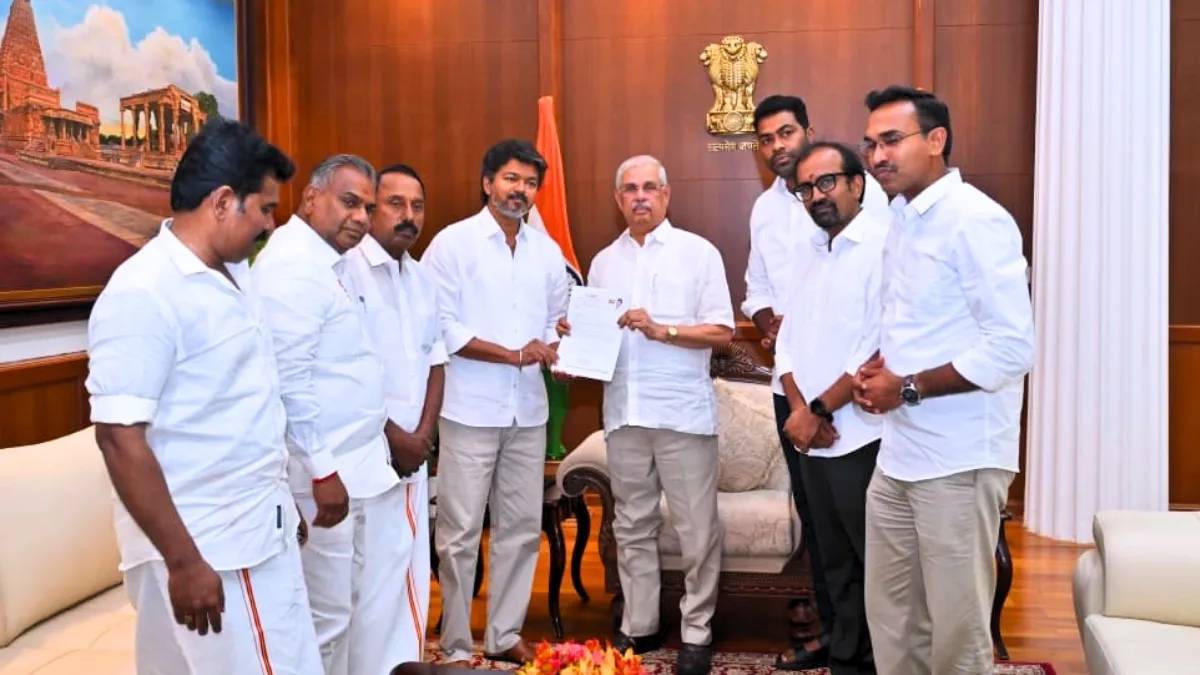
Tamil Nadu Election 2026 results have delivered a fractured mandate: TVK (108), DMK (59), and AIADMK (47) with no single party crossing the 118-seat threshold. The Governor Rajendra Arlekar has reportedly asked TVK leader Vijay to come back with 118 after the actor-politician staked a claim with support from 112 MLAs.
The discretionary powers of the Governor under the Indian Constitution in the context of the 2026 Tamil Nadu election results. It explains that while the Governor has the authority to seek proof of majority (118 seats). They cannot arbitrarily block the single largest party Tamilaga Vettri Kazhagam (TVK) from a floor test.
In this article Read about the S.R. Bommai judgment, the role of Article 164, and the legal limits on how many times a Governor can refuse a claimant.
Constitutional Provisions under Articles 163 and 164
The Governor is the constitutional head of the state, but their powers are largely bound by the Constitution.
Article 164: According to Article 164(1), the Chief Minister shall be appointed by the Governor.
Article 163: It talks about Discretionary Powers that states that the Governor shall be aided and while this sounds like an absolute power, it is guided by democratic conventions. The Governor must invite the leader who is most likely to command a majority on the floor of the House.dvised by the Council of Ministers, except in matters where the Constitution requires them to act in their discretion. Government formation in a hung assembly is the primary area where this "discretion" comes into play.
When Can a Governor Refuse a Claim?
A Governor can refuse to invite a party or a coalition to form the government under specific circumstances which includes:
-
Lack of Prima Facie Evidence: If a party leader claims to have the support of 118 MLAs but cannot produce a physical list or letters of support, the Governor can ask for proof before issuing an invitation.
-
Contradictory Claims: In the current TN context, if the TVK (108 seats) and the DMK-led SPA (73 seats) both claim they have the numbers via independent tie-ups, the Governor must judge which claim is more credible.
-
Unstable Alliances: If a coalition appears to be "unholy" or mathematically impossible based on the official results, the Governor can delay the invitation to ensure the prospective government won't collapse within 24 hours.
How Many Times Can They Refuse?
There is no numerical limit mentioned in the Constitution regarding how many times a Governor can say "no." However, this is not a license for arbitrary refusal.
The Governor can ask a leader to "come back with more proof" multiple times. In S.R. In the Bommai case the Supreme Court ruled that the "Floor of the House" is the only place to test a majority not the Governor's subjective opinion.
The Tamil Nadu 2026 Scenario:
The results of the 2026 Tamil Nadu Assembly Elections have ushered in a historic "Hung Assembly," creating a complex constitutional puzzle. With Vijay’s Tamilaga Vettri Kazhagam (TVK) emerging as the single largest party with 108 seats but falling short of the 118-seat majority mark, TVK is 10 seats short of the magic number (118) DMK: 59 seats, ADMK: 47 seats.
Can the Governor refuse Vijay's TVK?
If Vijay presents a letter of support from 112 MLAs, the Governor can technically refuse to swear him in immediately because he is still 6 seats short of the 118-mark.
The Governor has the discretion to invite the Single Largest Party (TVK) and give them a window (usually 7–15 days) to prove their majority. Invite a Post-Poll Coalition if the DMK and ADMK or other smaller parties move together to cross 118, the Governor can prioritize them over a single party that lacks the numbers.
Legal Safeguards:
The Supreme Court has set strict boundaries to prevent the misuse of these powers:
-
Sarkaria Commission Guidelines: It suggests a priority order: (1) Pre-poll alliance, (2) Single largest party, (3) Post-poll coalition.
-
Judicial Review: If a Governor arbitrarily refuses a legitimate claim, the party can move the Supreme Court (as seen in the 2018 Karnataka case). The court can order an immediate floor test (often within 24–48 hours) to settle the matter.
The 2026 Tamil Nadu election resulted in a hung assembly, with TVK as the single largest party falling short of a majority. This article explains the Governor's discretionary powers, constitutional provisions, and legal precedents like the S.R. Bommai judgment regarding government formation in such scenarios.