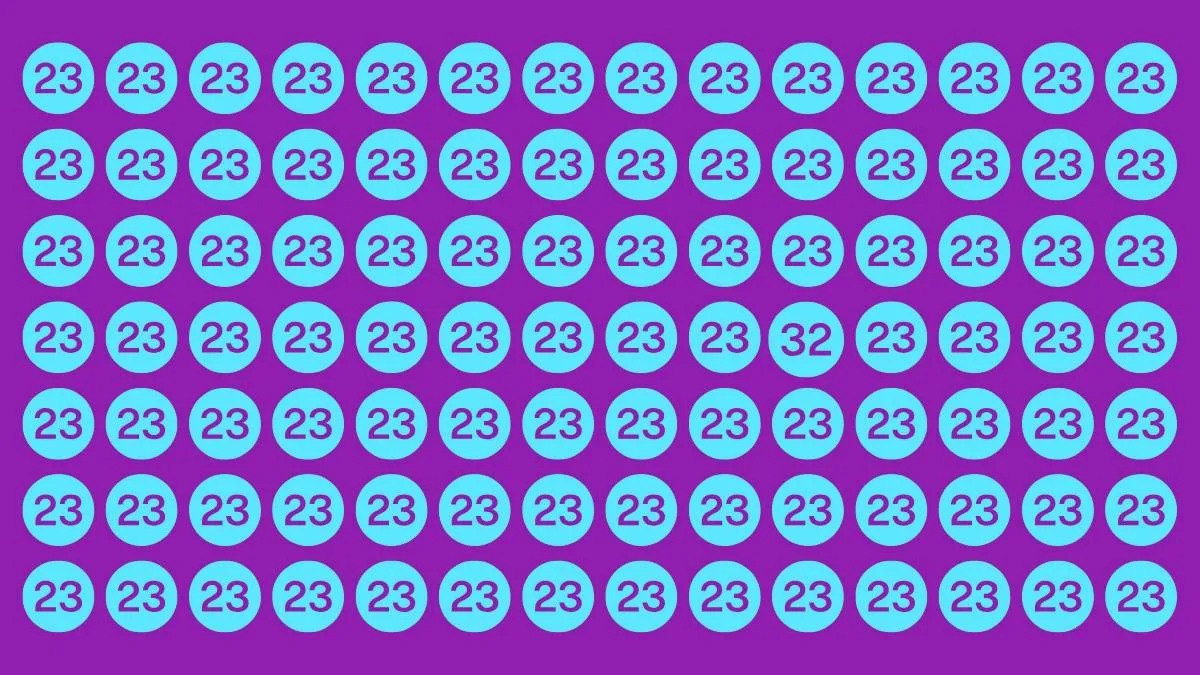
The following optical illusion picture contains a grid full of number 23, repeated in all the rows and columns. There is one 32 that has been substituted somewhere in that grid. The digits are the same. The typeface is identical. The order only is different.
Your task is to locate the 32 in just 5 seconds.
Optical illusions are fascinating visual phenomena that make our brains perceive something different from reality. They can deceive our visual system into seeing things that aren’t actually there or misinterpret what we observe.
This is a medium difficulty challenge. The vast majority of people who notice it fast do so in the right half of the picture. Unless you have located it within 5-10 seconds, do not scan row after row.
Allow yourself to get your eyes slightly out of focus and seek anything that does not look visually right. This change of strategy is the key to spotting the number.
Where is the number 32 hidden?
The 32 is in the right part of the grid, on the 10th column. The positioning of the number within the dense region of 23’s made you miss the number at the first glance. Look carefully and once you have spotted it, you won’t be able to unsee it again.
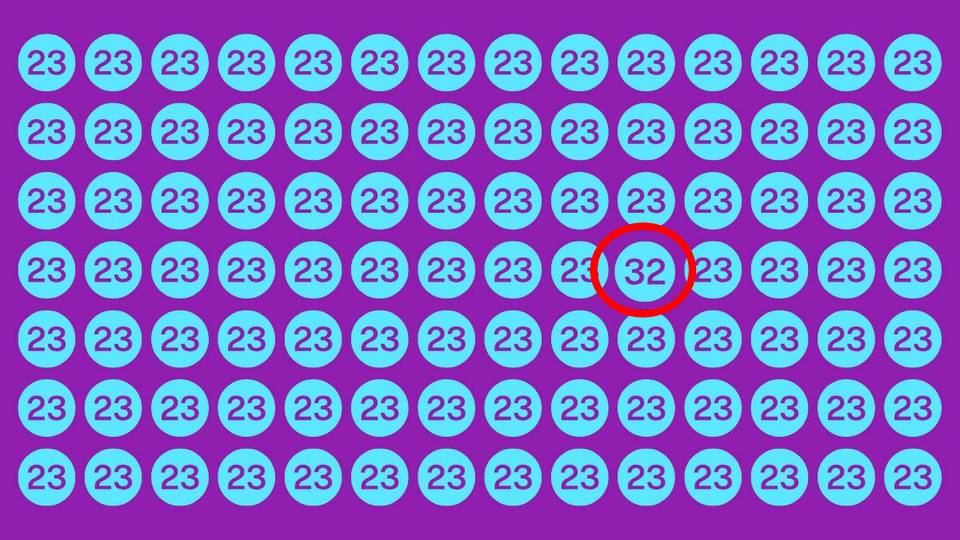
Why your brain missed it?
The functioning of this optical illusion has nothing to do with your vision or your intelligence. It is actually attributed to a process known as Gestalt uniform connectedness, which was identified by the study of the work of perceptual psychologists in the way the brain clusters together similar visual elements.
When your visual cortex encounters a uniform repeating pattern, it ceases processing the individual details and instead perceives the whole field as a single texture.
The moment when that occurs, minor variations within the pattern are not highlighted but muted. Your mind is not seeking 32. It has already determined that the grid only has 23s and it filters the incoming visual data to verify the expectation.
This is intimately connected with what cognitive neuroscientists refer to as inattentional filtering: the brain's urge to conceal detail in areas of low anticipated variation.
In a study published in the journal Psychological Science, it has been demonstrated that when the participants are requested to observe a homogenous field, they will consistently fail to notice transient anomalies that would otherwise be readily noticeable in a non-homogeneous setting.
Also, check out other interesting puzzle challenges in the Puzzles and IQ test section. Stay connected with Jagran Josh for more such informative and interesting articles.
ALSO READ
Spot the Differences Bird Sitting on Tree in 29 Seconds!
Can You Locate EXILE in this Word Search Puzzle in 11 Seconds?