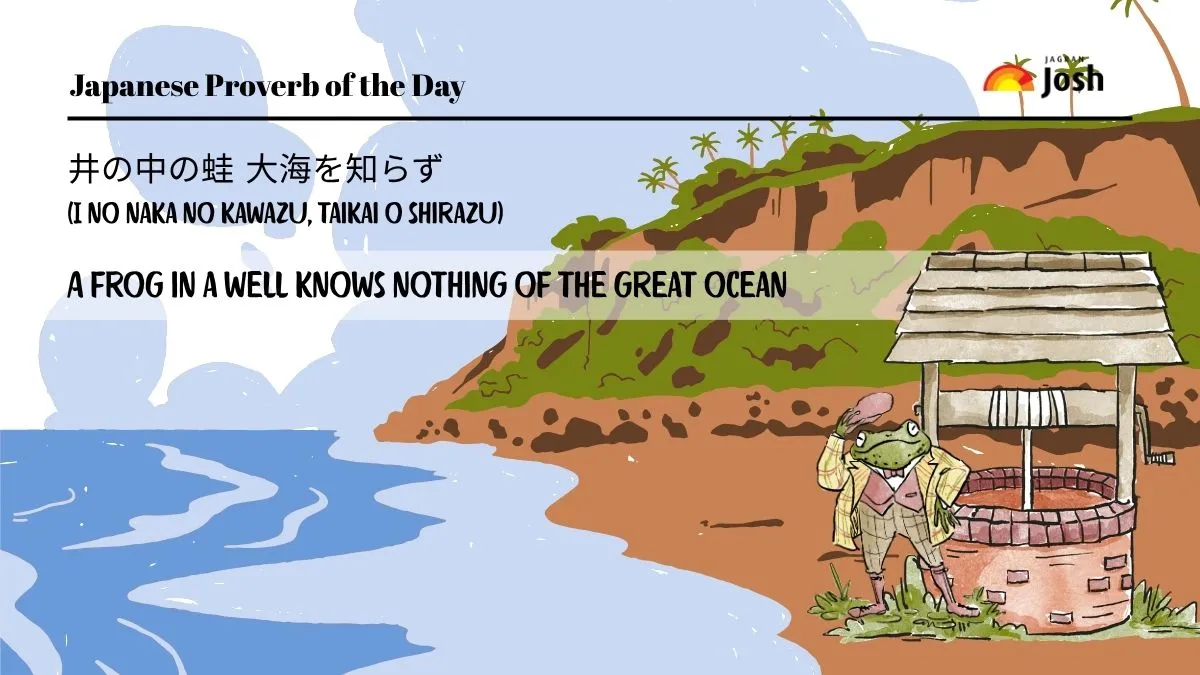
You are likely feeling the weight of 2026’s hyper-connected economy, where staying in your lane often means falling behind. The Japanese proverb of the day, “I no naka no kawazu, taikai o shirazu” (A frog in a well knows nothing of the great ocean), is the ultimate wake-up call for your personal and professional evolution.
As industries merge and digital borders dissolve, this ancient wisdom serves as a psychological mirror. It asks you: Are you truly a master of your craft, or are you simply comfortable because you haven't seen the "ocean" of the competition yet?
Japanese Proverb of the Day
Japanese Proverb: 井の中の蛙 大海を知らず (I no naka no kawazu, taikai o shirazu)
Meaning in English Translation: “A frog in a well knows nothing of the great ocean.”
What is the meaning of the Japanese proverb "A frog in a well knows nothing of the great ocean"?
This proverb is a strong metaphor for intellectual parochialism. It talks about a situation where a person's view of the world is so limited by their surroundings that they think their small world is the whole universe.
-
The 'Well' as Comfort: The well represents the boundaries of our current knowledge, culture, or echo chambers.
-
The 'Frog' as Ego: When we lack external benchmarks, we develop a false sense of superiority or mastery.
-
The 'Ocean' as Reality: The taikai (great ocean) represents the vast, complex, and infinite nature of truth and global innovation.
To embody this Japanese proverb, one must acknowledge that our current "water" is only a fraction of what exists. It is a call to humility and a push toward cultural intelligence.
Everyday Lessons from this Japanese proverb in modern-day 2026
The ocean is bigger than ever as we move through the middle of the 2020s. This is how you can use the wisdom from today's Japanese proverb in the modern world:
| Context | 2026 Application | Growth Mindset Lesson from the Proverb |
| Career Tech | Adapting to generative AI and automation. | Don't assume your current skills are "future-proof"; benchmark against global AI trends. |
| Information | Breaking out of algorithm-driven "echo chambers." | Actively seek diverse news sources to widen your "well" and escape confirmation bias. |
| Skill Building | Learning beyond your specific degree or job role. | Become a "T-shaped" professional; master your "well" but explore the ocean of cross-disciplinary skills. |
| Relationships | Navigating a globalized, decentralized social world. | Your local social norms may not apply globally; practice cultural empathy to connect with the "ocean." |
| Self-Image | Moving past being the "best" in your small circle. | If you’re the smartest person in the room, find a bigger room (or ocean) to keep growing. |
Origin and History of the Japanese Proverb
While synonymous with Japanese culture, this proverb originated from the Chinese Taoist philosopher Zhuangzi (Chuang-tzu) around the 4th century BCE. It eventually traveled to Japan, where it was embraced by Zen philosophy to illustrate the concept of beginner's mind (Shoshin).
"A frog in a well cannot be talked to about the ocean—he is limited by the space of his abode." — Zhuangzi, Section 17 (Autumn Floods)
During the Edo Period, this proverb was frequently used to critique those who resisted the modernization of Japan. It became a rallying cry for scholars who wanted to look beyond the island's borders to understand the great ocean of Western and global science.
Why is 'I no naka no kawazu' the ultimate Japanese proverb for success in 2026?
In 2026, the greatest threat to your success isn't failure, it's insularity. With the rise of the Global Nomad workforce and decentralized intelligence, the walls of the well are thinner than ever, yet harder to see.
Success today requires you to be multi-well proficient. This saying about having a growth mindset helps you change from a fixed mindset (the frog that thinks it knows everything) to a growth mindset (the frog that wants to find the ocean). This change is necessary for cultural intelligence, which lets you work together easily across time zones, languages, and AI-driven interfaces.
Also Read - Japanese Proverb of the Day: Fall Seven Times, Stand Up Eight
Interesting Fact about this Japanese Proverb of the Day
The linguistic structure of this proverb reveals a hidden layer of Japanese thought. The phrase is written as:
井の中の蛙大海を知らず
井 (I): Well.
蛙 (Kawazu): An archaic, poetic word for frog (the modern word is kaeru).
知らず (Shirazu): "Does not know"—the negative verb form adds a sense of tragic finality.
But the Twist is in its Ending:
In modern Japan, a popular hopeful suffix is often added: "...dakedo sora no aosa wo shiru" (...but it knows the blue of the sky).
This implies that while the frog lacks breadth (the ocean), it has achieved a singular, deep focus on the sky. It suggests that specialized knowledge is valuable, provided you eventually acknowledge that the ocean exists.
Check Out - Word for the Day Here!
The Japanese proverb of the day is more than a warning; it’s an invitation. Today, challenge yourself to step outside your comfort zone and look toward the horizon. The ocean is vast, but it’s yours to explore. Come back tomorrow for more timeless wisdom to fuel your journey!