ESA Euclid Telescope Captures Largest Milky Way Image with 60 Million Packed Stars
The European Space Agency’s Euclid telescope has unveiled the largest and most detailed visible-light cosmic portrait of the Milky Way’s core. Packed with over 60 million stars, this record-breaking snapshot provides a critical time-capsule reference for NASA's upcoming Roman space telescope mission.

When we look up at a clear night sky from anywhere on our planet we can easily spot a starry band of light even in a dark sky. That band of light is our home we know as the Milky Way galaxy. But it is impossible to see the galaxy as a whole with our naked eyes.
So, the recent Euclid telescope Milky Way galaxy image from the European Space Agency did something that completely floored me and other space enthusiasts around the world alike. The telescope lens captured our galaxy’s chaotic yet beautiful light in the clearest way possible.
The single Milky Way galaxy image captured over 60 million stars packed together along with a sky as wide as 25 full moons and the cosmic dust like never before.
How Euclid Telescope Captured the Largest Milky Way Galaxy Image
When I myself first looked at the raw image released by the agency it was hard to believe that our galaxy could be as big as what the image captured. Let me tell you that the Euclid telescope was actually built to study dark matter in space. But, scientists somehow paused its main mission for 26 hours to create a stellar map of our galaxy’s central part which we refer to as the galactic bulge.
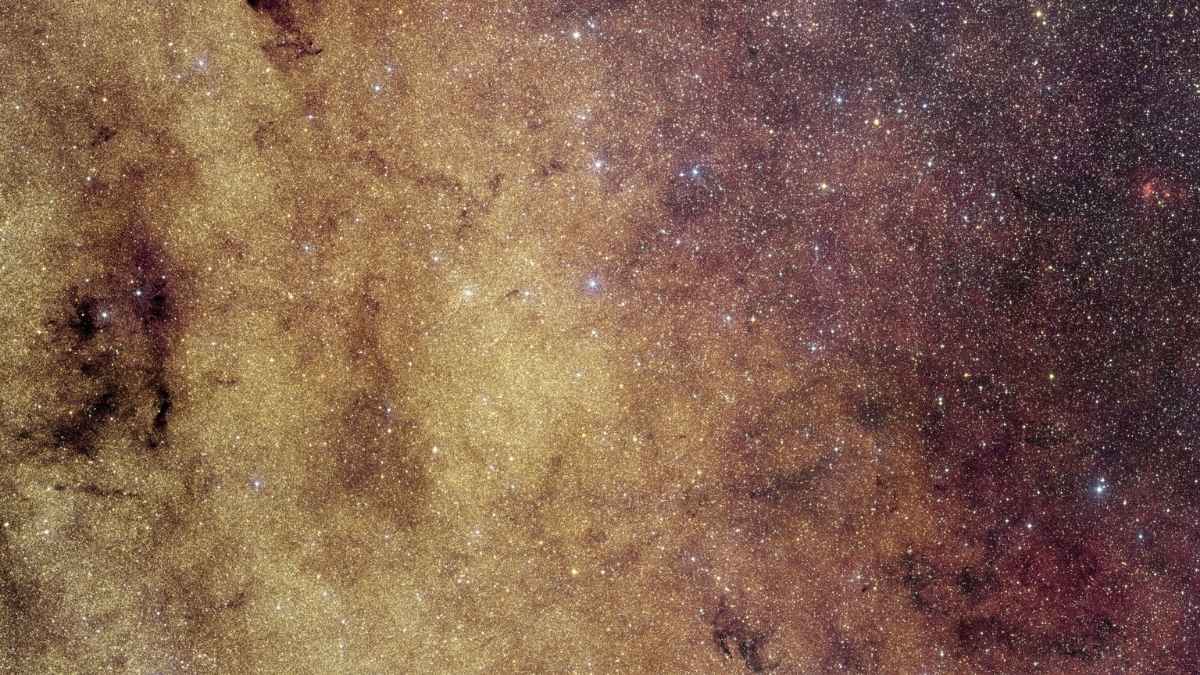
Euclid telescope Milky Way galaxy image (Credit: European Space Agency)
The Telescope Used Stars as Magnifying Glasses
We know that space is so vast that finding small alien planets is almost impossible. In this case scientists rely on a trick where the gravity of a closer star acts like a natural magnifying glass. So, the light bends naturally to enhance the light of a star sitting directly behind it.
It Captured Hidden Planets
The enhanced light from the stars also helped in disclosing the location of a hidden planet which was orbiting a closer star. Even its own gravity creates a tiny but extra bling of light that the Euclid telescope successfully captured.
This deep-space photograph is far more than just a beautiful wallpaper for our phones. By saving the exact positions of millions of stars today, the Euclid telescope has handed humanity a true celestial time capsule. It meanwhile gives future space missions a perfect roadmap to discover thousands of uncharted worlds right in the backyard of our Milky Way Galaxy.

Harshita Singh is an education and general knowledge journalist with over 5 years of experience in educational writing. Specializing in US affairs and GK, Harshita has a track record of breaking down intricate geopolitical and historical subjects into clear, digestible insights for learners. Her strong background in text analysis, coupled with a Bachelor of Arts (Hons) in English from the University of Delhi, helps her produce authoritative, thoroughly researched content that empowers readers to engage confidently with global current affairs. For inquiries or academic insights, you can reach out to her directly at harshita.singh@jagrannewmedia.com.


-1782393717961_t.webp)
