Bandipur Tiger Reserve: Area, Location, Flora & Fauna
Bandipur Tiger Reserve, which is also known as “ecological confluence” because of its geographical location. Check its area, location, flora and fauna in detail.

Key Takeaways
-
Bandipur Tiger Reserve was officially recognised as a tiger reserve in 2007.
-
The total area of this reserve is about 1456.3 sq. kms.
-
As per the 2010 tiger assessment, the tiger density is 11 per 100 sq.km
The Bandipur Tiger Reserve is situated in the Mysore and Chamarajanagar revenue districts of southern Karnataka. It was established in 1930 by the Mysore Maharaja, Nalwadi Krishnaraja Wodeyar IV.
According to the NTCA, this tiger reserve is also known as “ecological confluence” because of its geographical location. At this point of location, both the Western Ghat and Eastern Ghat meet, which creates a diverse and unique location for flora and fauna.
So, let’s explore this article in detail and know more about the area, location, and flora and fauna of Bandipur Tiger Reserve.
Area of Bandipur Tiger Reserve
Bandipur Tiger Reserve has a total area of about 1456.309 sq. kms. Below, you can find all its core, buffer, forest, and non-forest areas in the table:
| Aspects | Detail |
| Core/critical tiger habitat | 872.24 sq km |
| Buffer/peripheral | 118.279 sq.km. |
| Forest Area | 465.79 sq.km. |
| Non-Forest Area | Total: 584.069 sq.km. |
| Total | 1456.309 sq. kms. |
Location of Bandipur Tiger Reserve
Bandipur Tiger Reserve is situated in the Mysore and Chamarajanagar districts of Southern Karnataka. It is located at the tri-junction area of three states of India, which are Karnataka, Tamil Nadu, and Kerala.
However, it is located on the latitude of 11° 35’ 34” to 11° 55’ 02” and a longitude of 76° 12’ 17” to 76° 51’ 32”.
Map of Bandipur Tiger Reserve
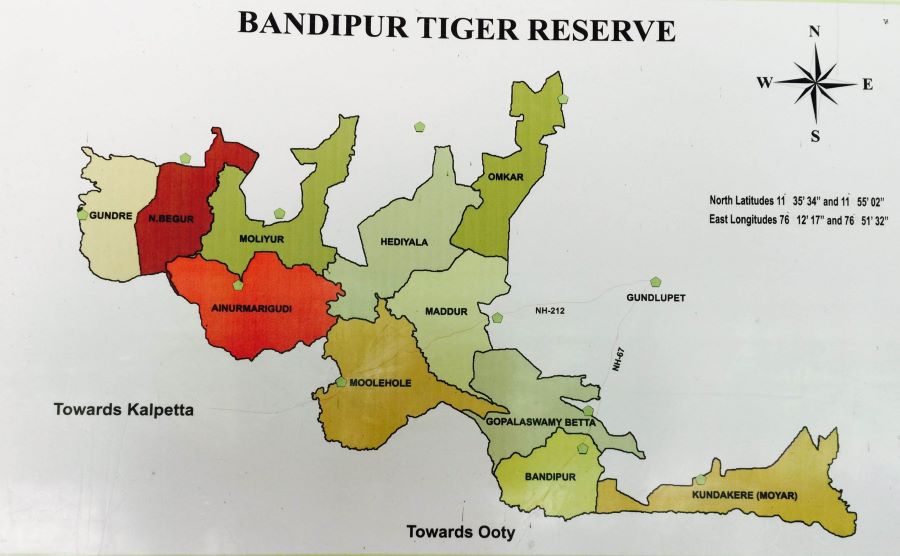
Source: wildtrails
Major River Near the Bandipur Tiger Reserve
Around the Bandipur Tiger Reserve (BTS), the main perennial rivers flowing around this tiger reserve are Nugu, Moyar, and Kabini.
The Nugu River flows through the middle of the Bandipur Tiger Reserve, whereas the Moyar River flows through the southern boundary of BTS and the Madumalayi Tiger Reserve.
The Kabini River flows north, which provides the water facility for daily usage and also helps in agricultural activities.
Flora & Fauna of Bandipur Tiger Reserve
There are many species of flora and fauna found in the Bandipur Tiger Reserve. This tiger reserve is also known for the highest production of sandalwood trees. Apart from this, many timber trees like Tectona Grandis, Rosewood (Dalbergia latifolia) were found.
Many species of fruits, flowers and shrubs are also found, including the Kadam tree, Indian gooseberry (Emblica officinalis), axlewood, black myrobalan, and many other plant species found in this tiger reserve.
Beyond these multiple varieties of flora, there are many fauna species also found, including elephants, tigers, leopards, gaurs, sambhars, hyenas, spotted deer, and many other species found in the Bandipur Tiger Reserve.
So, this article was about the Bandipur Tiger Reserve. Mark down all the necessary points which are very important for prelims in the UPSC and other examinations.

Prabhat Mishra is a Subject Matter Expert and digital journalist with an extensive background in the competitive exam landscape and over 4 years of experience in education, national and international news, and current affairs. Over his tenure with top knowledge platforms like Mentorship India, IAS BABA, IAS SARTHI, and now Jagran Josh, he has a deep understanding of government exams like UPSC and State PCS, including UP and Bihar, as he has already qualified for the UPPCS 2022 Mains and Bihar 68th Mains. With his core expertise in history, polity, geography & current affairs, he specialises in creating well-researched, aspirant-centric content and simplifying complex topics for competitive examinations.


-1782393717961_t.webp)
