e-Rupee vs UPI: What is the Difference and Which is Better?
Confused between e-Rupee and UPI? Master the key differences for your GK exams and daily life with this comprehensive guide based on RBI and NPCI frameworks.
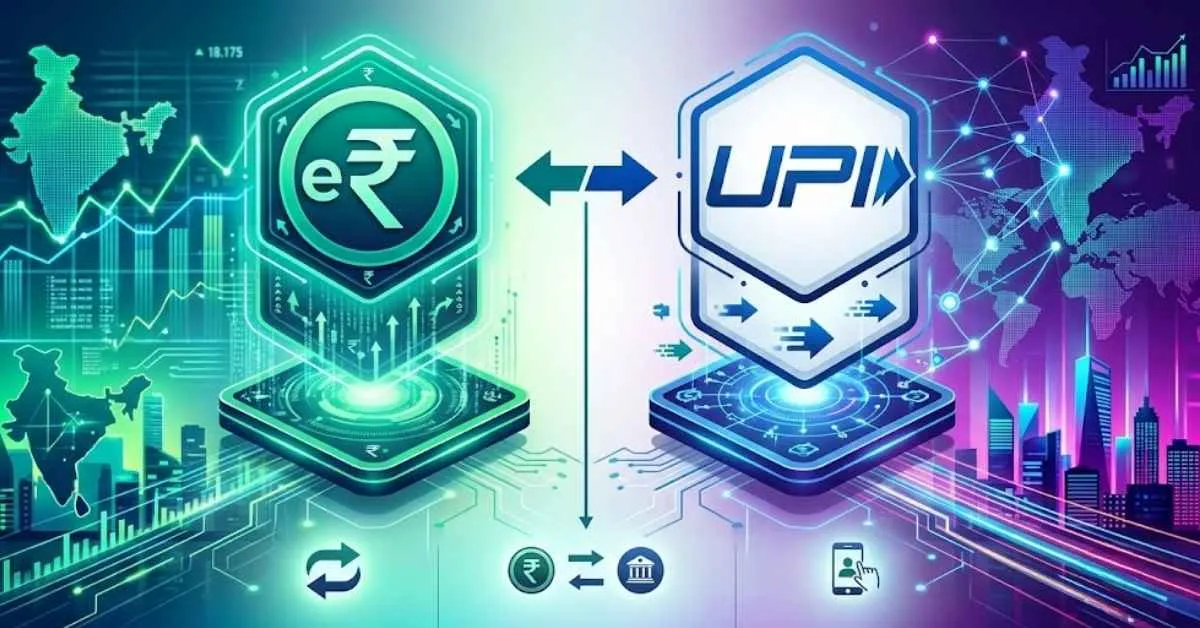
The past 10 years have seen numerous changes in the financial framework of India. Among the various tools driving this change, UPI (Unified Payment Interface) and e-Rupee (Digital Rupee) are the two most well-known.
Despite the fact that both UPI and e-Rupee enable users to carry out cashless transactions. They use a different financial infrastructure. Knowing the infrastructure they are built on helps to understand the principles of how new digital money works.
What is e-Rupee?
Digital Rupee (e₹) is the Central Bank Digital Currency (CBDC) launched by RBI. That means e₹ is a digital type of sovereign currency made by the central bank. Digital Rupee is just as legally valid as paper currency or coins.
People keep their e₹ tokens in special digital wallets offered by commercial banks. Transactions occur with the digital token moving directly from the senders’ wallet to receivers’ wallet without having to involve any intermediaries.
What is UPI?
UPI or Unified Payment Interface is a real-time payment system developed by the National Payments Corporation of India (NPCI) to connect various bank accounts in a single mobile application.
UPI is not currency but a network or infrastructure that supports fund transfer between available bank accounts.
For instance, payment apps like PhonePe, BHIM, etc. use UPI for instant payment transfers through UPI. When a payment is made through UPI funds are transferred electronically from the sending bank to the receiving bank.
Differences Between e-Rupee and UPI
| Feature | e-Rupee (e₹) | UPI |
| Nature of Asset | Digital fiat currency (CBDC) | Payment transfer infrastructure |
| Issuing Authority | Reserve Bank of India (RBI) | National Payments Corporation of India (NPCI) |
| Storage Location | Dedicated $e\text{₹}$ Mobile Wallet | Standard Commercial Bank Account |
| Interest Accrual | Does not earn interest (analogous to physical cash) | Funds in bank accounts may earn regular interest |
| Internet Requirement | Features offline transaction capabilities in pilot phases | Requires continuous internet connectivity |
Note: It is important to recognize that e-Rupee (e₹) is an entirely different concept from e-RUPI as it is a cash-less voucher system meant to facilitate welfare delivery and subsidy payments.
Which is Better?
The two systems are designed to complement each other as opposed to being replacements for each other.
UPI is the preferred option for day-to-day business transactions, peer-to-peer transactions as well as high merchant adoption due to its ease of integration with regular bank accounts and its widespread acceptance.
e-Rupee on the other hand has an advantage of anonymity, credit risk protection with direct backing from the central bank and ability to operate even without a proper internet connection.
When it comes down to day-to-day transactions, UPI is still the preferred option, since it has maximum utility in retail, bill payment and other routine transfers while at the same time e-Rupee represents a shift from physical money towards the use of sovereign digital cash.

Manisha Waldia is a distinguished content strategist with 5 years of experience crafting premium educational content for UPSC and State PCS, with a focus on deep conceptual analysis across Polity, Geography, History, and Environment. She currently brings this expertise to Jagran Josh, where she covers major national and international events, current affairs, and static general knowledge. Over her career, Manisha's specialized insights have led her to curate high-impact materials and serve as a UPSC Mains answer-evaluator for India’s top institutes—including Drishti IAS, Shubhra Ranjan IAS, Study IQ, GS Score, and PWonlyIAS. She has also worked alongside leading NGOs like Oxfam India and Avani Kumaon.
Contact: manisha.waldia@jagrannewmedia.com


![[OUT] EMRS Tier 2 Result 2026 Live: Download PRT, TGT and PGT Result PDF at nests.tribal.gov.in](https://img.jagranjosh.com/images/2026/August/3182026/EMRS-Tier-2-Result-2026.jpg)