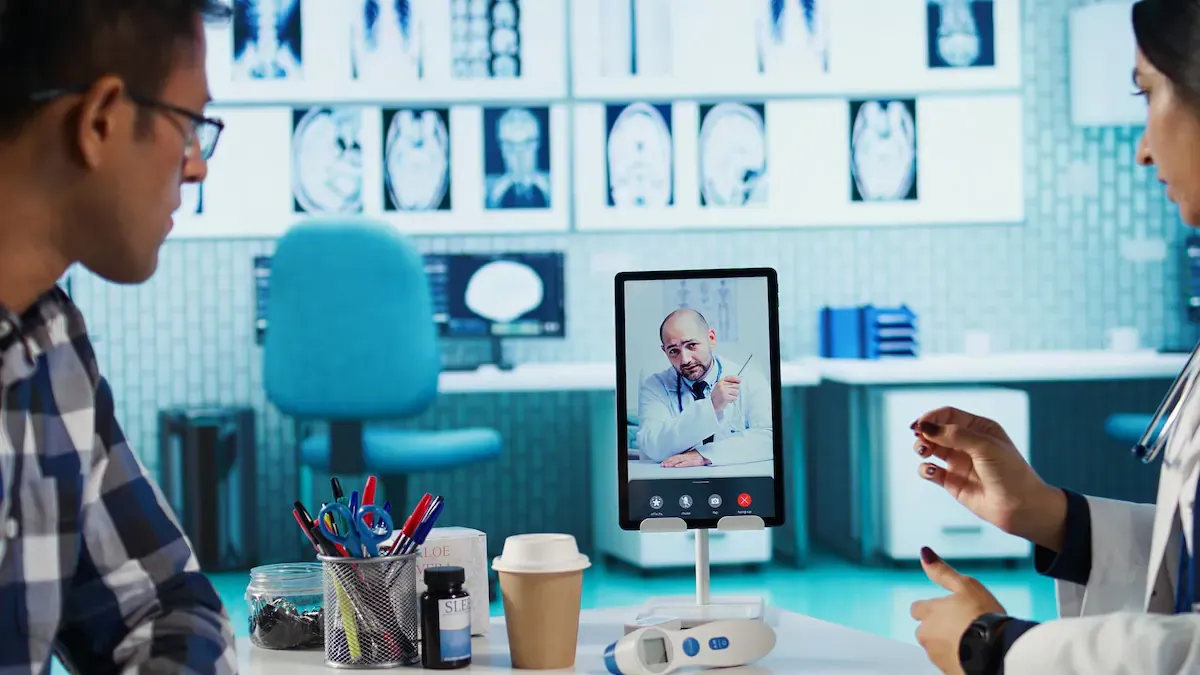
AIIMS set an innovative record when it performed the first remote ultrasound on a patient in a Maitri research station in the Antarctic in India, which is almost 12,000 km away.
The tele-robotic project is a real-time diagnostics tool created by AIIMS New Delhi, IIT Delhi, NCPOR, and startups that provides the opportunity to carry out diagnostics in challenging conditions.
Who Organised the First Remote Ultrasound?
Physicians of AIIMS New Delhi operating remotely the ultrasound system at Maitri station confirmed the continuity of connectivity and technical viability of the system at Antarctic conditions.
The show with NCPOR backing on logistics in Goa supports emergency care to 25-30 personnel to live in severe winters. NCPOR Director Dr. Thamban Meloth pointed out the Indian leadership in polar medical technology.
What is Tele-Robotic Technology?
It is a remote ultrasound control system in which a robotic arm is used and was first successfully tested in the COVID-19 pandemic in AIIMS.
IIT Delhi and AIIMS partnered with Addverb Technologies by allowing physical-less scans supported by specialists. It aids quick imaging on trauma or injuries to assist in evacuation decision-making.
India's Maitri Station
The second permanent Antarctic base opened in 1989 by India, Maitri, functions all year long, conducting multidisciplinary research under NCPOR.
It is a remote polar research station that accommodates scientists in East Antarctica. It is planned to be substituted with Maitri-2 by 2029 with an improved capacity of 90 researchers.
NCPOR Role
Since 1998 NCPOR which has been under the ministry of Earth Sciences co-ordinates the Antarctic program of India and maintains stations such as Maitri and Bharati.
It deals with expeditions, transporting and polar research assignments and is headquartered in Goa. This trial necessitated the use of the agency to transport and connect equipment.
This innovation is extended to high-altitude, offshore and disaster-prone locations and to rural India, filling healthcare gaps. It builds upon the expansions of telemedicine during the post-COVID period and establishes India as the leader in extreme-environment medicine. The future applications may improve global polar operations and remote diagnostics.



Comments
All Comments (0)
Join the conversation