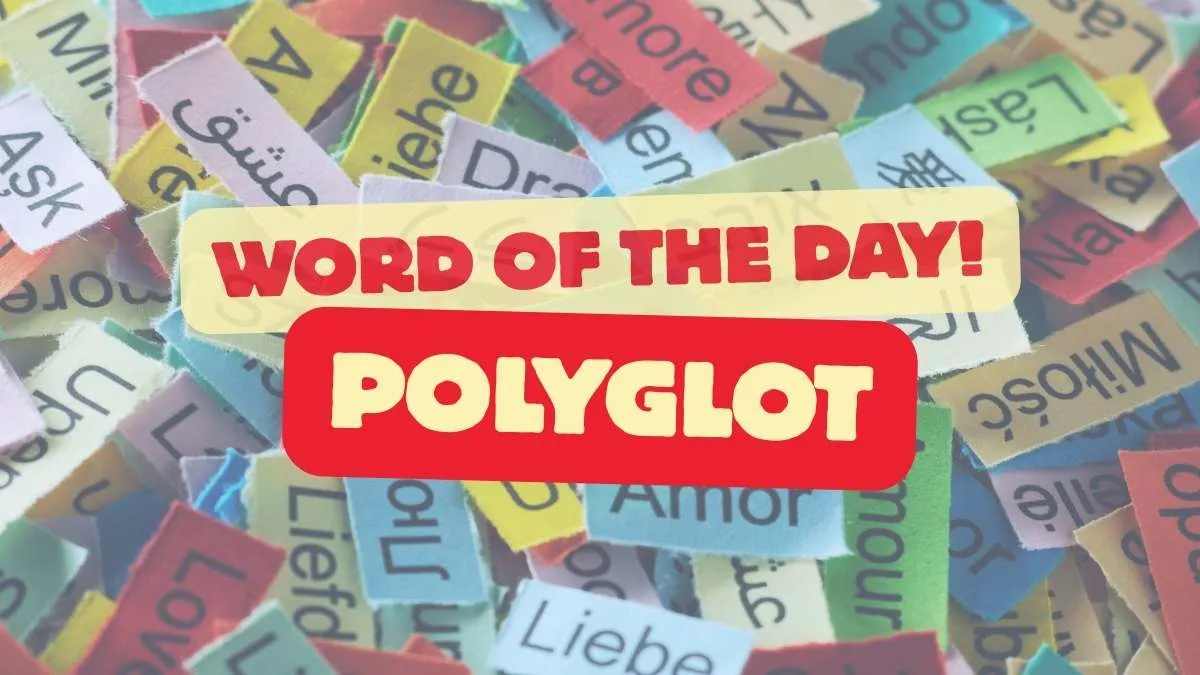
Polyglot meaning: Have you ever sat in a transit lounge or a high-stakes international summit and marvelled at that one individual effortlessly switching between Mandarin, French, and Arabic?
As AI-driven translation reaches its peak in 2026, the human polyglot has become more than just a linguist; they are the ultimate cultural bridge. While machines can translate words, only a polyglot can translate the nuance of a soul.
Whether you're getting ready for the UPSC, GRE, or just trying to get around in our digital world without borders, it's important to know what a polyglot is.
Polyglot: Meaning and Pronunciation
According to standard English usage and Merriam-Webster, today’s word of the day, polyglot, is described as follows:
| Attribute | Details about Polyglot |
| Type | Noun (also used as an Adjective) |
| Pronunciation | /ˈpɒl.i.ɡlɒt/ (POL-ee-glot) |
| Polyglot Meaning | A person who knows, uses, or writes in several languages. |
Polyglot: Origin and Etymology
The word polyglot acts as a linguistic time capsule. It originates from the Greek word polyglōttos, which is a compound of two distinct roots:
-
Poly-: Meaning "many."
-
Glōtta: Meaning "tongue" or "language."
While the term surfaced in English in the mid-17th century, it initially referred specifically to Bibles containing the same text in several different languages. Over the years, it changed from meaning books to referring to people who can speak many languages.
Usage Examples of Polyglot
-
The international tribunal required a polyglot clerk to ensure the testimonies of the diverse witnesses were recorded without loss of semantic nuance.
-
As trade barriers shift in 2026, the most successful CEOs are those with polyglot capabilities, allowing them to negotiate directly in emerging markets.
-
My sister is a true polyglot; she started with Spanish and English but picked up Japanese and German during her travels.
Synonyms and Antonyms of Polyglot
| Synonyms | Antonyms |
| Multilingual | Monolingual |
| Linguist | Unilingual |
| Hyperpolyglot | Alloglottic (limited to one other) |
| Diglot (strictly two) | Non-linguist |
| Philologist | Tongue-tied |
Did You Know?
There is a distinct difference between a polyglot and a hyperpolyglot. While a polyglot is generally someone fluent in more than three languages, the term hyperpolyglot was coined by linguist Richard Hudson to describe those who master 11 or more!
One of the most famous historical polyglots was Cardinal Giuseppe Mezzofanti, who reportedly spoke at least 38 languages fluently without ever leaving Italy.
More Words of the Day
| 5 February, 2026 | |
| 4 February, 2026 | |
| 3 February, 2026 | |
| 2 February, 2026 |
Now that you’ve mastered the nuances of polyglot, try to spot one in your next meeting or video call. Expanding your vocabulary is the first step toward expanding your world.


-1770227009733.jpg)
-1770373694153.jpg)

Comments
All Comments (0)
Join the conversation