500 Years Ago, The Perfect Metal Mirror Was Discovered by Accident – The Story Of Oldest Mirror Of India
Dating back centuries, India's oldest mirror tradition ditches glass entirely. Why? In favour of a secret, sacred blend of polished metals. Handcrafted by a single lineage of craftsmen, this metallic marvel reflects pure history. Let's discover the story behind this legendary artefact.

Magic mirror on the wall, who is the fairest one of all? We all remember this line from Snow White and the 7 Dwarfs. Mirrors are made of glass and reflect an image of a subject or object. However, here's a catch for you: just as gravity was discovered by the mere fall of an apple on Newton's head. Can you guess how someone came up with the idea of a glass mirror?
In ancient times, people never used glass mirrors. The first form of a mirror was made by filling a small pool of water in a dark-coloured container. Since the water is transparent, its stillness reflected the light. Hence, anyone could see their image.
However, now let's talk about the Indian subcontinent. Do you know how the mirror was invented in ancient India? We are not going to reveal the answer in the introduction itself. For that, you have to read the complete article to understand the unexpected discovery of the mirror.
Hint: it wasn’t intentional; the mirror was invented by mistake. Quite interesting, right? Let’s uncover the history, lesser-known facts and the name of the oldest mirror in India.
How Were Mirrors Discovered? How Did a Temple Crown Accidentally Spark 500 Years of Mirror-Making Mastery?
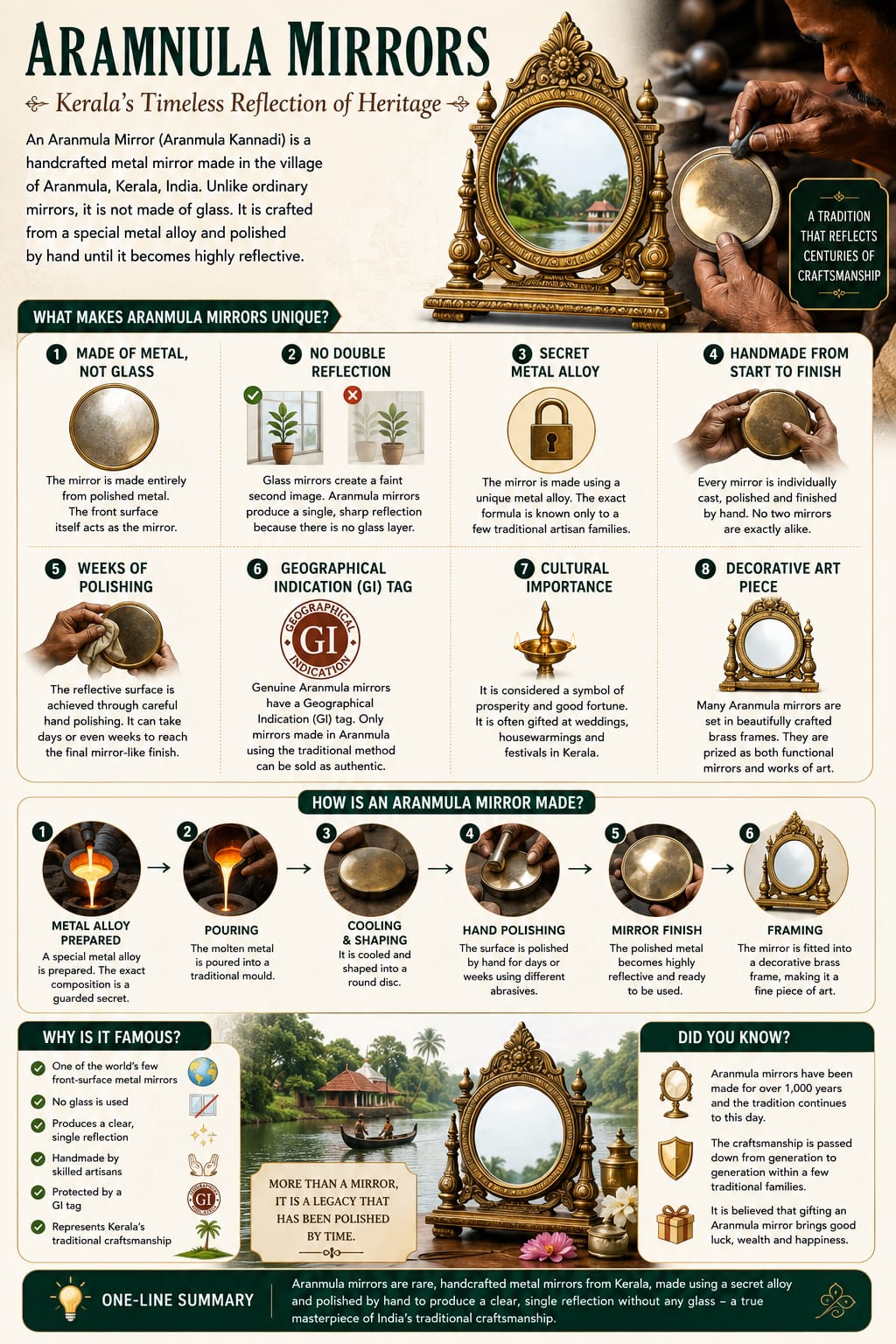
The oldest mirror was invented by artisans of the Vishwakarma community. These craftsmen have been working in the Aranmula Parthasarathy Temple, one of the oldest temples in South India.
So, originally, these artisans were known for creating bronze idols of deities. But 500 years ago, they made a special hand-made mirror called the Aranmula kannadi, which became their most famous product, outshining the idols.
So the story of the mirror starts long, long ago, when the high priest of the temple noticed a crack on the deity's crown. He informed the king about this matter. Without wasting any time, the king ordered these craftsmen to make a new crown for the deity within 3 days.
Now, the craftsman went into a state of worry and anxiety that they would create a beautiful and intricate crown for the deity in only 3 days. Also, they didn't even have the required raw materials to make the crown.
Now, the head craftsman's wife prayed to the god every day and night, and one day she had a dream. In the dream, she saw the deity appearing and giving her a secret proportion for creating an alloy that would shine like glass. The next day, she shared her dream with the women in the community.
To make it true, they all gathered their gold ornaments. The artisans sold them to buy the raw material, and a crown was made. It shone brightly and, when polished, reflected like a mirror. The crown was called the 'kannadi bhimbom' (mirror image).
The King was very pleased. Then the artisans made a vaal kannadi (hand-held mirror) of a similar composition, which was much in demand by the royalty and aristocracy of Kerala. The King decided that the mirror would be included in the ashtamangalyam set, which is a brass plate with eight auspicious items used in religious rites.
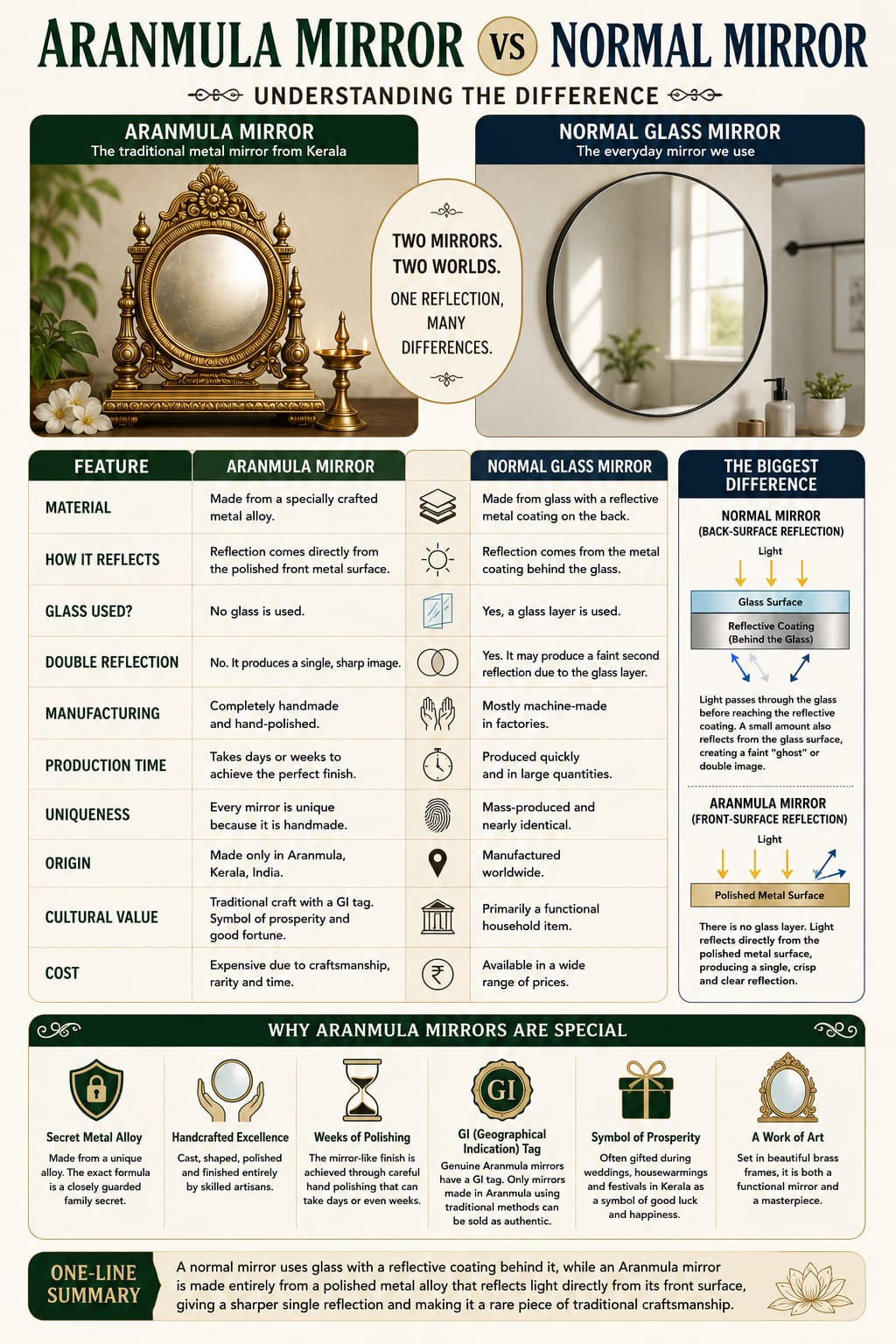
Do you know what makes these mirrors different from other glass mirrors? The Aranmula Kannadi is different from regular mirrors. It reflects light from the back surface of the glass, not the front. The reflective coating is applied there. Light goes through the glass and back in plane mirrors, so it bends and changes direction. This can lead to image distortion.
The type of distortion may vary based on the quality of the reflective coating. For the Aranmula Kannadi, light doesn't go through glass. Instead, it reflects off the top metal surface.
Why Is Aranmula's Metal Mirror Optically Superior To Glass Mirrors?
Ordinary mirrors have a trick up their sleeves. The silvering is hidden underneath the layer of glass. The light reflects on both the glass and the mirror. This results in the appearance of the ghostly image right beside the actual reflection.
The Aranmula mirror is made up of highly polished metal without any glass in between. The reflection takes place on the surface itself. Think of touching the ordinary mirror using a pencil tip. There is always a slight gap between the pencil tip and its reflection.
Touch the Aranmula mirror using a pencil, and there is zero distance between the tip and its reflection. As there is no presence of glass in the middle, the reflection is totally true to life and absolutely clear.
The Drop Test Secret: How Genuine Aranmula Mirrors Self-Identify As Real
Imitations of Aranmula mirrors are normally crafted from ordinary glass or brass. When you put a drop of water on such an imitation, it stays there or forms a puddle.
A real Aranmula mirror is capable of some sort of a magical trick. Such a mirror is created using a unique composition of metals that has been used for a very long time.
When you put a water drop on such a mirror, it does not form a puddle; it simply keeps its round shape like a crystal drop and flows effortlessly over the mirror surface. This is a truly magical look at a piece of pure science.

Kriti Barua is a skilled digital journalist and communications professional with 4+ years of experience, currently writing for the General Knowledge section at Jagran New Media. She has established herself as a subject matter expert in History, Geography, Trending National and International News, Sports, Science, and Defence, producing clear, reliable, and search-optimised content that connects with readers worldwide.
Kriti holds a BA degree from Delhi University and a one-year diploma in TV Production and Journalism, an academic background that adds research depth and strong storytelling instincts to her writing. Her experience spans brand writing, content marketing, and digital media, giving her a sharp understanding of what makes content both helpful to readers and visible in search.
At Jagran New Media, she applies this expertise to national and international news coverage, query-based articles, and in-depth pieces across her specialist subject areas. Her content is defined by easy language, factual accuracy, strong keyword strategy, and reader-friendly storytelling.