Show Key Points
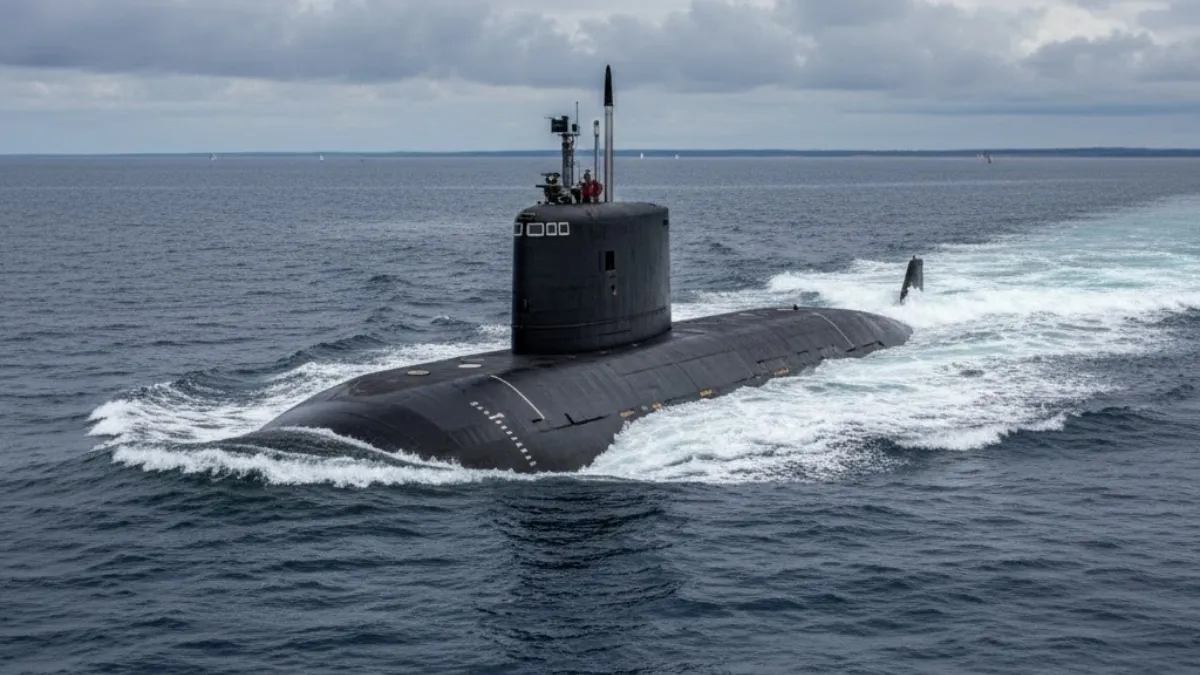
INS Aridhaman: India is on the verge of commissioning its Third Nuclear-Powered Ballistic Missile Submarine (SSBN) INS Aridhaman. It is expected to enter active service by April or May 2026. Developed under the secretive Advanced Technology Vessel (ATV) project. The Aridhaman follows the INS Arihant and the INS Arighat.
It is named after "Aridhaman" (Destroyer of Enemies), the vessel is a testament to India’s growing prowess in high-end naval engineering. Its induction is a critical milestone in perfecting India’s nuclear triad, the ability to launch nuclear weapons from land, air, and sea ensuring that the nation maintains a robust deterrent against regional threats.
Google Largest Full-Stack AI Hub in Visakhapatnam With $15 Billion Investment
Features of INS Aridhaman
-
It is developed under the Advanced Technology Vessel (ATV) project.
-
Built at the Ship Building Centre (SBC) in Visakhapatnam(India's nuclear submarine construction).
-
It is India's third indigenously built nuclear-powered ballistic missile submarine (SSBN).
-
The second vessel in the Arihant class (S4/S4* variant).
-
Enhanced Missile Capacity:Equipped with eight vertical launch tubes for strategic missiles.
-
K-15 Sagarika: Capable of carrying up to 24 K-15 missiles (Range: 750 km).
-
K-4 Missiles: Capable of carrying longer-range K-4 missiles (Range: 3,500 km) for intercontinental-style strikes.
-
Advanced Propulsion: The submarine is powered by an indigenous 83 MW 83 MW pressurized water reactor (PWR), designed and supplied by the Bhabha Atomic Research Centre (BARC).
-
the vessel to remain submerged for months at a time, making it much harder to detect than conventional diesel-electric submarines.
-
Superior Stealth and Sonar: The Aridhaman features a more streamlined hull design and advanced "USHUS" integrated sonar systems developed by the DRDO.
-
It incorporates enhanced noise-reduction technology, making it significantly quieter and more capable of evading enemy detection.
-
Indigenization: Over 60% of the submarine’s components are manufactured domestically which meet India’s goal "Atmanirbhar Bharat" (Self-Reliant India) initiative in the defense sectors
-
Strategic Deterrence: It serves as a mobile hidden launch platform that ensures India can retaliate with devastating force even if its land-based assets are neutralized in a first strike not as frontline combat.
| Feature | Specification |
| Class | Arihant-class (S4) |
| Displacement | 7,000 tonnes (submerged) |
| Propulsion | 83 MW indigenous pressurized light-water reactor |
| Max Speed | 24 knots (submerged) |
| Missile Tubes | 8 Vertical Launch System (VLS) tubes |
| Primary Armament | Up to 8 × K-4 (3,500 km) or 24 × K-15 (750 km) missiles |
| Stealth | Enhanced acoustic damping and anechoic tiles |
| Endurance | Virtually unlimited (limited by food and crew supply) |
| Sensor Suite | Indigenous USHUS and Panchendriya systems |
INS Aridhaman represents a significant leap in India’s naval capabilities. As the second boat of the Arihant class and the third indigenous nuclear-powered submarine, it features substantial upgrades over its predecessor, INS Arihant. Designed to carry more long-range missiles and operate more quietly, the Aridhaman is a cornerstone of India’s "No First Use" policy, providing a credible and survivable second-strike capability from the deep sea.



Comments
All Comments (0)
Join the conversation