

Key Points
- Higher Educational Institutions must for Equity Committees for Discrimination cases
- Look into discrimination based on religion, race, gender, place of birth, caste, or disability
- Applicable to all the higher education institutions in India
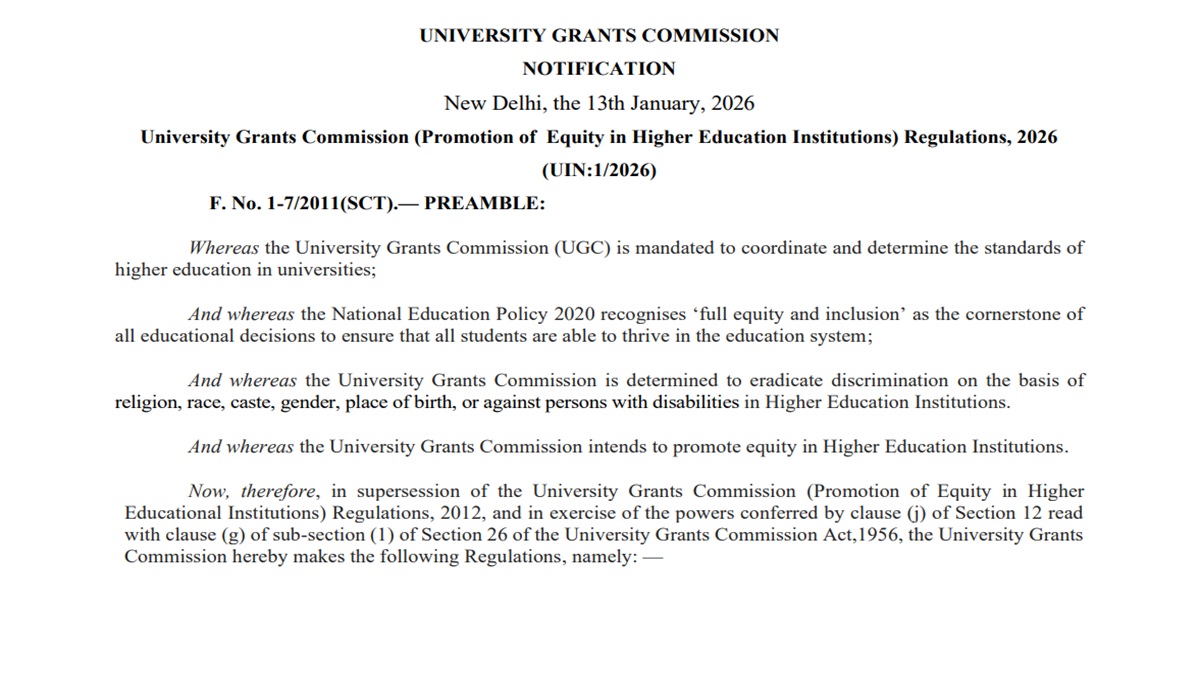
UGC Act 2026: The University Grants Commission has issued new rules to prevent discrimination in higher education institutions across the country. The new UGC Promotion of Equity in HEIs Regulations will be applicable to all HEIs and cover students, teachers and non teaching staff members. The new rule states that no one will be denied dignity or opportunity in HEIs because of their identity.
The new rules will affect the everyday campus functioning replacing the earlier UGC equity guidelines with a greater responsibility of implementing the rule on institutions. Vice Chancellors, Principals and Heads of Institutions are now directly responsible to prevent and respond on discrimination charges making them accountable. The rules will be applicable for discrimination only on the basis of religion, race, gender, place of birth, caste, or disability, particularly against the members of scheduled castes and scheduled tribes, socially and educationally backward classes, economically weaker sections, persons with disabilities, or any of them, and to promote full equity and inclusion amongst the stakeholders in higher education institutions.
UGC Act 2026: News Equity Regulations - Click Here
UGC Act 2026: Equity Committee
A committee will be responsible to look into charges filed by students, teachers and non-teaching staff members. The committee will include the following people in positions.
-
The Head of the Institution shall be the ex-officio Chairperson
-
Three Professors/Senior Faculty Members of the HEI, as Members
-
One Staff Member, other than a teacher, of the HEI, as a Member
-
Two representatives from civil society having relevant experience, as Members
-
Two student representatives, to be nominated based on academic merit/excellence in sports/performance in co-curricular activities, as Special Invitees.
-
The Coordinator of the Equal Opportunity Centre shall act as the ex-officio Member Secretary
The Committee must also have representation of Other Backward Classes, Persons with Disabilities, Scheduled Castes, Scheduled Tribes, and women. The term of the members shall be for two years, and the term of the special invitees shall be one year.
Procedure During an Incident of Discrimination
An aggrieved person can report any incident of discrimination on an online portal, in writing, or by sending an email to the Coordinator of the Equal Opportunity Centre. The identity of the aggrieved person shall be kept confidential if requested.
The aggrieved person will also have the option of reporting the incident to the Equity Helpline. The information received on the helpline will be forwarded to the police authorities concerned if, prima facie, a case under the penal laws is made out.
Upon receipt of such information, the equity committee will meet within 24 hours to take appropriate action.
The committee will then submit its report to the Head of the Institution within 15 working days. A copy of the Equity Committee's report shall also be sent to the aggrieved person.
The Head of the Institution will then initiate further action as per the rules of the HEI within 7 working days. However, if a case under the penal laws is made out, police authorities shall be informed forthwith
In the event any complaint is made against the Head of the Institution, the meeting of the Equity Committee shall be chaired by the Coordinator of the EOC, and the report of the Equity Committee shall be forwarded to the next higher authority of the Head of the Institution.


Comments
All Comments (0)
Join the conversation