
The rotation of the earth finishes a full cycle in 24 hours. This is what makes the day-night cycles, weather patterns, and existence on Earth. This movement was the collapse of the solar nebula 4.6 billion years ago.
This caused the formation of the solar system, which was preserved in the angular momentum without any significant external influences preventing its disruption. The causes, effects, and evolution of this will be explored to gain an in-depth understanding of it.
How did Earth Start Spinning?
Heavy rotating gas and dust cloud condensed into a solar system as gravity drew it in, spinning it like a skater drawing in his arms.
When this protoplanetary disk collapsed, the inner matter that would compose the Earth acquired this angular momentum that would cause it to rotate to the east all along.
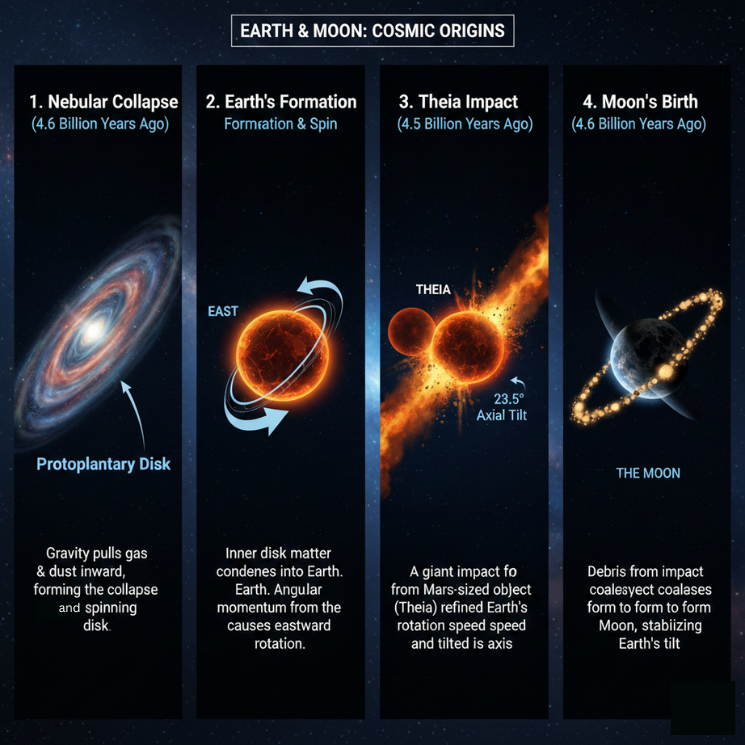
(Generated with the help of Google Gemini)
An extremely massive collision of a Mars-sized object, named Theia, approximately 4.5 billion years ago, was probably what refined the rotation speed and gave the 23.5deg axial tilt, which also gave birth to the Moon.
What are the Effects of Spinning Earth?
The earth rotates on a daily basis, alternating day and night with the surface facing and away facing the Sun with a 23 hour 56 minute sidereal day.
Centrifugal force causes the equatorial bulge that causes Earth to be oblate and this decreases gravity there by 0.5% and facilitates Coriolis effect that turns winds on the right in the Northern Hemisphere and left in the Southern.
Seasons The atmosphere is also stabilized by this spin, ocean currents and in combination with orbital tilt.
IN CASE YOU MISSED| List of Top 6 Longest Ruling Queens in World History
What Changed Over Time?
Frictional interactions with the Moon cause the same to pass angular momentum onto the lunar orbit, slowing the rotation rate of the Earth by approximately 2.3 milliseconds per century and increasing days.
The axis rotates in a 26,000-year cycle because of gravitational forces of the Sun and Moon. The polar movement incorporates a 14-month Chandler wobble of internal mass movement.
Days were approximately 6 hours shorter 620 million years ago as seen in fossil records, and demonstrate slowing down.
Historical Discovery
Even ancient astronomers such as Ptolemy observed the daily movement and explained it as motion of stars around a stationary earth.
Heliocentrism was defended by Copernicus (1543) and Galileo, that the Earth was rotating on its axis, and Foucault proved the inertial rotation, when it did not depend on the surface of the Earth, by the pendulum experiment in 1851.
Modern space observations such as satellites tracing polar movement enhance our understanding of variations.
The ongoing rotation of the earth underlines the basics of physics, which define climate, time and space voyages, such as GPS and space voyages. Since tidal slowing is a continuing process, its knowledge can assist in predicting the future length of the day as well as planetary science.
Read more: Which Ocean Is Known as the King of Oceans?





Comments
All Comments (0)
Join the conversation