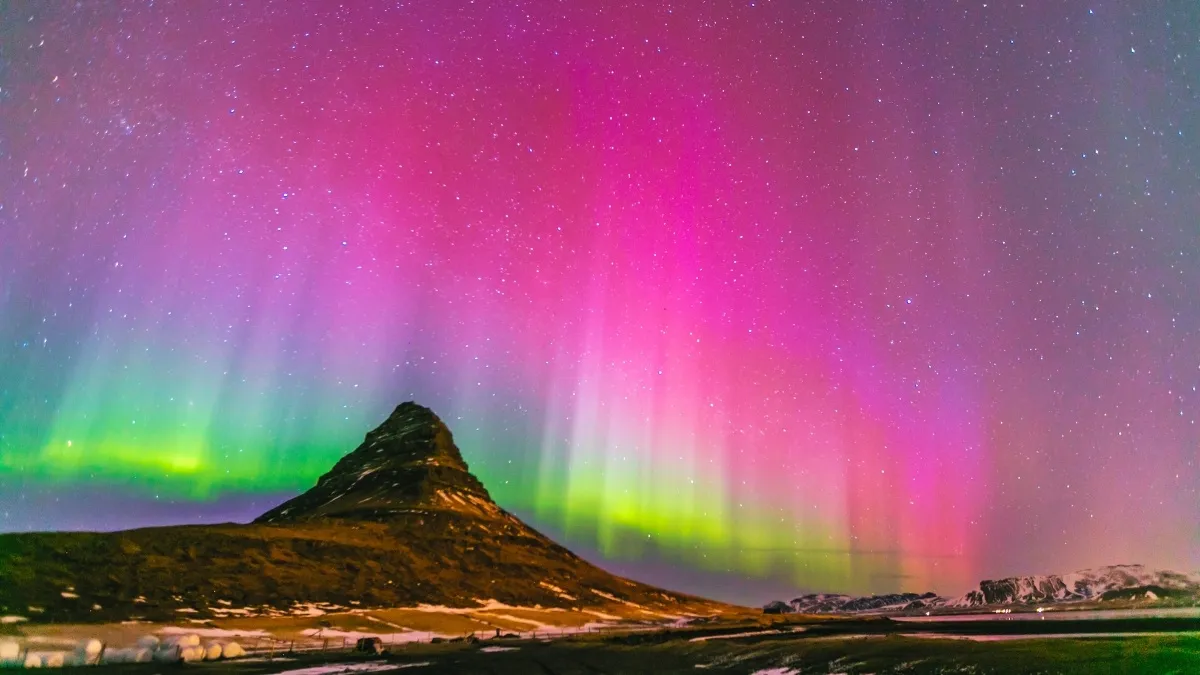
The Best Year to watch Bright Northern Lights is in 2026. The reason behind the mesmerizing dance of northern lights is the strong solar activity at the peak of the sun's 11-year cycle.
Strong solar activity will lead to charged particles colliding with Earth's atmosphere and sometimes create bright green, purple, and red displays.
As the NOAA Space Weather Prediction Center noted, the solar cycle reached its peak in October 2024, but the decreasing phase in 2026 is still producing frequent G2-G3 geomagnetic storms visible at low latitudes.
Learn causes behind Northern Lights sightings in 2026, best viewing times, spots, and tips here
What’s Causing Bright Northern Lights Sightings in 2026?
During the sun's post-maximum phase, Solar wind particles from coronal mass ejections will slam into Earth's magnetic field, exciting atmospheric gases for brilliant auroras.
The 11-year solar cycle peaked in 2024-2025; 2026 sees turbulent decline with strong flares, such as the X5.1 event this past November. Equinoxes are amplified through the Russell-McPherron effect, which doubles storm odds.
Read Why is 2026 the Best Year to See the Northern Lights?
When to See the Northern Lights in 2026?
The best time to view Northern Lights is late September to late March, while late March and September's equinoxes offer maximum chances due to magnetic alignment.
Active nights have displays from dusk till 2 a.m., taking minutes to hours. Visit NOAA's 30-minute aurora oval prediction for G1+ storms. A Geomagnetic Kp index of 5+ means that there are strong
The new phases reduce light pollution to allow brighter views of the sky. The dancing curtains tend to occur during the post-midnight.
Where Can You Watch the Northern Lights in 2026?
The boreal display is viewed best within the aurora oval at 66°N, as in Alaska, Canada, and Scandinavia; storms in 2026 extend viewing areas to the Midwest and Europe.
| Region | Top Spots | Why Ideal |
| USA | Fairbanks AK, Isle Royale MI | Dark skies, frequent storms |
| Canada | Yellowknife NT, Whitehorse YT | Aurora tours, clear views |
| Europe | Tromsø Norway, Reykjavik Iceland | Easy access, lodges |
| Asia | Abisko Sweden, Murmansk Russia | Mountain funnels enhance glow |
Check the Aurora Borealis Forecast Here.
Best Time to Watch Northern Lights in 2026
Peak activity is during evening hours between 10 p.m. and 2 a.m. local time when it is dark during the winter solstices because geomagnetic peaks occur when it is dark.
Equinoxes in spring/autumn have double chances with tipped magnetic fields. Skip full moon days and clouded skies with apps like Aurora Alerts.
Take the Quiz Here: How Well Do You Know About Northern Lights?
Conclusion
Bright Northern Lights in 2026: These northern lights are a result of solar activity during their solar cycle, exciting gases to form spectacular displays at their poles, visible in an unusual stretch south. NOAAPredicts high activity by end of year. Stargazers are advised to monitor storms, seek out dark regions, and layer up—with a spectacular display of light from nature in store for them.




Comments
All Comments (0)
Join the conversation