Key Points
- Kbal Spean, or Stung Kbal Spean, is known as the 'River of a Thousand Temples'.
- The river features carvings started during King Suryavarman I's reign.
- Rediscovered in 1969, the carvings purify water flowing to Angkor.
Rivers are essential to our planet. Millions of rivers flow all over the world, carving out large river basins that support life.
The Amazon River has the largest volume of water, whereas the Nile is the longest river in the world.
Throughout history, people have given rivers special names. The Yellow River is known as "China's Sorrow", while the Ganga is referred to as the "Holy River".
But do you know which river is the "River of a Thousand Temples"? This mysterious river flows through Southeast Asia.
It is famous for its ancient stone carvings hidden underwater. In this article, we will explore this sacred waterway and its amazing history.
ALSO READ| Which River Is Known As The River Of Nine Dragons?
Which River is known as the River of a Thousand Temples? (River of 1000 Lingas)

The river called the River of a Thousand Temples is really the Kbal Spean River, which is also known as the Stung Kbal Spean.
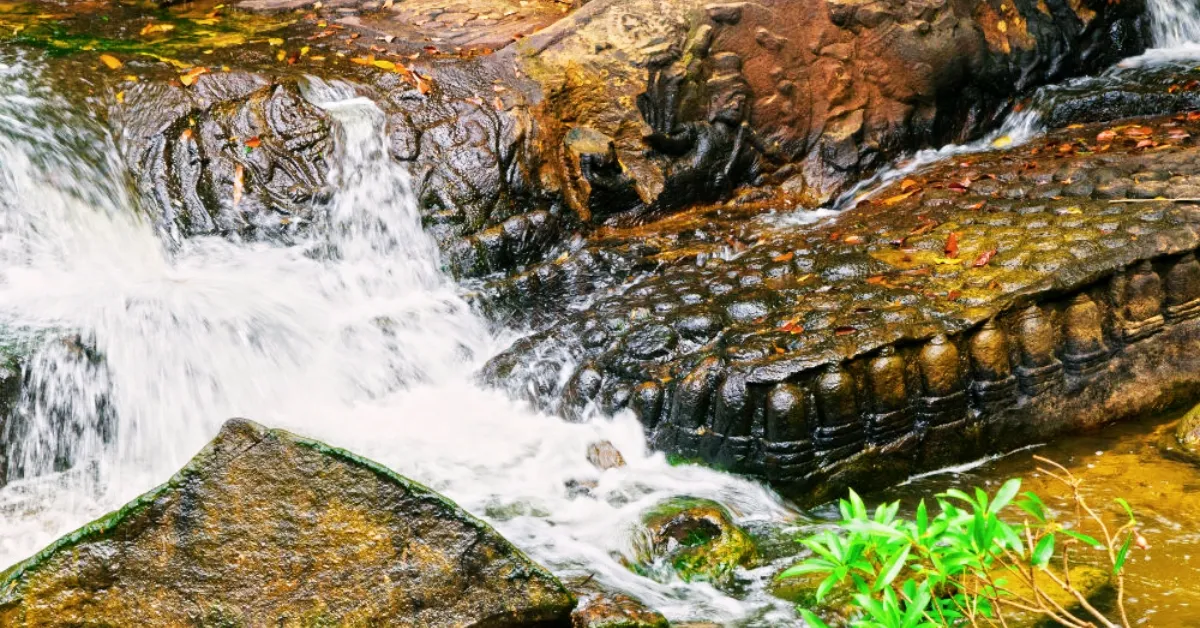
It is in the thick jungles of Cambodia, close to the well-known Angkor Wat area. Unlike most rivers, its "temples" are carved right into the sandstone riverbed.
The river begins in the Kulên Mountains and flows down to the plains. It finally merges with the Siem Reap River, which empties into Tonlé Sap Lake. The river flows entirely within Siem Reap Province in Cambodia.
Its path is known for the "Thousand Lingas", which are sacred symbols carved into the rocks beneath the water. These symbols bless the stream as it flows toward the ancient city.
10 Fascinating Facts About Kbal Spean
- Most of the carvings are located beneath the water's surface, making it a unique "submerged" monument.
- Ancient people believed the carvings purified the water, turning it into a holy "Ganges" of the East.
- The carvings were started during the reign of King Suryavarman I and finished under King Udayadityavarman II.
- The site was only rediscovered by Western researchers in 1969 after being hidden by the jungle for hundreds of years.
- The "Thousand Temples" refer largely to Lingas, which are symbols representing the Hindu god Shiva and creative energy.
- Along with symbols, the riverbed features detailed carvings of gods like Vishnu and animals like cows and frogs.
- The site features a beautiful waterfall where the "blessed" water tumbles down the mountainside.
- To see the Kbal Spean river, visitors must hike nearly 2 kilometres uphill through a lush tropical forest.
- The entire riverbed is made of soft sandstone, which allowed ancient artists to carve intricate details directly into the floor of the stream.
- This river was the primary water source for the ancient city of Angkor, providing life to its massive population.
MUST READ| Which River Is Known As The Silver River?
Why is the Kbal Spean River known as the River of 1000 Temples? What is the Science Behind It?
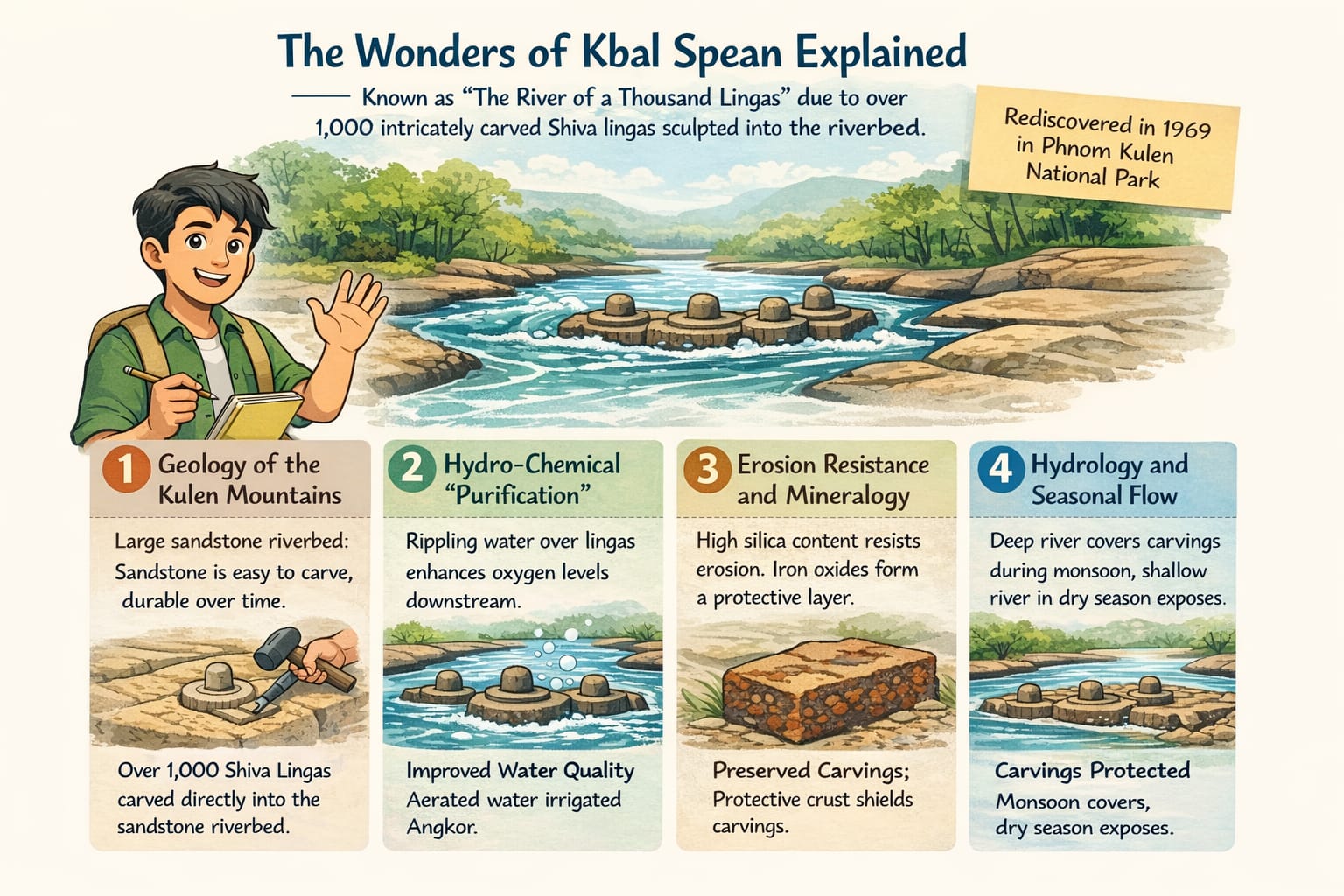
The Kbal Spean River in Cambodia is famous as the "River of a Thousand Lingas" (or Sahasralinga) due to over 1,000 intricately carved Shiva lingas, which are phallic symbols of the Hindu god Shiva, carved directly into its sandstone riverbed.
i) The Geology of the Kulen Mountains
The main scientific reason is the lithology, or rock composition. The riverbed of Kbal Spean consists of large sandstone.
Sandstone is a sedimentary rock that is soft and easy to carve when first exposed. However, it becomes very durable as time goes on.
This allowed Khmer artisans to carve high-relief sculptures directly into the riverbed without the rock breaking apart.
ii) Hydro-Chemical "Purification"
From a historical and scientific viewpoint, the Khmers had a strong grasp of water management.
Scientifically, as water flows over the textured surface of the carvings, it experiences more aeration. The ripples made by the thousands of raised lingas boost the oxygen levels in the water.
While the ancient Khmers saw this as "spiritual purification", it also improved the water quality as it flowed downstream to the irrigation systems of Angkor.
iii) Erosion Resistance and Mineralogy
The sandstone at Kbal Spean has a high silica content, so it is resistant to chemical weathering.
Even though the river flows all the time, the rate of erosion is slow enough that the 11th-century details are still visible.
The presence of iron oxides in the rock helps to case-harden the surface. This creates a protective layer that shields the artwork from the abrasive force of silt and sand carried by the current.
iv) Hydrology and Seasonal Flow
The site was chosen carefully due to its constant flow. Scientists note that the river stays deep enough to cover the carvings during the monsoon.
This protects them from sun damage and thermal expansion. In the dry season, the river becomes shallow enough for pilgrims to study and admire the carvings.
The site was rediscovered in 1969. It is located within Phnom Kulen National Park and is a unique example of "underwater temples" where geology and spirituality merge.
WHAT'S NEXT| List Of 7 Rivers That Flow Underground





Comments
All Comments (0)
Join the conversation