Key Points
- India and EU signed a Free Trade Agreement on Jan 27, 2026, after 18 years of debate.
- The deal creates a $24 trillion market, granting India access to 97% of EU tariff lines.
- Tariffs will be reduced on over 90% of goods, doubling EU exports to India by 2032.
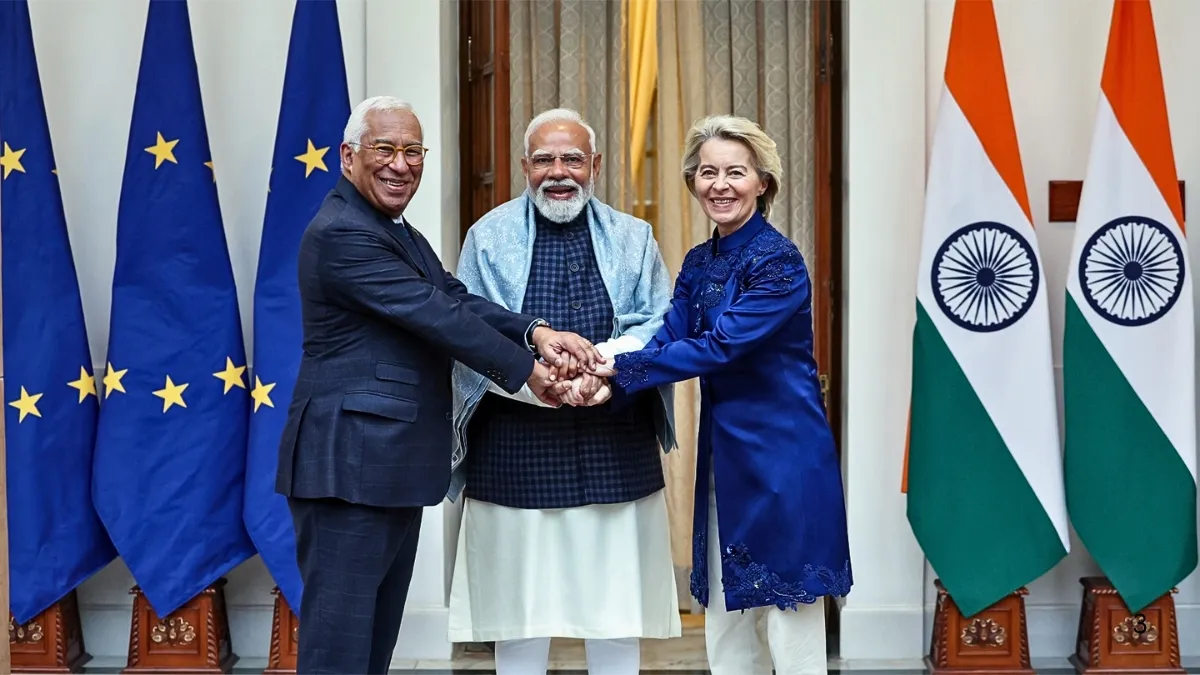
India-EU Free Trade Agreement: India and European Union have officially signed a comprehensive Free Trade Agreement after 18 years of intense debate, deliberations and periodic pauses. The announcement was made at the 16th India-EU Summit by Prime Minister Narendra Modi and European Commission President Ursula von der Leyen during the visit of European leaders to India.
It is often referred to as ''Mother of All Deals’’ by trade analysts and policymakers this deal represents one of the most ambitious and expansive economic partnerships in the 21st century. By bridging the world’s largest democracy with the world’s largest single market, redefineing the geopolitical and economic landscape of the global economy.
Why is It Called the "Mother of All Deals"?
The India-EU Free commercial Agreement is known as the "Mother of All Deals" because it creates a vast, rules-based commercial partnership between the 2nd and 4th largest economies in the world, generating a combined market of USD 24 trillion (about INR 2,091.6 Lakh Crore). India now has unprecedented privileged access to 97% of EU tariff lines, which covers an incredible 99.5% of its export value, according to the historic pact. With the removal of import taxes that formerly varied from 4% to 26%, the agreement is revolutionary for India's labour-intensive industries, including textiles, leather, gems and jewellery, and marine products. It is anticipated that this quick transition to zero-duty access for exports valued at more than USD 33 billion will significantly increase India's competitiveness in the global market and support its India@2047 developmental objectives.
Beyond physical commodities, the basis for this name comes from its profound integration of services and talent mobility, both of which are key growth drivers in both regions. The EU has made binding pledges in 144 service subsectors, including IT, professional services, and education, to provide a stable environment for Indian high-tech exports. Simultaneously, a complete mobility framework has been built for professionals, including intra-corporate transferees and independent professionals, allowing skilled workers and their families to enter and stay temporarily. The agreement redraws the map of global trade by aligning digital trade and investment protection while protecting sensitive sectors such as dairy and cereals, linking 2 billion people via a secure, predictable, and modernised economic corridor.
Also Read: EPFO 3.0: New UPI Withdrawal, Easy PF Acess & Other Details
The EU and India concluded negotiations today for an ambitious, comprehensive free trade agreement.
— European Commission (@EU_Commission) January 27, 2026
This is the largest trade agreement that both the EU and India have ever concluded.
More: https://t.co/obud5ija8a pic.twitter.com/VfP4s0jlyt
Key Elements of the Agreement
The finalised FTA is built on several core pillars designed to create a "win-win" scenario for both EU and India:
-
Tariffs Elimination: The deal removes or significantly reduces customs duties on over 90% of tariff lines which gives Indian textiles, leather, and agricultural products easier access to European markets, while European machinery, transport equipment, and specialty chemicals enter India more competitively.
-
The EU and India present trade over €180 billion worth of goods and services per year. This deal is expected to double EU goods exports to India by 2032 by eliminating or reducing tariffs in value of 96.6% of EU goods exports to India. Overall, the tariff reductions will save around €4 billion per year in duties on European products.
-
-
Service Sector Integration: For India, the "Mother of All Deals" is a major win for its services sector, facilitates easier movement for Indian professionals like IT, engineering, and healthcare to work in the EU under "Mode 4" provisions, while the EU gains better access to India’s financial, telecommunications, and maritime sectors.
-
Investment Protection: India will grant the EU tariff reductions that none of its other trading partners have received. A dedicated Investment Protection Agreement (IPA) provides a stable and predictable legal framework for European investors in India, encouraging a surge in Foreign Direct Investment (FDI) for infrastructure and green energy projects.
-
Reducing Agri-Food Tariffs: the agreement reduces prohibitive traffic over 36% average on EU exports of agri-food products, which opens a massive market to farmers where sensitive agricultural sectors will be fully protected as products like beef, Chicken meat, rice etc,.
-
the EU and India are currently negotiating a separate agreement on Geographical Indications (GIs), which will help traditional iconic EU farming products sell more in India, by removing unfair competition in the form of imitations.
-
-
Enhance Sustainability and Labor Standards: The agreement has a dedicated trade and sustainable development chapter, which enhances environmental protection and addresses climate change, protects workers' rights, supports women's empowerment, provides for a platform for dialogue and cooperation on trade related environmental and climate issues and ensures effective implementation.
Bacground of India and EU Trade Realtions:
The EU and India had first launched negotiations for a Free Trade Agreement(FTA) in 2007. The talks were suspended in 2013 and then again relaunched in 2022. The 14th and last formal negotiating round took place in October 2025, followed by intersessional discussions at technical and political level. At the same time the EU and India also launched negotiations for a Geographical Indications Agreement and an Investment Protection Agreement. Negotiations for these agreements are still ongoing.
Timeline of India-EU Trade Relations
| Year | Outcome | Description |
| 1962 | Early Foundations | India becomes one of the first countries to establish diplomatic ties with the European Economic Community (EEC). |
| 1994 | Cooperation Agreement | A broader agreement is signed to move beyond trade into political and sector-specific cooperation. |
| 2000 | First India-EU Summit | The inaugural high-level summit is held in Lisbon, establishing an annual dialogue framework. |
| 2004 | Strategic Partnership | Relations are upgraded to a "Strategic Partnership," acknowledging India’s role as a global power. |
| 2007 – 2013 | BTIA Negotiations | Talks for a Broad-based Trade and Investment Agreement begin but stall in 2013 over car tariffs and visa issues. |
| 2021 | Relaunch in Porto | Following a 2020 "Roadmap to 2025," leaders agree to resume formal negotiations for a Free Trade Agreement (FTA). |
| 2022 – 2023 | TTC & New Momentum | The Trade and Technology Council (TTC) is launched to coordinate on semiconductors and green tech. |
| Jan 27, 2026 | The "Mother of All Deals" | India and the EU officially conclude FTA negotiations at the 16th Summit in New Delhi. |
Source: PIB
India Secures From the Agreement:
-
India has gained preferential access to the European markets across 97% of tariff lines, covering 99.5% of trade value, in particular:
-
70.4% tariff lines covering 90.7% of India’s exports will have immediate duty elimination for important labour-intensive sectors such as textiles, leather and footwear, tea, coffee, spices, sports goods, toys, gems and jewellery and certain marine products, amongst others.
-
20.3% tariff lines covering 2.9% of India’s exports will have zero duty access over 3 and 5 years for certain marine products, processed food items, arms and ammunition, amongst others.
-
6.1% tariff lines covering 6% of India’s exports will have preferential access by way of tariff reduction for certain poultry products, preserved vegetables, bakery products amongst others or through TRQs for cars, steel, certain shrimps/ prawns products, amongst others.
What European Union Gets from India:
-
Overall, India is offering 92.1% of its tariff lines which covers 97.5% of the EU exports, in particular:
-
49.6% of tariff lines will have immediate duty elimination.
-
39.5% of tariffs lines are subject to phased elimination over 5, 7, and 10 years’
-
3% of products are under phased tariff reductions and few products are subject to TRQs for Apples, Pears, Peaches, Kiwi Fruit.
-
Imports of EU’s high technology goods are expected to diversify India’s import sources, thereby reducing input costs for businesses, benefit consumers and will create opportunities for Indian businesses to integrate into global supply chains.
The India-EU Free Trade Agreement marks a landmark shift in global trade, the largest such deal ever concluded by either side. It will strengthen economic and political ties between the world's second and fourth largest economies, at a time of rising geopolitical tensions and global economic challenges. It also highlights joint commitment to economic openness and rules-based trade by balancing tariff liberalization with robust protections for labor, climate, and investment.
Also Read: Why Are the UGC 2026 Promotion of Equity Regulations Facing Supreme Court Challenges?
Enter your Blink text here...
-1764828864392.jpg)


Comments
All Comments (0)
Join the conversation