I2U2 is an intergovernmental economic cooperation forum formed following the Abraham Accords to foster cooperation between Middle Eastern and Asian nations. The I2U2 Group is currently being led by senior government representatives of each partner country.
The I2U2 group held its inaugural summit on July 14, 2022, in which Indian Prime Minister Narendra Modi, US President Joe Biden, Israeli Prime Minister Yair Lapid, and UAE President Mohammed bin Zayed Al Nahyan participated.
The I2U2 group identifies six areas of cooperation and investment, namely water, energy, transportation, space, health, food security, and technology.
In this article, we will learn about the I2U2 grouping, member countries, objectives, and its significance for India.
Which countries are part of the I2U2 Group?
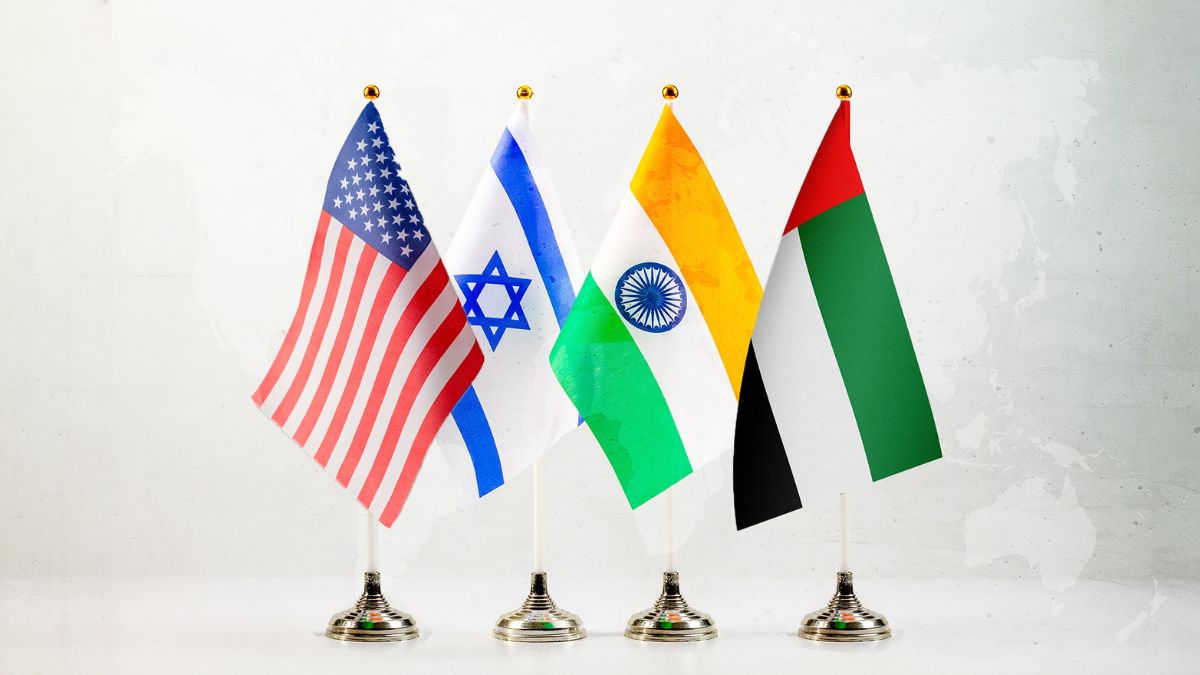
The I2U2 Group is a strategic partnership composed of four countries: India, Israel, the United Arab Emirates (UAE), and the United States (USA).
'I2' represents India and Israel, while 'U2' represents the UAE and the USA.
It is sometimes referred to as the "West Asian Quad" or "Middle East Quad".
What is the I2U2 grouping?
I2U2, comprising India, Israel, the UAE, and the USA, was formed during their first ministerial meeting virtually in October 2021, following the Abraham Accords between Israel and the UAE.
Foreign ministers from the four countries held their first virtual meeting in October 2021 to deal with issues concerning maritime security, infrastructure, and transportation in the region, while also fostering joint investments and new initiatives in water, energy, space, health, and food security.
The first, inaugural summit of the I2U2 Leaders (Prime Minister Narendra Modi, Prime Minister Yair Lapid, President Mohammed bin Zayed Al Nahyan, and President Joe Biden) took place virtually on 14 July 2022.
What are the projects and initiatives of I2U2?
The I2U2 group identifies six areas of cooperation and investment, namely water, energy, transportation, space, health, food security, and technology.
Food Security
the UAE will invest $2 billion to develop a series of integrated food parks across India with state-of-the-art climate-smart technologies to reduce food waste and spoilage, conserve fresh water, and employ renewable energy sources.
These investments will help maximize crop yields and, in turn, help tackle food insecurity in South Asia and the Middle East.
Clean Energy
The group will install a 300-megawatt (MW) wind and solar power plant located in Gujarat, India, coupled with a battery energy storage system.
The U.S. Trade and Development Agency funded a feasibility study for the $330 million project.
This project will contribute in India’s goal of achieving 500 GW of non-fossil fuel capacity by 2030.
Space
India, Israel, the UAE, and the United States, all signatories of the Artemis Accords. They aim to collaborate on space-based technology and data sharing.
Also read: Which Middle East countries are part of the BRICS?