Show Key Points
The Treaty of Versailles is one of the most significant documents in modern history signed in 1919. It officially brought World War I to the end, ending the state of war between Germany and the Allied Powers. The document was signed at the Palace of Versailles near Paris and hence is known by the name Treaty of Versailles. It was aimed to ensure "peace for our time," the treaty’s harsh terms and the controversial way it was implemented remain a subject of intense historical debate.
Historical Background
Following the cessation of hostilities on November 11, 1918, the world was in a state of chaos. Europe was reeling from the deadly Spanish flu and the political fallout of the Russian Revolution.
In 1919, delegates from 32 nations gathered for the Paris Peace Settlement. However, the real authority rested with the "Big Three": Woodrow Wilson from the United States, David Lloyd George from Great Britain and Georges Clemenceau fromFrance.
Despite Germany’s hope for a settlement based on Wilson’s idealistic "Fourteen Points," the Allied powers, particularly France, sought to punish Germany to prevent any future aggression.
Treaty of Versailles
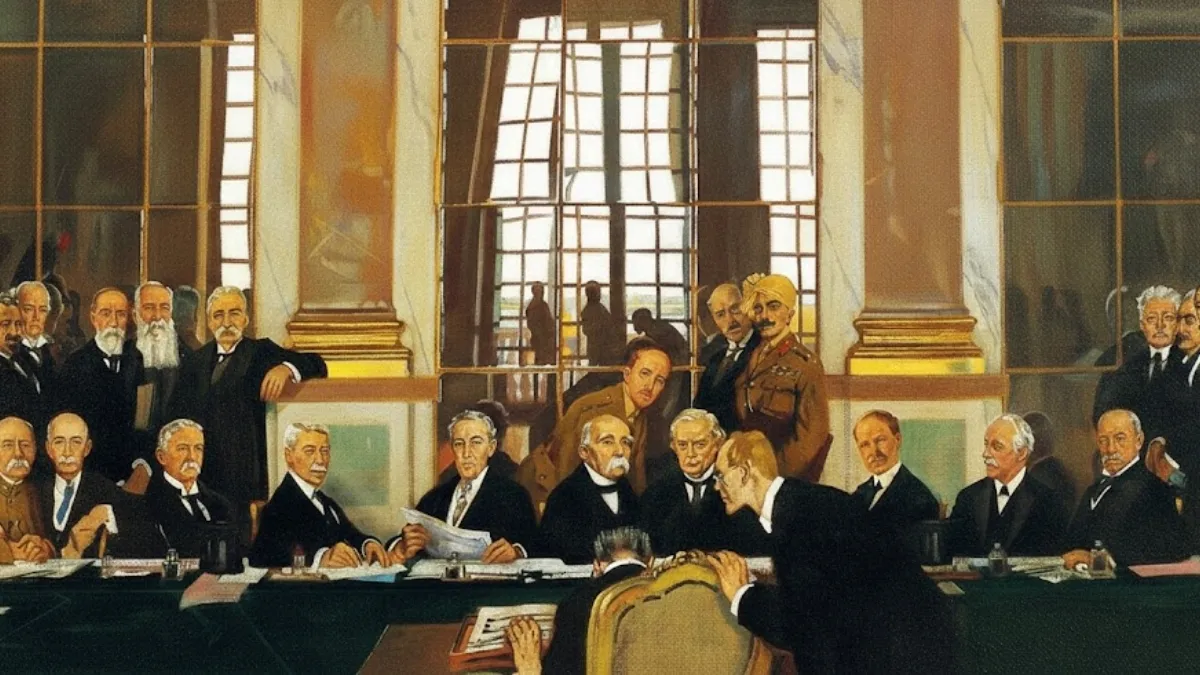
The Treaty of Versailles was the primary peace document that officially ended World War I. Signed on June 28, 1919, in the Hall of Mirrors at the Palace of Versailles, it concluded the state of war between Germany and most of the Allied Powers.
The treaty was not merely a peace agreement; it was a complex restructuring of global politics and economics. Its primary provisions included:
-
Germany was forced to accept total responsibility for causing the war under Article 231.
-
The establishment of the League of Nations, an international organization was established to resolve future disputes through diplomacy rather than conflict.
-
Drastic military limits were placed on Germany's standing forces to ensure they could not mount another offensive.
-
Military Caps: Army limited to 100,000 men.
-
No submarines, no tanks, and no air force.
-
Rhineland permanently demilitarized.
-
In the reparations Germany was ordered to pay 132 billion gold marks for war damages.
-
Territorial Losses to Germany lost 13% of its land including Alsace-Lorraine and the Polish Corridor and all overseas colonies.
-
Recognizing the rights of specific nationalities to govern themselves though this was applied inconsistently.
-
Anschluss Ban on Germany, explicitly forbidden from unifying with Austria.
The Fourteen Points Of Woodrow Wilson & Treaty of Versailles
In January 1918, U.S. President Woodrow Wilson presented his Fourteen Points to Congress to provide a moral foundation for a lasting peace that avoided the vengeful "spoils of war" mentality typical of European diplomacy.
However by the time of the 1919 Paris Peace Conference, Wilson faced intense pressure from Allied leaders like France’s Georges Clemenceau who had suffered massive casualties and wanted to ensure Germany could never threaten them again.
Consequently, the final Treaty of Versailles focused far more on punishing Germany than on Wilson’s idealistic framework.
-
No more secret treaties; diplomacy to be conducted in public.
-
Navigational freedom for all ships in peace and war.
-
Removal of economic barriers and equality of trade conditions.
-
National armaments to be reduced to the lowest point consistent with domestic safety.
-
Impartial adjustment of colonial claims, giving weight to the interests of the native populations.
-
Evacuation of all Russian territory and the opportunity for Russia to determine its own political development.
-
Restoration of Belgian sovereignty.
-
Liberation of French territory and return of Alsace-Lorraine.
-
Readjustment of Italian borders along clear lines of nationality.
-
Autonomous development for the peoples of Austria-Hungary.
-
Evacuation of Romania, Serbia, and Montenegro; secure access to the sea for Serbia.
-
Sovereignty for Turkish portions; autonomous development for other nationalities under Ottoman rule.
-
An independent Polish state with secure access to the sea.
-
Formation of an international association to guarantee political independence and territorial integrity for all nations known as League of Nations
The Impact on Germany: Implementation and Penalties
The implementation of the treaty had devastating consequences for the German state, categorized into three major areas, territorial losses Germany’s borders were aggressively redrawn. Notable changes included. Alsace-Lorraine was returned to France.
The "Polish Corridor" West Prussia and Posen was ceded to the new Polish state, cutting off East Prussia from the rest of Germany. Danzig was declared a "free city." and All overseas colonies and investments were confiscated.
Germany was ordered to pay a staggering 132 billion gold marks ( $269 billion today) in gold and goods. This burden crippled the already weakened German economy, leading to hyperinflation and eventual default in 1923 which prompted the French occupation of the Ruhr.
Military Restrictions on Germany to ensure security which was effectively dismantled. The army was capped at 100,000 men. The air force was completely prohibited. Conscription was abolished. The Rhineland became a demilitarized zone occupied by Allied troops.
The German population viewed the Treaty of Versailles as a "Diktat", a dictated peace. They were excluded from negotiations and forced to sign under the threat of renewed invasion. This sense of national humiliation and economic despair became a breeding ground for radicalism, ultimately contributing to the grievances that led to the outbreak of World War II.



-1771598712303_t.webp)

Comments
All Comments (0)
Join the conversation