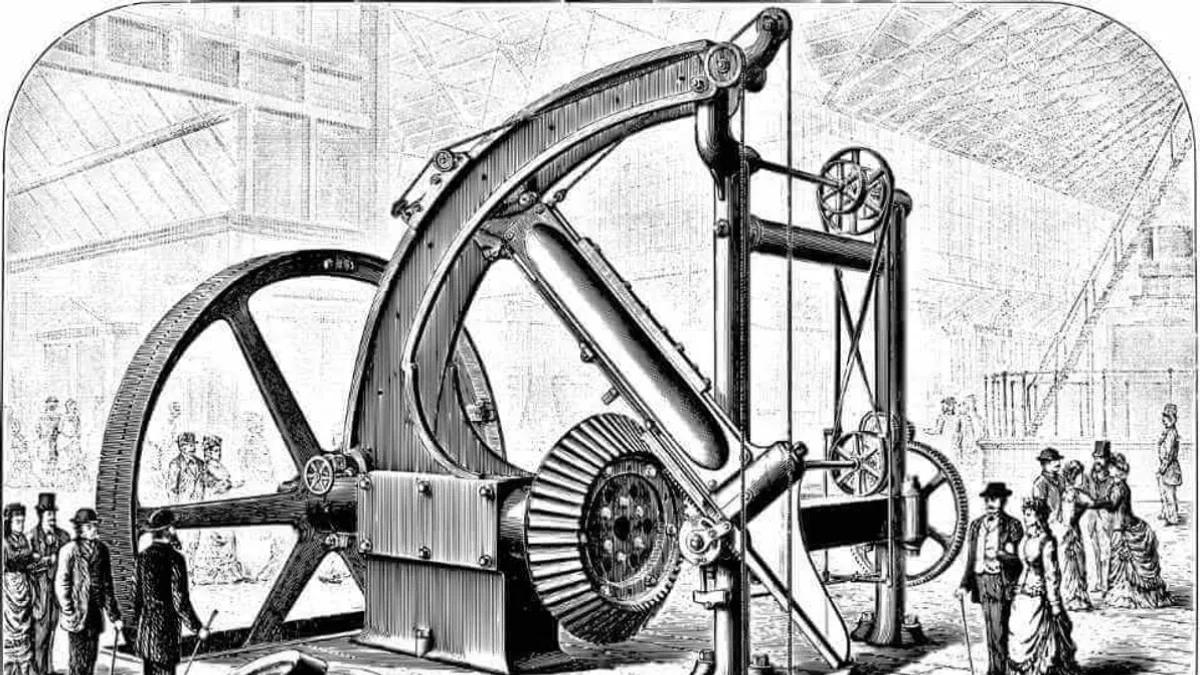
The Industrial Revolution was a fundamental transformation in manual work and agrarian societies into a machine-driven production and industrial sector and started in Britain around 1760 and continued into the 1840s. This period formed the foundation of modern industry, urbanization and economic dominance of the industrialized countries over the world.
The Industrial Revolution revolutionized the world order by bringing about power-driven machines to the world, which essentially altered the way goods are produced, as well as the way societies are organized.
It began in Great Britain in the mid 18th century, circa 1760-1840, due to the inventions of textiles, iron and steam power and was followed by other parts of Europe, North America and further on.
What were the Main Characteristics of the Industrial Revolution?
The factory system was one of their main characteristics, as workers worked in centralized factories pushed by water, steam and then electricity.
This First Industrial Revolution differed with the previous Agricultural Revolution that had increased population and supply of labor. Another Second phase followed circa 1870-1914, which targeted steel, chemicals and electricity.
Its legacy continues in the current digital and automated economies which have been likened to the current fourth industrial revolution that incorporates AI and robotics.
What were the Origins and Causes of the Industrial Revolution?
A number of factors which were interwoven led to Industrial Revolution in Britain and it was the epicentre and not other European powers.
Plentiful natural resources such as coal and iron ore served to power their energy, and the Agricultural Revolution (1700s) provided more productive farm work, forcing the laborers out of the fields and into factory jobs.
The political stability of Britain, such as parliamentary stability and property rights, stimulated investment and innovation; the raw materials (e.g. cotton in India/America) and markets were offered in the colonial empire.
Increase in population of 6.5 million in the 1750s to 21 million in 1851 provided ready workers.
The trade and banking generated capital accumulation and allowed a culture of scientific inquiry (e.g., Royal Society) to allow inventions to be scaled by entrepreneurs such as Richard Arkwright.
What were the Key Inventions?
Production was transformed by inventions, beginning with textiles with a rise in the volumes of cotton imports in Britain due to mechanized spinning and weaving. James Hargreaves' Spinning Jenny (1764) enabled one person to spin several threads, and Richard Arkwright Water Frame (1769) used water power to spin more powerful yarn, the first factories.
The advancements of James Watt (1769-1780s), which made steam engines dependable on rivers, made factories available in any location and drove locomotives/ships. The 1856 converter of Henry Bessemer produced inexpensive steel to use in railways and machines; the Second phase was characterized by the invention of an electric bulb (1879) by Thomas Edison and an internal combustion engine (late 1800s).
What were the Major Impacts of this Revolution?
It triggered unparalleled economic expansion: the GDP per capita in Britain increased twofold 1800-1850; factories, which allowed mass production, reduced prices and enlarged trade. There was an urbanization boom--Manchester, which had 10,000 people in 1717, had 300,000 people in 1850.
On the social level, it established a new working population that had to work 14-hour shifts, child labor (5-10% of the working population), slums, which led to such reforms as the 1833 Factory Act. Women gained mass entry into the labour force; middle classes grew through business/trades.
Coal burning led to pollution (London fogs) environmentally, as well as speeded up imperialism due to the resources worldwide.
Diffusion Britain Britain was diffused through technology transfer and migration: Belgium (first-1810s coal/iron); France/Germany (first-1830s); US Northeast (first-1820s Lowell mills).
It was not implemented in Russia until the 1860s; the Meiji Restoration (1868) in Japan quickly became industrialized.
India was de-industrialized as machine-made textiles of British origin replaced handlooms making it the supplier of raw cotton. In 1900, the US was at the forefront in steel/oil production.
Legacy Today
Capitalism, labor laws and technological advancement were born as a result of the Revolution, as was inequality and environmental pressure--lessons to be learned in the current climate crises. It evokes the Industry 4.0 discussions of robots replacing work, Luddite-like heights.
Contemporary analogs are the globalization of supply chains and the shift to renewable energy, which is similar to the role of the steam.
Know More: Longest Road Networks in World.



Comments
All Comments (0)
Join the conversation