The majority mark in assembly elections under the Indian parliamentary system is the minimum number of seats that a party or coalition has to win in order to form a government. This number is often called the "magic number" in political reporting. It makes sure that the government which is in power has a majority of over half the members of the Legislative Assembly.
What is the Majority Mark in Assembly Elections?
The majority mark is the mark at which a party will have the absolute control of the legislative process. The Constitution of India stipulates that a government has to enjoy the support of the House to stay in power. This confidence is determined by a floor test.
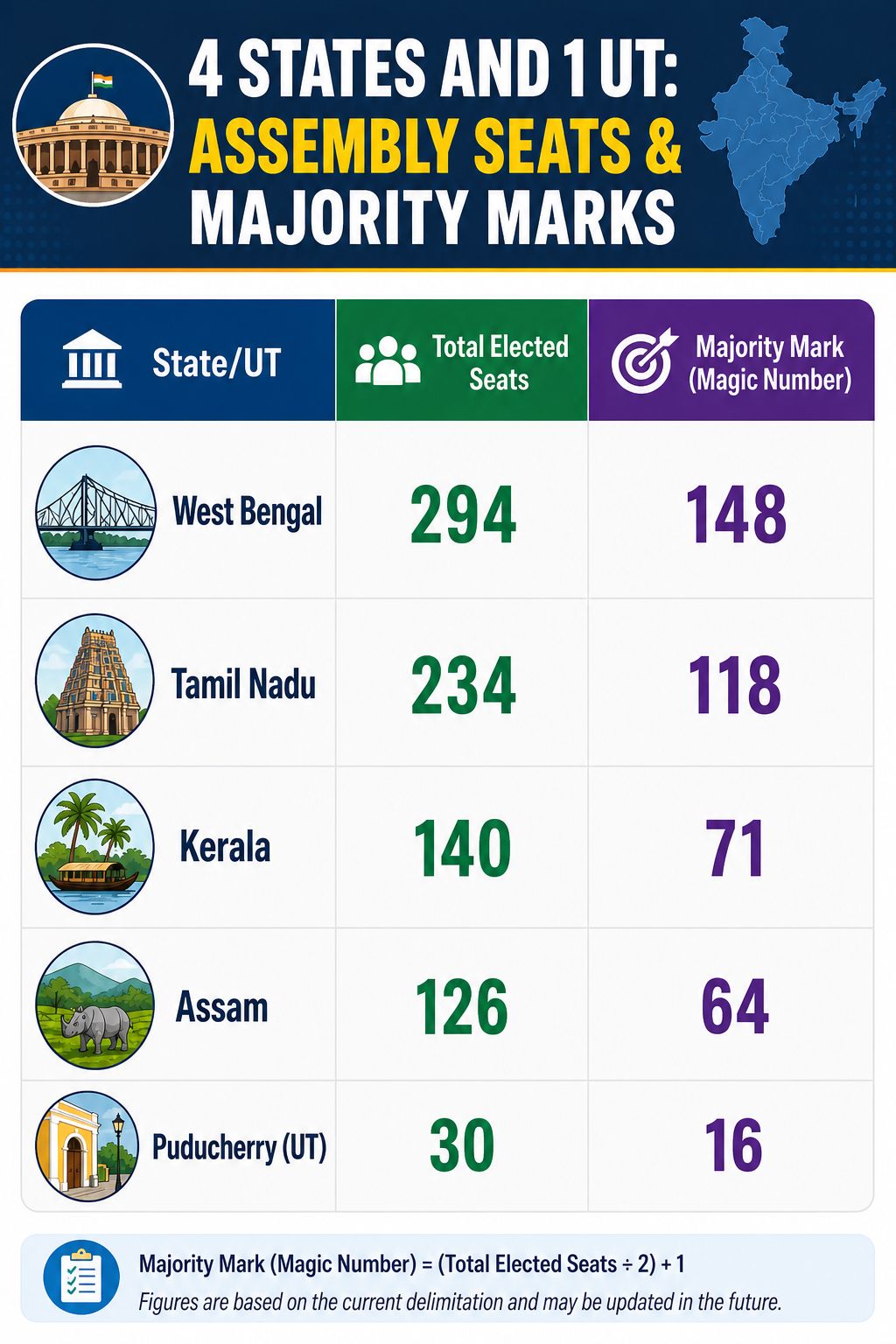
The formula for the majority mark is (Total Elected Seats / 2) + 1. When the total number of seats is an odd number, the answer is rounded up to the next whole number. An example for that is an assembly having 243 seats, the half-way mark is 121.5 and therefore the majority mark is 122. The Governor will ask the leader of the single largest party or the largest pre-poll alliance to demonstrate their majority in case no single party is able to reach this mark.
Constitutional Significance of the Majority
Article 170 of the Indian Constitution provides the composition of the Legislative Assemblies. According to it, the number of members in an assembly must not exceed 500 nor be less than 60. There are exemptions in the case of smaller states such as Sikkim and Goa.
When none of the parties attains the majority mark, then we have a Hung Assembly. The Governor plays a crucial role in such situations to determine who is granted the initial chance to establish a coalition government.
Quick Facts
1. A Legislative Assembly has a term of 5 years except when it is dissolved before its term.
2. Most of them indicate changes in case seats become vacant as a result of resignations or deaths.
3. A "Simple Majority" refers to more than 50% of the members present and voting.
4. An "Absolute Majority" refers to more than 50% of the total strength of the house.
Majority Mark or Magic Number for West Bengal
West Bengal is one of the states in India that have the largest legislative assembly. The state is divided into 294 constituencies. Each constituency has one Member of the Legislative Assembly (MLA) who is elected directly by the citizens of the constituency.
It requires a party to have 148 seats to form a government in West Bengal. This figure gives the government a clear mandate to enact bills and budgets.
ALSO READ
List of Chief Ministers of West Bengal (1947-2026)
Majority Mark or Magic Number for Tamil Nadu
Tamil Nadu has a unicameral legislature of 234 elected members. The majority mark in assembly elections in Tamil Nadu is 118. Stability in politics in this state has always been based on the good regional associations that have reached this mark.
ALSO READ:
List of all Chief Ministers of Tamil Nadu (1952-2026)
Majority Mark or Magic Number for Kerala
There are 140 elected seats in the Legislative Assembly of Kerala. The majority mark for Kerala is 71. Kerala is unlike most other states in that it has had a long history of coalition politics in which two major fronts compete to cross this 71-seat threshold.
ALSO READ
List of all Chief Ministers of Kerala (1957-2026)
Majority Mark or Magic Number for Assam
There are 126 assembly seats in Assam. A party or coalition needs 64 seats to form the government in Dispur. The delimitation process may occasionally alter the boundaries of the constituencies, but the overall number of seats does not change until the next official revision.
ALSO READ
List of all Chief Ministers of Assam (1937-2026)
Majority Mark or Magic Number for Puducherry
Puducherry is a Union Territory that has a special arrangement. It has 30 elected seats. The 16 is the majority mark of the elected members. Nonetheless, the central government has the mandate of nominating 3 more members to the assembly. Although these nominated members may vote on some of the issues, the magic number of a general majority is normally calculated using the number of 30 elected members.
What happens if a party falls one seat short of the majority?
In case one party fails, it has to turn to the aid of independent candidates or other minor parties. They also create a coalition to achieve the necessary majority level in the assembly elections.
Does the Speaker of the House count toward the majority?
The Speaker is an elected MLA and is part of the total strength. The Speaker however just tends to vote in case of a tie. This is referred to as a "Casting Vote."
Can nominated members help form a government?
Nominated members have long been involved in confidence motions in Union Territories such as Puducherry. The 104th Constitutional Amendment Act repealed the provision of nominating Anglo-Indian members in the states.
Check out some more interesting articles from the general knowledge section to boost your knowledge of national and international topics. Stay connected with Jagran Josh for more topics like this.
ALSO READ
Who are the Chief Electoral Officers of Assam, Tamil Nadu, Kerala, and Puducherry?