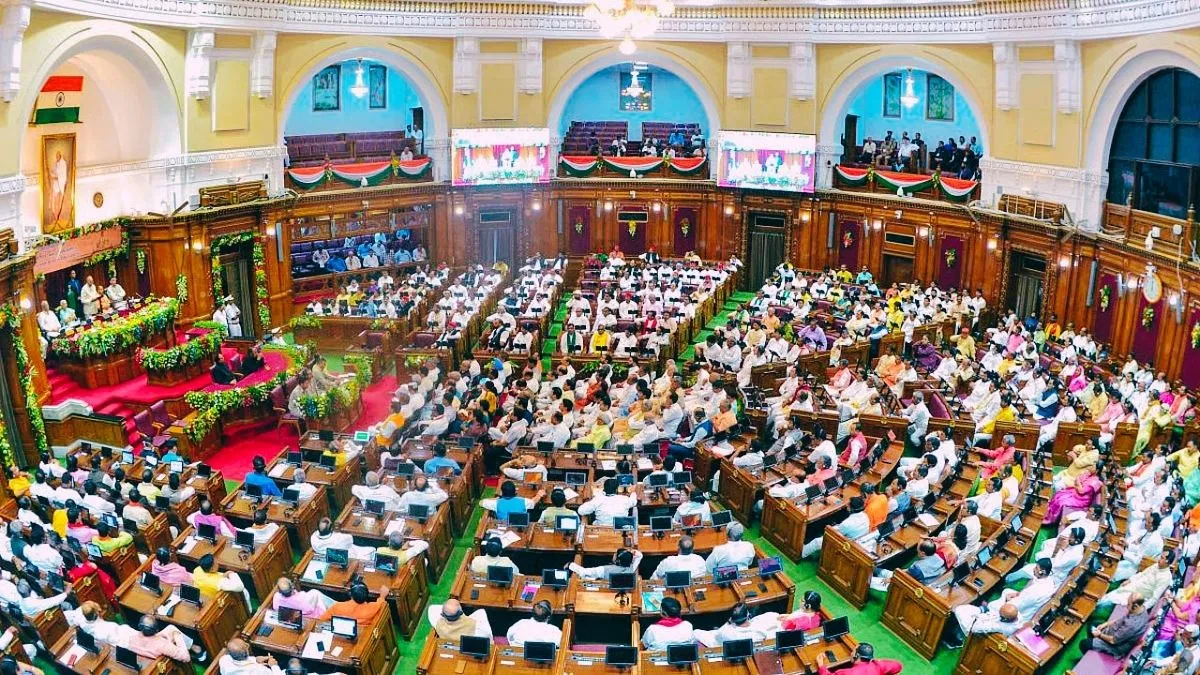
Vidhan Sabha is the Lower House of the State Legislature of India, consisting of elected lawmakers who pass legislation for their respective state legislatures.
The Vidhan Sabha acts in conjunction with the Governor in executing day-to-day activities of the state government concerning education, healthcare, and transportation.
The institution allows the common citizen to participate directly in decision-making in matters pertaining to their locality via their MLAs.
According to the figures released by the Election Commission of India for the year 2026, there are over 4,120 MLAs currently in service in all Indian states combined.
The federal nature of the Indian Constitution ensures that the Vidhan Sabha manages all the affairs of the particular state.
What is the State Legislative Assembly in India?
In India, the State Legislative Assembly serves as the primary legislative wing in each state known as Vidhan Sabha, comprising MLAs elected by citizens to speak on their behalf.
It forms the backbone of state administration as per Article 168 of the Constitution. While most Indian states comprise the unicameral assembly alone, six states have another upper house as well. The term of the members lasts five years, barring any premature dissolution.
The legislative wing convenes in a magnificent hall where discussion determines state policies.
Key Features of State Legislative Assembly in India
Key features of the State Legislative Assembly in India include direct elections, a Speaker as leader, and a maximum of 500 MLAs per state.
Members are elected from constituencies via adult suffrage. The Governor summons sessions, and the Speaker maintains order. Sessions include Question Hour for public issues.
Quorum is one-tenth of members. Bills need a simple majority to pass. Anti-defection laws keep MLAs loyal to their parties.
Functions of State Legislative Assembly in India
Functions of the State Legislative Assembly in India cover making laws, approving budgets, and overseeing the state government.
It passes bills on state subjects like agriculture and police. Money bills start here, controlling state funds. It can question ministers and pass no-confidence motions.
The assembly ratifies ordinances and amends state laws. Committees review bills deeply. This ensures checks on executive power
It debates policies and represents voter voices. Annual budgets get line-by-line scrutiny here.
How many State Legislative Assembly are there in India?
India has 28 State Legislative Assemblies, one in each state, plus three in union territories like Delhi, Puducherry, and Jammu & Kashmir.
As of 2026, all states except those with councils have unicameral setups. Bicameral states like Uttar Pradesh and Bihar still have assemblies as the powerful lower house. The total reflects India's 28 states post-reorganization.
Each assembly size varies: Uttar Pradesh has 403 MLAs, while smaller states like Sikkim have 32. Elections happen every five years.
Delhi's assembly, for example, has 70 seats. This structure balances big and small states.
The State Legislative Assembly in India empowers locals through elected MLAs who craft state laws and budgets. It's the heartbeat of state democracy, ensuring voices from villages to cities shape governance. Understanding Vidhan Sabha helps you value India's federal system.