National Awards for e-Governance 2026
How Many Projects Are Selected for the National Awards for e-Governance 2026? Explore 17 winning projects, categories, awards, and initiatives.
National Awards for e-Governance (NAeG) are presented every year by the Union Government of India to recognise and promote excellence in the implementation of e-Governance initiatives. This year, in 2026, there are 17 projects from Central, State, and Local governments selected across the country.
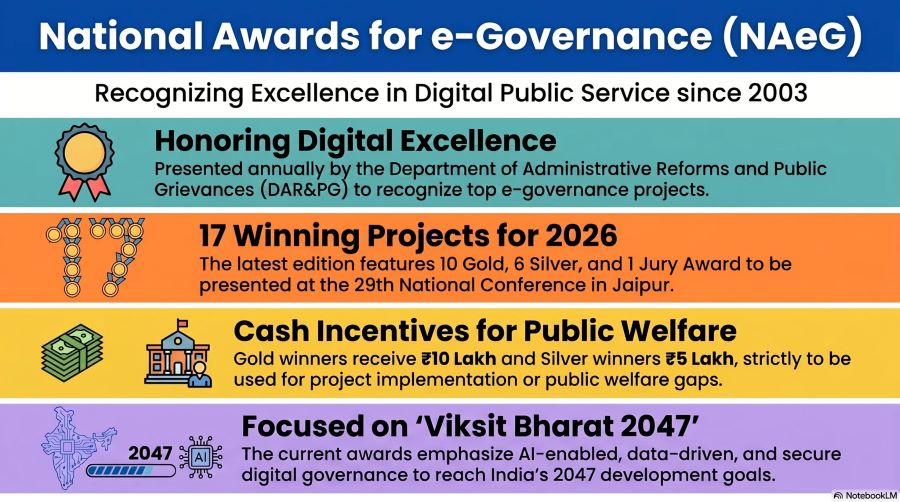
The 29th e-Governance award is given every year to encourage and honour good practice in the country, and this year it will be given on July 1-2, 2026, in Jaipur, Rajasthan, and the theme of this year is “Viksit Bharat 2047: AI-Enabled, Data-Driven and Secure Digital Governance”.
So, let’s explore the complete details about the National Awards for e-Governance (NAeG) 2026.
What are the National Awards for e-Governance?
The National Awards for e-Governance are one of the most important government recognitions in the field of digital governance in India.
These awards are awarded to government departments, ministries, local bodies and organisations for leveraging technology to provide better services to citizens.
The primary principle behind these awards is very straightforward: more government to go digital, making public services quicker, easier and more transparent.
With India's increasing emphasis on the Digital India initiative and technology in governance, this year is the 29th year of the awards, which has become a tradition.
How Many Projects Are Selected for the National Awards for e-Governance 2026?
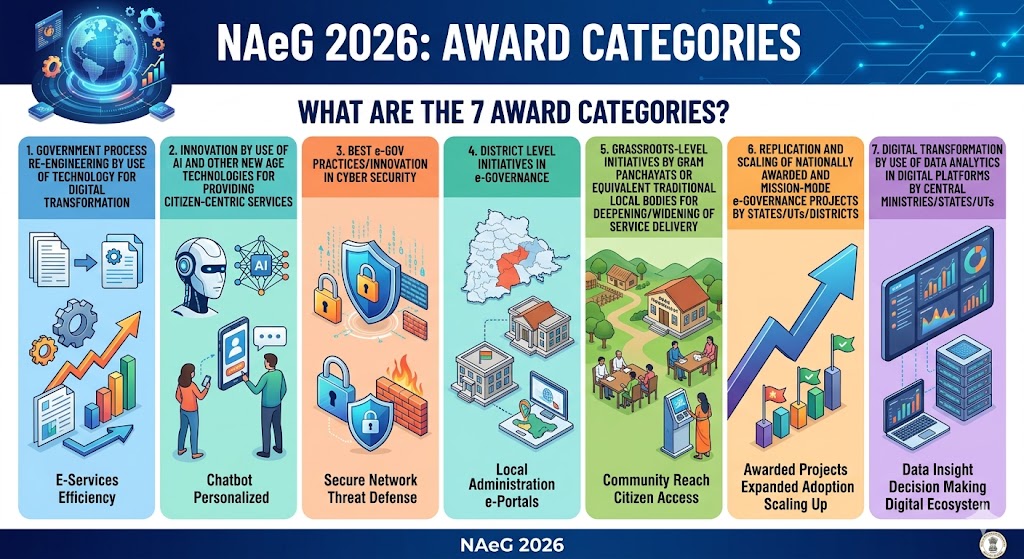
17 Projects/ Initiatives selected for the National Awards for e-Governance 2026 across 7 Award categories🏆
— PIB India (@PIB_India) June 4, 2026
🥇10 Gold Awards, 🥈6 Silver Awards and 1 Jury award to recognise exemplary contributions in e-Governance#NAeG pic.twitter.com/NANI4hGSf0
There are a total of 17 projects and initiatives that have been selected across 7 award categories. Out of these, 10 Gold Awards and 6 Silver Awards have been announced. In addition, one jury award has also been given.
The prize money attached to each award makes it meaningful beyond just recognition. Gold Awardees receive a cash incentive of Rs 10 lakh, while Silver Awardees receive Rs 5 lakh, along with a Trophy and Certificate.
This amount is to be used for the implementation of the project or for bridging resource gaps in any area of public welfare.
National Awards for e-Governance (NAeG) 2026 Winners
| S. No | Name of the Project | Organisation Name |
| 1. | Agri Stack | Ministry of Agriculture & Farmers Welfare |
| 2. | e-jagriti | Ministry of Consumer Affairs |
| 3. | Mahakumbh 2025 | Prayagraj Mela Authority, Prayagraj, Uttar Pradesh |
| 4. | Blood Bag Traceability and Citizen Interaction portal for promoting speedy, safe and voluntary blood donation | Kerala Development and Innovation Strategic Council (K-DISC) |
| 5. | AI-enabled Clinical Decision Support system in eSanjeevani telemedicine service | Ministry of Health and Family Welfare |
| 6. | District Court Case Management System (DCMS) | High Court of Kerala |
| 7. | ICMR’s Multistate Implementation Research Study on Integration of Screening and Management of Mental and Substance Use Disorders with other Non-Communicable Diseases (ICMR-MINDS) | Indian Council of Medical Research (ICMR) |
| 8. | Security Product for Threat Intel Distribution and DNS Filtering Service | Space Application Centre-ISRO, Ahmedabad |
| 9. | E Nagar Palika with cyber security | Urban Development and Housing Department M.P. |
| 10. | Integrated Cyber Security framework for a resilient Digital Banking Ecosystem | Bank of Baroda |
| 11. | E – Aarogya Dhamni – Transforming Healthcare through E - Governance | Health Department, Zilla Parishad, Nandurbar, Maharashtra |
| 12. | Pune 360 | Pune Municipal Commission, Maharashtra |
| 13. | Kadepur Gram Panchayat | Sangli District, Maharashtra |
| 14. | Bijoy Nagar Gram Panchayat | West Tripura District, Tripura |
| 15. | TRINETRA – AI based Video Surveillance system for Mahakal Rudrasagar Integrated Development Area (MRIDA) including Mahakaleshwar Temple | Mahakaleshwar Temple Trust, Samrat Vikramaditya Prashasnik Sankul Bhawan, Ujjain |
| 16. | Panchayat Advancement Index - Data Driven Governance for Viksit Bharat | Ministry of Panchayati Raj |
| 17.(Jury) | Real Time Precise Positioning Services through CORS Network | Survey of India |
Source: PIB
Source: AI
Notable Gold Award Winners
| Project / Initiative | Developing Organization / Ministry | Sector / Domain |
| Agri Stack | Ministry of Agriculture and Farmers Welfare | Agriculture |
| e-Jagriti Platform | Ministry of Consumer Affairs | Consumer Affairs |
| Mahakumbh 2025 Initiative | Prayagraj Mela Authority, Uttar Pradesh | Event Management / Digital Management |
| AI-enabled Clinical Decision Support System (integrated into eSanjeevani) | Ministry of Health and Family Welfare | Healthcare / Telemedicine |
| Blood Bag Traceability and Citizen Interaction Portal | Kerala Development and Innovation Strategic Council (K-DISC) | Healthcare / Public Health |
| Integrated Cyber Security Framework for a Resilient Digital Banking Ecosystem | Bank of Baroda | Cyber Security / Banking |
| Security Product for Threat Intel Distribution and DNS Filtering Service | Space Application Centre (ISRO, Ahmedabad) | Cyber Security / Space & Tech |
How is Gram Panchayat-Level Recognised in National Awards for e-Governance 2026?
One of the most notable features of NAeG 2026 is that it includes a dedicated category for gram panchayats. The 29th NAeG 2026 awardees include the Gram Panchayats category, recognising deepening and widening of service delivery at grassroots level through digitisation. This year, Kadepur Gram Panchayat from Sangli District, Maharashtra, and Bijoy Nagar Gram Panchayat from West Tripura District, Tripura, have been selected among the awardees.
This reflects the government's push to ensure that digital governance is not limited to big cities but reaches the village level as well.
The Jury Award
The Jury Award for NAeG 2026 has been given to the Survey of India for its Real Time Precise Positioning Services through CORS (Continuously Operating Reference Stations) Network.
This project provides highly accurate location data in real time, which has wide applications in mapping, infrastructure planning, and disaster management.
Source: notebooklm
What is e-governance?
E-governance, also known as 'electronic governance', is the use of digital technologies, like the internet and other Information and Communication Technology (ICT) tools, by governments to provide public services, information and communication, conduct transactions and facilitate active citizen participation in governance.
To enhance transparency, accountability and responsiveness is the most important aim of e-governance.
Evolution of E-Governance in India
India’s transition into a digital-first nation has been a journey spanning over five decades. This evolution can be broken down into four distinct phases: foundational computerisation, systematic planning, widespread digital transformation, and current structural challenges.
1. Establishment of E-Governance in India (1970s–1990s)
-
Early Computerisation (1970s): The concepts of digital governance started with the introduction of computers into the government offices to automate basic administrative works.
-
Institutional Infrastructure (1976): The National Informatics Centre (NIC) was established, providing technical support to gradually include Information and Communication Technology (ICT) in public administration.
-
Networking and Automation (1980s–1990s): Government processes were increasingly automated, and government buildings were also linked to each other over early networks to enhance internal efficiency.
2. Systematic Planning & Local Access (2000s)
-
The NeGP Milestone (2006): The National e-Governance Plan (NeGP) was launched, moving from automation to a strategic and citizen-centric approach.
-
Common Service Centers (CSCs): One of the key achievements of this period was the establishment of Common Service Centers (CSCs). These physical hubs served as a crucial link for rural communities, offering them access to vital digital services.
3. Mass Scale and Digital Empowerment (2010s–Present)
With the introduction of the Digital India Mission, the governance system in the country has undergone a complete transformation with the infrastructure being scaled up and absolute transparency being the agenda:
-
Streamlined Welfare: The world's largest biometric identification platform was introduced, revolutionizing the distribution of public welfare, greatly reducing leakages and corruption.
-
Unified Access: Platforms such as UMANG brought hundreds of services that government provides to one window in the citizens' mobile phones.
-
Efficiency and Transparency: Digital systems like GeM (Government e-Marketplace) cleaned up public procurement, while initiatives like e-Office and e-Courts automated internal workflows and judicial tracking.
What are the current challenges in e-governance?
Even after the vast progress, there are still many current challenges in e-governance, which are:
-
Inadequate Digital Literacy: As infrastructure becomes more advanced, digital literacy is not. As per the State of India's Digital Economy (SIDE) Report 2025, India is at the 28th position in the world for per capita digitalisation.
-
Security and Privacy: With the transfer of large quantities of sensitive citizen records, data protection and strong cybersecurity are a key priority.
Way Forward
In the future, India's journey toward digital transformation will depend on a comprehensive strategy that prioritises access to high-speed internet connectivity, accessibility of affordable digital devices, and robust protection of user privacy.

He has contributed to top platforms like Mentorship India, IAS BABA, and IAS SARTHI, delivering engaging articles on trending topics and global affairs. As a content writer for Jagranjosh.com, Prabhat specializes in crafting high-quality, insightful content for the G.K. and Current Affairs section, driving engagement and providing value to a wide audience.
Reach him at prabhat.mishra@jagrannewmedia.com, and explore his work on Jagranjosh.com for the latest updates and analyses!

-1780829029616_t.webp)

-1780818971806_t.webp)