Grey Zone Warfare: Definition, Tactics, and Why It Threatens Global Security
Grey Zone Warfare involves non-military tactics like cyberattacks and economic sanctions, operating between peace and conventional war to gain advantage without direct conflict.
Modern international conflict have changed. There are no longer ordinary conflicts taking place on battlefields with tanks and airplanes. Nowadays, countries are using various non-military tactics like cyber attacks and economic sanctions for obtaining an advantage over their opponents.
What is Grey Zone Warfare?
Grey Zone Warfare is a method of state policies that goes along an unclear line between peaceful negotiations and conventional warfare.
This method includes different actions that are thought out in such a way that they do not encourage direct military intervention or international protests.
The main objective of this type of war is to modify the international situation in the aggressor country’s favor while keeping the responsibility “hard to be proved”.
Prominent Tactics Used in Grey Zone Warfare
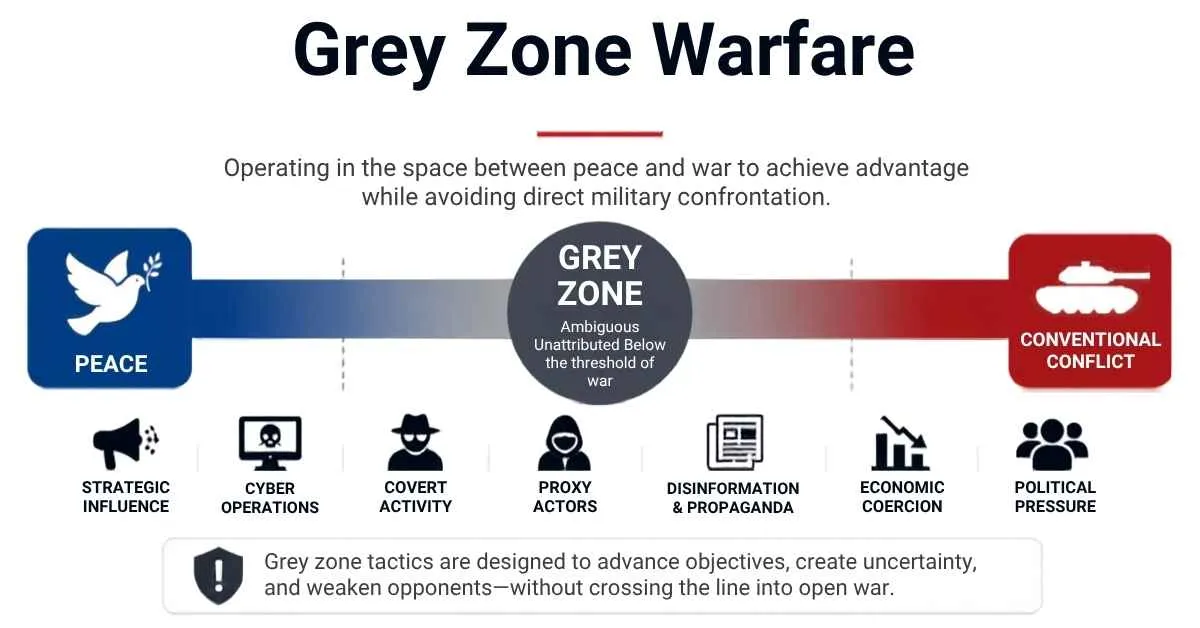
Schools often assess students on various techniques that are used in hybrid and grey zone wars. The strategies include:
-
Cyber Warfare: State-sponsored agents hack essential infrastructure (power grids, communication and financial sectors) using malware.
-
Information Warfare and Disinformation: Fake news dissemination using social media bots, state-owned media outlets and deep-fake technology to polarize societies and disrupt democratic process.
-
Lawfare: Taking advantage of international treaties and maritime law (for example, UNCLOS) to validate illegal acts of occupation.
-
Economic Coercion: Weaponising supply chains and enforcing unexpected embargoes and “debt-trap diplomacy” on small nations to attain compliance.
-
Proxy and Militia Deployments: Using non-state actors, mercenaries or maritime militia (like Concealing fishing boats) to assert territorial claims without the involvement of regular armed forces.
Examples: China’s Grey Zone Strategy and its Impact
Defense experts often look at the military activities of China along its borders to explore the functioning of grey zone warfare. They avoid direct military intervention and use multiple methods of political warfare to change the geopolitical landscape and apply pressure.
-
The Cabbage Strategy (South China Sea): Blocks rival vessels and asserts control over areas through the use of non-military vessels of the coast guard and maritime militia.
-
Taiwan Strait Pressure: Harasses Taiwan by performing military drills, sending fighter aircraft and drones without warning to decrease the morale of the Taiwanese military and exhaust their equipment.
-
Cyber Espionage and Disinformation: Uses hacking and the coordinated use of social media networks to spy and produce distrust in democracies.
-
Commander's Intent or Salami Tactics (India): Engages in marginal military action along the Himalayan borders instead of launching a full-scale invasion and builds infrastructure on new territories to create new facts on the ground.
Why is It a Threat to Global Security?
Grey zone warsare bringing a significant challenge to the globalorder based oninternationallawsdue to the following reasons:
Undermining of International Law: Grey zone warfare consists of clandestine operations carried out in the grey zone of peace and war during which revisionist states alter borders and destroy regimes while seemingly conforming to international rules of war.
Inevitability of Deterrence: Grey zone warfare reveals that the existing mutual-defense treaties and military partnerships are designed to deal with regular armed aggression and therefore are slow and ill-fitted to take efficient measures against waves of civil guerilla activities, economic pressure campaigns and cyber sabotages.
Accountability Trap: The rise of proxy wars and highly sophisticated cyber warfare systems leads to plausible deniability and diminishes the chances of global reaction by the international community in the form of sanctions or excuses.
Continuous War against Weak States: Victim states become victims of a permanent state of economic warfare and are forced to defend themselves against constant threats exhausting them permanently.

Manisha Waldia is a distinguished content strategist with 5 years of experience crafting premium educational content for UPSC and State PCS, with a focus on deep conceptual analysis across Polity, Geography, History, and Environment. She currently brings this expertise to Jagran Josh, where she covers major national and international events, current affairs, and static general knowledge. Over her career, Manisha's specialized insights have led her to curate high-impact materials and serve as a UPSC Mains answer-evaluator for India’s top institutes—including Drishti IAS, Shubhra Ranjan IAS, Study IQ, GS Score, and PWonlyIAS. She has also worked alongside leading NGOs like Oxfam India and Avani Kumaon.
Contact: manisha.waldia@jagrannewmedia.com






![[OUT] EMRS Tier 2 Result 2026 Live: Download PRT, TGT and PGT Result PDF at nests.tribal.gov.in](https://img.jagranjosh.com/images/2026/August/3182026/EMRS-Tier-2-Result-2026.jpg)