What is the Full Form of RNA? Explore its Meaning, Structure and Functions
What is the full form of RNA? Explore its meaning, single-stranded structure, functions, how it differs from DNA, its role in protein synthesis, and its vital types like mRNA.

What is the Full Form of RNA? Explore its Meaning, Structure and Functions
Key Takeaways:
-
Full form of RNA: Ribonucleic Acid
-
RNA is made of four nucleotides, A, U, C and G
-
RNA helps in making proteins inside the cell
-
RNA is mostly single-stranded, unlike DNA
-
More than 150,000 different mRNAs have been found in human cells
-
About 95 % of human genes can produce different RNAs through a process called 'alternative splicing'.
If you have ever read about cells, genes or DNA, you must have heard about RNA also. Chemically, the DNA and RNA are very similar, but they both are different in their structure and functions.
This article is based on the National Human Genome Research Institute. In this article, what RNA is, how RNA is different from DNA, how RNA is made, and the different types of RNA are given in detail.
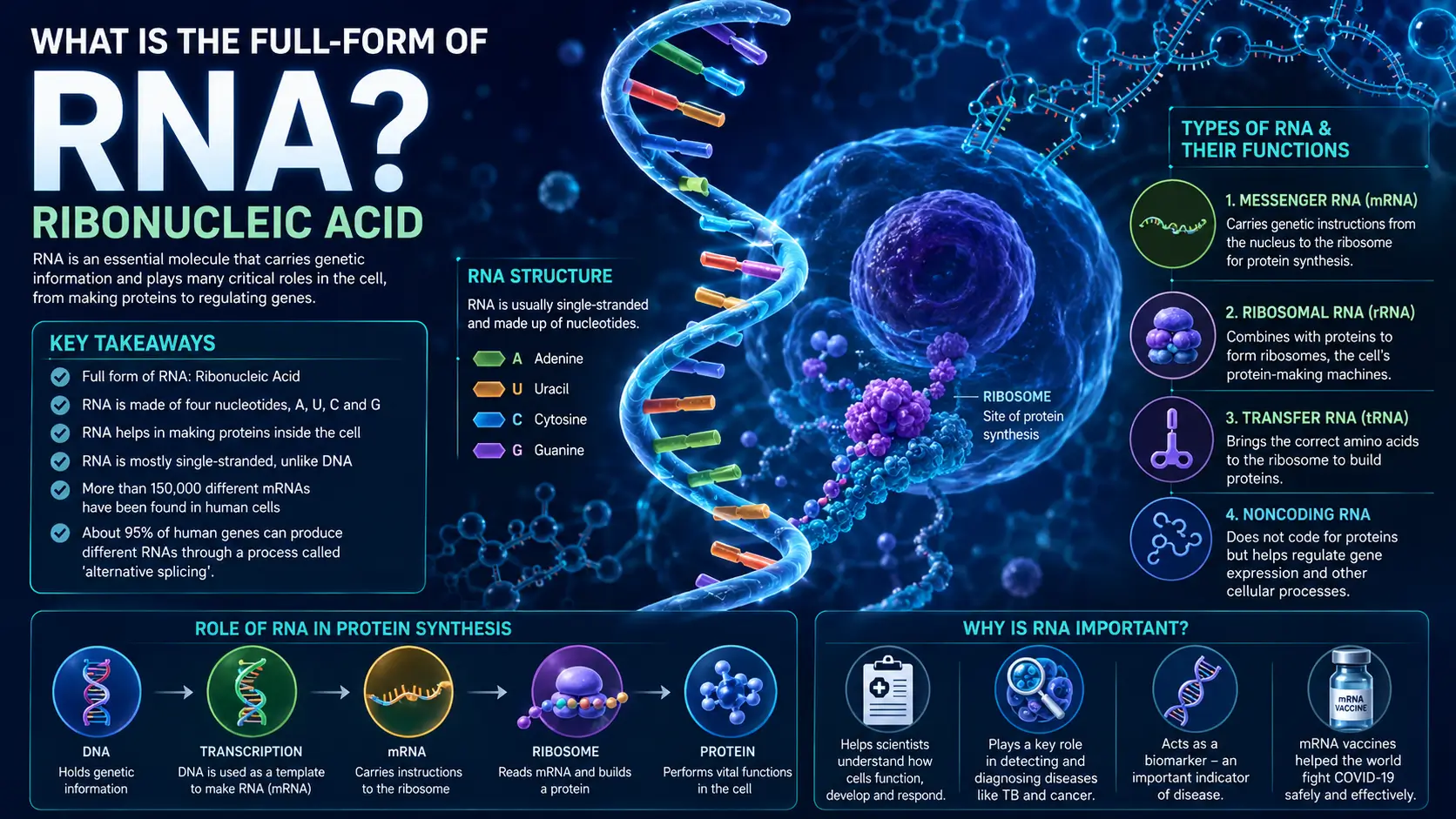
What is the Full-Form of RNA?
The full form of RNA is Ribonucleic Acid. It is one of the most important molecules found inside every living cell. It is so important that without RNA, no living being can survive, grow or make proteins.
What is RNA?
According to the National Human Genome Research Institute, “Ribonucleic acid (RNA) is an essential molecule that performs many roles in the cell, from carrying the instructions to make proteins to regulating genes.”
It is a molecule that helps in carrying information inside the cell. It performs many roles inside the body, such as carrying instructions to make proteins, giving structure to certain parts of the cell and helping in important chemical reactions.
Just like DNA, RNA is also made up of small units called nucleotides. These nucleotides join together in long chains to form RNA. All living organisms, from humans to bacteria, have RNA inside their cells.
How is RNA Different from DNA?
Both RNA and DNA are very similar, but they perform different biological functions. Both RNA, and DNA are made up of nucleotides, which are joined together in long chains.
But DNA usually has a double-stranded structure like a ladder, while RNA often has it but has a single-stranded structure.
Here is a simple comparison table to understand the difference easily.
| Aspects | DNA | RNA |
| Full Form | Deoxyribonucleic Acid | Ribonucleic Acid |
| Structure | Usually double-stranded, like a ladder | Usually single-stranded |
| Main Work | Stores genetic information | Carries and uses genetic information |
| Lifespan | Long lasting, passed from one generation to another | Short lived, often used and broken down quickly |
DNA is like a big archive where all information is safely stored, while RNA is like a photocopy of one page that is needed for a short time.
How is RNA Made?
RNA is made through a process called transcription. In RNA, there are four different types of nucleotides found, which are abbreviated by the first letters of their chemical names: A, U, C, and G, and each of these nucleotides has a complementary nucleotide, which makes the DNA strands
During this process of transcription, DNA acts like a template, and a new strand of RNA is built using this template. This RNA carries the information that was present in the DNA.
As a result, the strand of RNA carries the encoded information in the DNA, which helps in acting as the messenger for genetic codes (mRNA), building proteins (rRNA), and transporting amino acids (tRNA).
This whole process of transcription is known as 'gene expression'. According to the National Human Genome Research Institute,
"Gene expression is the process by which the information encoded in a gene is turned into a function. This mostly occurs via the transcription of RNA molecules that code for proteins or non-coding RNA molecules that serve other functions.
Gene expression be thought of as an “on/off switch” to control when and where RNA molecules and proteins are made and as a “volume control” to determine how much of those products are made. The process of gene expression is carefully regulated, changing substantially under different conditions and cell types.
The RNA and protein products of many genes serve to regulate the expression of other genes. Where, when, and how much a gene is expressed can also assessed by measuring the functional activity of a gene product or observing a phenotype associated with a gene.”
What are the Different Types of RNA and Their Work
There are many types of RNA, and each type has a special job. The main types are explained below in simple words.
1. Messenger RNA (mRNA)
mRNA carries the instructions needed to make proteins. It travels from the nucleus of the cell to a part called the ribosome, where proteins are actually built.
2. Ribosomal RNA (rRNA)
rRNA joins with proteins to form the ribosome itself. The ribosome is the cell's protein-making machine. As per NHGRI, rRNA makes up about 80 to 90 percent of all RNA found inside a human cell.
3. Transfer RNA (tRNA)
tRNA helps in bringing the correct building blocks, called amino acids, to the ribosome so that a new protein can be built correctly. Each tRNA is folded into a special L shape that helps it do its job.
4. Noncoding RNA
Apart from mRNA, many other RNAs do not carry instructions for making proteins. These are called noncoding RNA. Some examples are microRNA (miRNA), which can switch off genes, and long noncoding RNA (lncRNA), which helps in controlling how genes work.
Why is RNA Important?
Studying RNA makes the scientist know about how cells function, develop, or respond in their environment. It also plays an important role in medicine, as it includes biomarkers, or indicators of disease.
It helps the doctor to detect diseases of tuberculosis or many types of cancer, and helps them to diagnose them.
It also played a big role during the COVID-19 pandemic. The mRNA vaccines made during that time used a piece of mRNA to teach our body how to fight the virus safely.

Prabhat Mishra is a Subject Matter Expert and digital journalist with an extensive background in the competitive exam landscape and over 4 years of experience in education, national and international news, and current affairs. Over his tenure with top knowledge platforms like Mentorship India, IAS BABA, IAS SARTHI, and now Jagran Josh, he has a deep understanding of government exams like UPSC and State PCS, including UP and Bihar, as he has already qualified for the UPPCS 2022 Mains and Bihar 68th Mains. With his core expertise in history, polity, geography & current affairs, he specialises in creating well-researched, aspirant-centric content and simplifying complex topics for competitive examinations.


