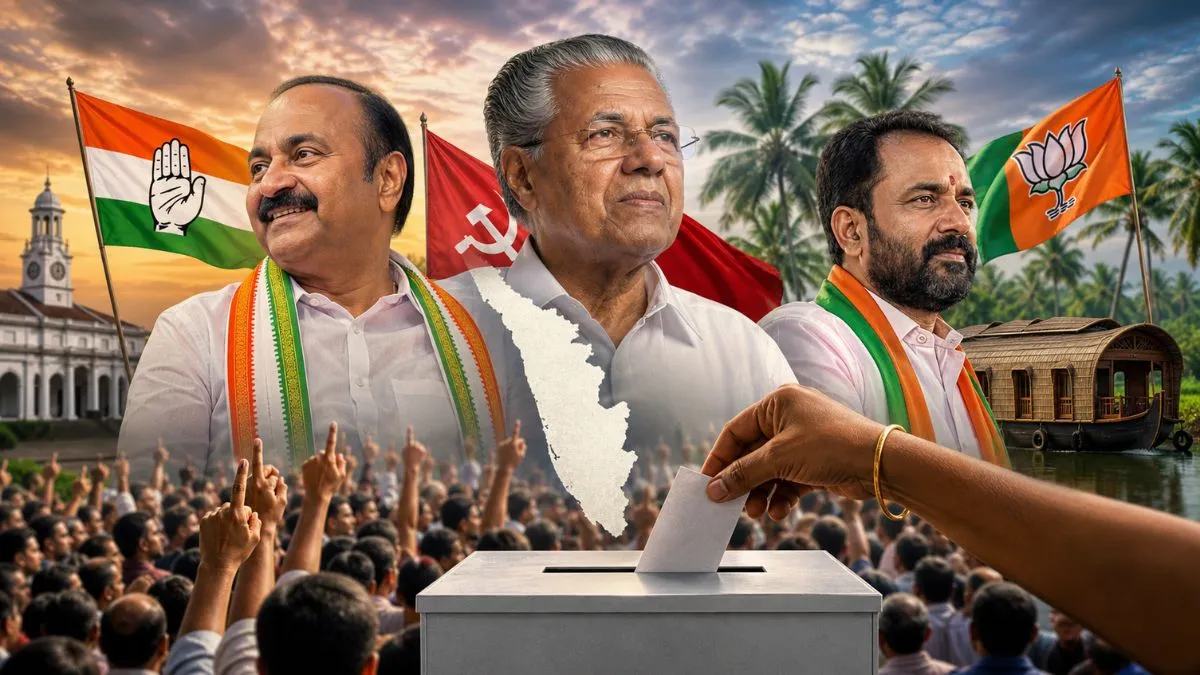
Kerala is one of India's most politically sophisticated states — a land where voter turnout routinely crosses 75%, where ideological alliances are deeply entrenched, and where for four straight decades, power alternated like clockwork between the Left Democratic Front (LDF) and the United Democratic Front (UDF). That unbroken cycle was finally shattered in 2021, when the LDF under Chief Minister Pinarayi Vijayan secured a historic back-to-back mandate.
Now, as 2.71 crore voters across 140 constituencies cast their ballots on April 9, 2026, the central question is: will the LDF extend its grip for a third term, or will the UDF claw back power in line with Kerala's classic pendulum tradition?
Quick Facts: Kerala Assembly Election 2026
| Date of Voting | April 9, 2026 |
| Result Counting Day | May 4, 2026 |
| Total Assembly Seats | 140 |
| Majority Mark | 71 seats |
| Total Registered Voters | 2.71 crore (27.1 million) |
| Nature of Contest | 3-Way: LDF vs UDF vs NDA |
| Schedule Announced | March 15, 2026 |
| Phases | Single Phase |
Why Kerala Elections Matter Beyond the State: Kerala is a testing ground for welfare-oriented governance in India. With high literacy, strong diaspora remittances, and a mature civil society, the state's electoral choices send political signals that reverberate nationally — particularly around Left politics and Congress revival.
Also Read: Kerala Exit Polls 2026: LDF vs UDF vs NDA, What Top Pollsters Say
2011 Kerala Election: UDF's Razor-Thin Victory
The 2011 Kerala election, held on April 13, 2011, with results declared on May 13, was one of the closest in the state's history. The United Democratic Front edged out the incumbent Left Democratic Front by just 4 seats — a margin so slim it was practically a statistical tie.
2011 Election Results — Seat & Vote Share Summary
| Alliance | Seats Won | Vote Share | Result |
|---|---|---|---|
| LDF (CPM-led) | 68 | ~45.6% | |
| UDF (Congress-led) | 72 | ~45.8% | WINNER |
| NDA (BJP-led) | 0 | ~6.0% |
What Happened in 2011?
The LDF had been in power since 2006 under V. S. Achuthanandan's leadership. Despite the government's welfare record, a combination of anti-incumbency sentiment and strong Congress mobilisation among minority and Christian communities swung the result narrowly in the UDF's favour. Oommen Chandy was sworn in as Chief Minister on May 18, 2011. The CPI(M) alone won 45 seats while the Indian National Congress secured 38 — the two largest individual-party tallies.
Why Did LDF Lose in 2011?
-
Internal party friction: The VS Achuthanandan government was marked by visible discord between the Chief Minister and CPI(M) central leadership, which the UDF successfully exploited.
-
UDF's united front: Congress presented a cohesive alliance, mobilising its core social coalition among Nair, Christian, and Muslim communities through IUML.
-
NDA non-factor: The BJP and NDA failed to win a single seat, confirming that right-wing politics had not yet found a foothold in Kerala's two-front structure.
| KEY INSIGHT — 2011 The margin of victory — just 4 seats out of 140 — underscores how finely balanced Kerala's electorate was. The 2011 election demonstrated that even minor shifts in voter sentiment can produce dramatically different outcomes in a two-front state like Kerala. |
2016 Kerala Election: LDF's Emphatic Comeback
Voting took place on May 16, 2016, and the results were a decisive verdict against the UDF's Oommen Chandy government. The LDF won 91 out of 140 seats — a landslide by Kerala's standards. Voter turnout was 77.35%, reflecting exceptionally high public engagement.
2016 Election Results — Seat & Vote Share Summary
| Alliance | Seats Won | Vote Share | Result |
|---|---|---|---|
| LDF (CPM-led) | 91 | ~43.4% | WINNER |
| UDF (Congress-led) | 47 | ~38.8% | |
| NDA (BJP-led) | 1 | ~14.9% |
What Happened in 2016?
Pinarayi Vijayan, the veteran CPI(M) leader, was sworn in as Chief Minister on May 25, 2016, beginning a transformative era for Left governance. The UDF was reduced to just 47 seats — a collapse of 25 from its 2011 tally of 72. In a significant political development, the BJP-led NDA opened its account in Kerala for the first time, with veteran politician O. Rajagopal winning the Nemom constituency — the first BJP MLA in Kerala's legislative history.
Why Did the UDF Lose So Badly in 2016?
-
Solar scam: Corruption allegations directly implicating the Chief Minister's Office severely dented the UDF's credibility.
-
Bar bribery controversy: Allegations of systemic bribery in liquor licensing added to the UDF's moral collapse.
-
LDF's clean slate: Pinarayi Vijayan presented a sharp, no-nonsense image untainted by UDF-era controversies — a stark contrast that resonated with voters.
-
Anti-incumbency: A decade-old tradition of voting out incumbents, combined with genuine grievance, produced an outsized seat swing.
| KEY INSIGHT — 2016 The LDF's 91-seat win was the most emphatic mandate in recent Kerala electoral history. It made Pinarayi Vijayan the undisputed dominant political figure in Kerala and set the stage for his unprecedented bid for a second consecutive term in 2021. |
2021 Kerala Election: LDF Makes History
The 2021 Kerala election, held on April 6, 2021, will be remembered as one of the most extraordinary electoral events in Kerala's post-independence history. The LDF not only retained power — it improved its tally from 91 to 99 seats, making it the first alliance to win back-to-back terms in Kerala since 1977.
2021 Election Results — Seat & Vote Share Summary
| Alliance | Seats Won | Vote Share | Result |
|---|---|---|---|
| LDF (CPM-led) | 99 | ~45.4% | WINNER |
| UDF (Congress-led) | 41 | ~41.2% | |
| NDA (BJP-led) | 0 | ~12.5% |
What Happened in 2021?
Pinarayi Vijayan became the first Chief Minister in Kerala's history to be re-elected after completing a full five-year term. His government's handling of the COVID-19 pandemic — particularly under Health Minister K. K. Shailaja, who won in Mattanur with a record 67,013-vote majority — earned widespread admiration. The UDF was reduced further to 41 seats, and the NDA suffered a humiliating reversal, losing the lone seat it had won in 2016.
BJP's high-profile candidate E. Sreedharan ('Metro Man') lost the Palakkad constituency to Congress's Shaji Parambil, encapsulating the NDA's failed gamble on a celebrity candidate to break into the mainstream.
Why Did LDF Win Again in 2021?
-
COVID-19 governance: Kerala's pandemic response — transparent data, robust healthcare, economic support — resonated powerfully with an electorate that compared the state favourably to the rest of India.
-
Welfare delivery: Flagship programmes including pension hikes, LIFE Mission housing, and free ration distribution expanded LDF's social base into previously UDF-leaning demographics.
-
Alliance arithmetic: Induction of Kerala Congress (M) under Jose K. Mani into LDF gave the front crucial access to Latin Catholic and Syrian Christian vote banks of Kottayam — traditionally UDF territory.
-
UDF's leadership vacuum: The Congress-led front struggled with fragmented leadership and failed to present a compelling counter-narrative to LDF's governance record.
| KEY INSIGHT — 2021 The 2021 result was a referendum on governance during crisis. It demonstrated that responsive welfare administration and rapid disaster response could override Kerala's traditional anti-incumbency impulse — but only under exceptional circumstances. With no comparable crisis in 2026, the structural return of anti-incumbency looms large. |
Historical Trend: Kerala Election Results (2011–2021)
The table below summarises the seat tallies of the three major alliances across three recent assembly elections, based on Election Commission of India data:
| Year | LDF Seats | UDF Seats | NDA Seats | Winner | Chief Minister |
|---|---|---|---|---|---|
| 2011 | 68 | 72 | 0 | UDF | Oommen Chandy |
| 2016 | 91 | 47 | 1 | LDF | Pinarayi Vijayan |
| 2021 | 99 | 41 | 0 | LDF | Pinarayi Vijayan |
The 'Swing State' Pattern — Broken?
For over four decades (1977–2016), Kerala followed an almost perfectly predictable pattern: whichever alliance won in election year N would lose in year N+5. LDF won in 1980, 1987, 1996, and 2006; UDF won in 1982, 1991, 2001, and 2011. This pattern was shattered in 2021 when LDF secured its second consecutive term.
| PATTERN ANALYSIS: If the alternating cycle had continued, UDF should have won in 2016. Instead, LDF won — and then won again in 2021. This two-cycle break from tradition raises the defining question of 2026: is the cycle now reasserting itself in favour of a UDF return, or has Kerala entered a new LDF-dominated era? |
Kerala Election 2026: Exit Polls & Predictions
The 2026 Kerala assembly election — voting on April 9, 2026 and counting on May 4, 2026 — is being closely watched by political analysts across India. Multiple exit polls have been released, and the consensus points to a competitive, UDF-leaning contest.
Exit Poll Comparison — All Major Agencies
| Poll Agency | UDF Seats | LDF Seats | NDA Seats |
|---|---|---|---|
| Manorama News–CVoter | 82–94 | 44–56 | 1–3 |
| Axis My India | 78–90 | 49–62 | 0–3 |
| Peoples Pulse | 75–85 | 55–65 | 0–3 |
| Today's Chanakya | 69 ± 9 | 64 ± 9 | 7 ± 4 |
Majority mark: 71 seats are needed to form a government. The UDF is projected well above this threshold by most polls.
What Do the Exit Polls Tell Us?
The clear majority of exit polls project a UDF return to power. The Manorama News–CVoter poll is the most bullish on UDF with 82–94 seats, while Today's Chanakya offers the most cautious view with a near-tie scenario (69 ± 9 UDF vs 64 ± 9 LDF).
Regionally, the UDF is expected to dominate Malappuram (14–16 of 16 seats), perform strongly in Ernakulam (12–14 of 14 seats), and make significant gains in Kasaragod. The LDF is projected to hold strength in Thrissur (9–11 seats) and Palakkad (7–9 seats).
Key Issues Driving Voter Sentiment in 2026
-
Anti-incumbency: After 10 consecutive years of LDF rule, fatigue is real. A third term would be unprecedented in modern Kerala politics.
-
Economic anxieties: High public debt, salary delays to government employees, and rising cost of living have given the UDF ammunition to attack LDF's economic record.
-
Pinarayi Factor: The Chief Minister remains a commanding figure, but allegations around the gold smuggling case and K-Rail controversy have been persistent liabilities.
-
UDF's Campaign: Led by V. D. Satheesan and backed by Rahul Gandhi's appeal, the UDF ran on an anti-incumbency platform with 'Indira guarantees' — free bus travel for women, Rs 25 lakh health insurance, senior citizens' welfare department.
-
LDF's Campaign: LDF campaigned under the slogan 'Mattarund LDF Allathe?' (Who else but LDF?), highlighting infrastructure development, social welfare programmes, and the 'Nava Kerala' vision manifesto with 950 proposals.
-
NDA Factor: BJP entered aggressively under Rajeev Chandrasekhar, with PM Modi campaigning in Kochi. Despite high hopes, exit polls suggest NDA may win only 0–7 seats, primarily in the Thiruvananthapuram district.
Who Will Win the Kerala State Assembly Election in 2026?
Based on the weight of historical data, exit poll projections, and ground-level factors, the balance of evidence strongly favours a UDF return to power in 2026. Here is why:
-
The historical pendulum is due to swing. Despite the LDF breaking the cycle in 2021, Kerala's electorate has a deep-seated tradition of power alternation. A third consecutive LDF term would be without precedent in Kerala's democratic history.
-
Exit poll consensus is clear. Every major poll agency — Manorama News, CVoter, Axis My India, Peoples Pulse, and Today's Chanakya — either projects a UDF majority or a UDF plurality. That degree of agreement across multiple methodologies carries significant predictive weight.
-
UDF's structural recovery. Under V. D. Satheesan's leadership, Congress has revitalised its cadre base since 2021. Projected dominance in Malappuram and Ernakulam speaks to structural recovery in traditional vote banks.