Bronze Age Collapse: Why did History’s Most Interconnected Empires Suddenly Vanish from Earth?
The Bronze Age collapse remains one of history’s greatest mysteries. Around 1177 BC, a catastrophic network failure brought flourishing Mediterranean empires to an abrupt end. Recent archaeological discoveries, including insights from the world's oldest graveyard sites, are shedding new light on how interconnected societies can completely disintegrate.

The modern world likes to think of itself as connected, but history shows that too much dependence on connectivity is a fatal flaw. Around 1177 BC, some sort of sudden, catastrophic network failure wiped out the prosperous empires of the Late Bronze Age civilisations all around the Mediterranean and Middle East in the blink of an eye.
New scientific data and excavations of prehistoric burial grounds, often thought to be humanity’s oldest graveyard networks, show that the Bronze Age was not the result of a single invading force.
Instead, it was an apocalyptic perfect storm of climate-driven mega-droughts, massive seismic activity, internal rebellions and sudden severing of links in international trade. Leading historians’ recent work has revealed the collapse to be a chilling historical parallel to today’s economic vulnerability.
Which Age is Known as the Bronze Age of History?
The Bronze Age marks a pivotal turn in human proto-history, spanning roughly from 3300 BC to 1200 BC. It is defined by humanity's mastery of metallurgy, specifically the creation of bronze by smelting copper and alloying it with tin. This technological leap revolutionised warfare, agriculture, and craftsmanship, shifting human communities away from the Stone Age.
Rather than existing in isolation, the prominent empires of this era built a highly globalised network. Their survival depended entirely on multi-national trade routes to secure rare raw materials like tin, which had to be transported across vast distances from places as far as modern-day Afghanistan to the shores of the Mediterranean.
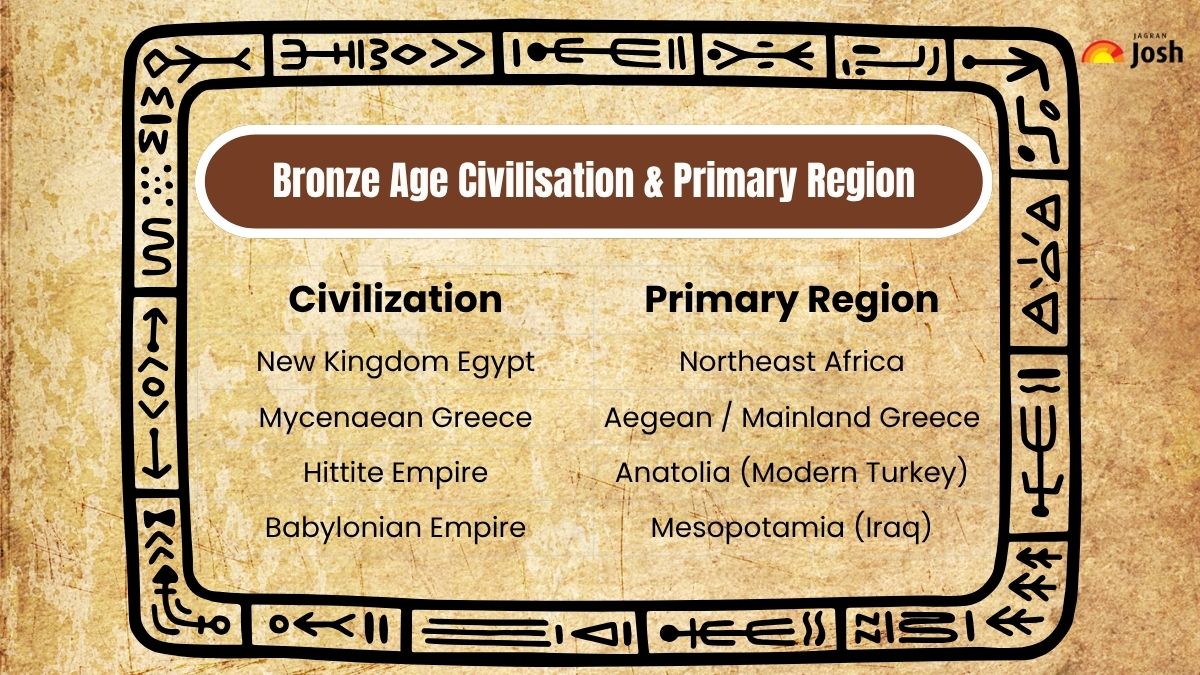
| Bronze Age Civilization | Primary Region | Major Cultural Achievement |
| New Kingdom Egypt | Northeast Africa | Monumental architecture, advanced bureaucracy, powerful standing armies. |
| Mycenaean Greece | Aegean / Mainland Greece | Palatial states, early Greek writing (Linear B), extensive maritime trade. |
| Hittite Empire | Anatolia (Modern Turkey) | Advanced iron-working precursors, chariot warfare, extensive legal codes. |
| Babylonian Empire | Mesopotamia (Iraq) | Sophisticated urban planning, mathematical astronomy, codified law. |
Why a Network Failure Caused the Bronze Age Collapse in 1177 BC
The primary catalyst for the catastrophic end of these great empires was structural vulnerability. In his definitive scholarship, 1177 BC: The Year Civilisation Collapsed, archaeologist Dr Eric Cline explains that these ancient societies were so deeply interdependent that the fall of one nation triggered a socio-economic domino effect.
1. The Severing of Trade Lines
When seafaring pirates and mysterious marauders, collectively known as the Sea Peoples, began attacking coastal ports, the supply chains for tin and copper evaporated. Without tin, weapons could not be forged, and agricultural tools could not be replaced.
2. The Environmental Crisis
Official climate data extracted from ancient pollen and sediment samples shows that a severe century-long drought struck the Mediterranean Basin around 1200 BC. This triggered widespread famine, crop failures, and mass migrations.
3. The Multitude of Disasters
Cities did not just fall to invaders. Evidence from ruined palace walls shows that an earthquake storm (a series of seismic events along fault lines) battered the Aegean and Levant simultaneously, leaving populations vulnerable to internal civil unrest and foreign incursions.
What do Prehistoric Graveyards Reveal about Ancient Civilisation Survival?
While written records from the Late Bronze Age are scarce due to the sudden loss of literacy during the collapse, modern experts are reading history directly from the earth. Archaeological excavations at complex communal burial sites and early regional graveyards are utilising advanced ancient DNA (aDNA) and isotopic tracking to rewrite what we know about human resilience during systemic failures.
By analysing the teeth and skeletal remains found in multi-generational cemeteries, scientists can map out ancient migration patterns, dietary stress, and disease outbreaks. The biological data indicate that when the major imperial trade networks dissolved, local populations suffered severe nutritional deprivation.
Strontium isotope analysis suggests that communities became extremely isolated, or alternatively, were inundated with desperate refugees escaping from famine-stricken areas. These hidden records buried in the soil show that the collapse of the Bronze Age was not just a political shift, but a deeply traumatic, multi-generational human crisis that forced survivors to abandon grand cities and return to small-scale, localised farming.
Ultimately, the sudden demise of the Bronze Age serves as a stark reminder of the fragile nature of global systems. When climate shifts, warfare, and economic disruptions collided, a highly advanced ancient world fractured into a centuries-long dark age. The tragic lessons of 1177 BC continue to echo today, proving that true societal resilience requires adaptability, diverse supply chains, and a sustainable balance with the natural environment.

Harshita Singh is an education and general knowledge journalist with over 5 years of experience in educational writing. Specializing in US affairs and GK, Harshita has a track record of breaking down intricate geopolitical and historical subjects into clear, digestible insights for learners. Her strong background in text analysis, coupled with a Bachelor of Arts (Hons) in English from the University of Delhi, helps her produce authoritative, thoroughly researched content that empowers readers to engage confidently with global current affairs. For inquiries or academic insights, you can reach out to her directly at harshita.singh@jagrannewmedia.com.


