The Hashemite Kingdom of Jordan is a small country with few natural resources, but it has played a pivotal role in the struggle for power in the Middle East. It is a key ally of the United States.
After the Arab revolt against the Ottomans in 1916 during World War One, the region was partitioned by Britain and France, with the Emirate of Transjordan established in 1921 and becoming a British protectorate. Jordan became independent in 1946.
In this article, we will explore the HASHEMITE KINGDOM OF JORDAN facts, bordering countries, its geographical landscape, the Jordan Rift Valley, the mountains, and the major cities of Jordan.
HASHEMITE KINGDOM OF JORDAN: FACTS
| Aspects | Facts |
| Official Name | Hashemite Kingdom of Jordan |
| Capital | Amman |
| Area | 89,342 sq km |
| Population | 11.5 million |
| Language | Arabic |
| Main Religion | Islam |
| Major Country Population | Sunni Muslim (about 97%) |
Source: nationsonline
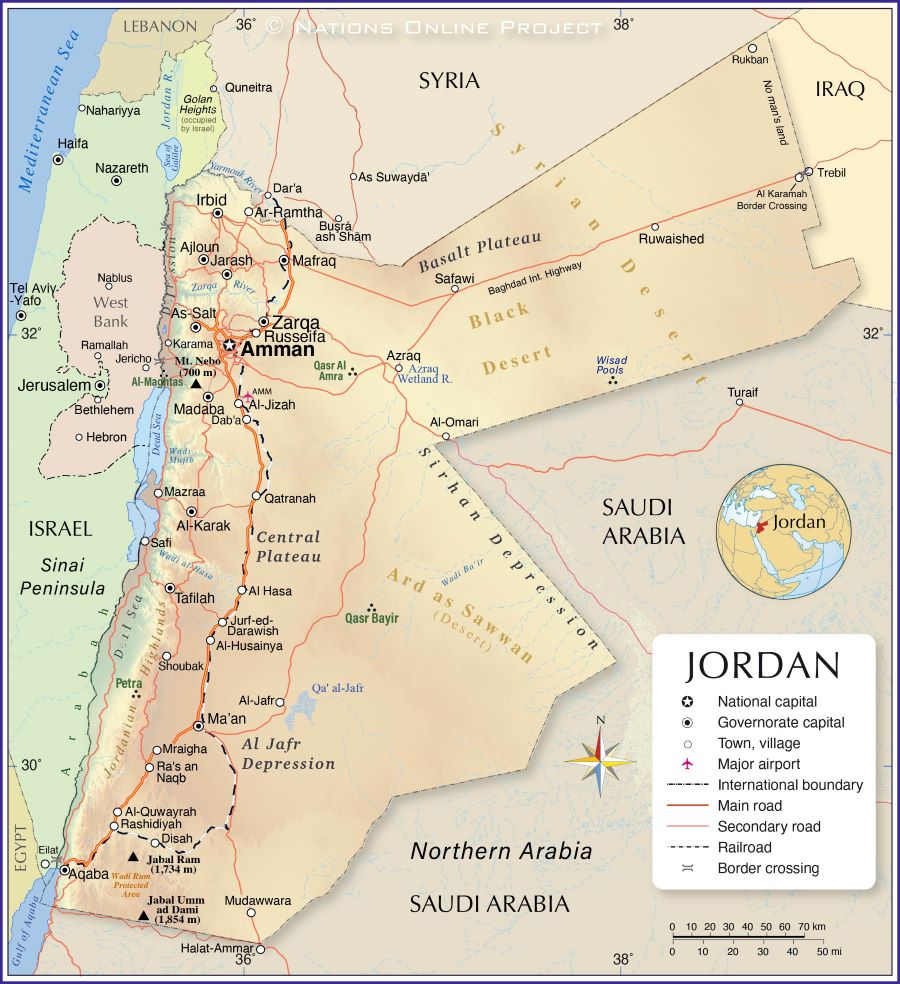
Source: nationsonline
Bordering countries of Jordan
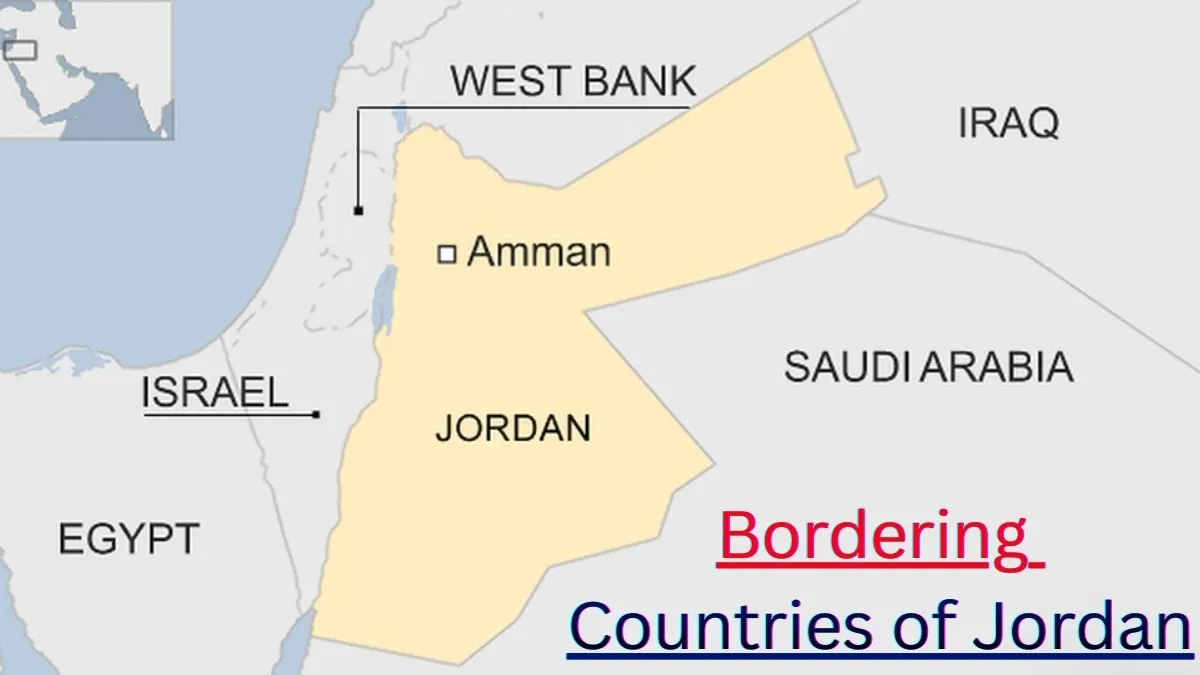
Jordan shares land borders with several nations in the Middle East:
-
To the west: Israel and the West Bank (Palestinian territory)
-
To the north: Syria
-
To the northeast: Iraq
-
To the east and south: Saudi Arabia
Although Jordan is almost landlocked, it has a small but important coastline along the Gulf of Aqaba, which connects it to the Red Sea and global maritime routes.
Also Read: List Of Neighbouring Countries Of Iran
What is the geographical landscape of Jordan?
Jordan’s terrain is diverse despite its desert reputation. The country includes:
-
Vast desert plains
-
The Rocky Mountains and highlands
-
Deep valleys and seasonal riverbeds (wadis)
-
Fertile oases with date palms
Much of Jordan sits on a plateau between 700 and 1,200 meters above sea level. The land is shaped by ridges, valleys, and gorges.
The region east of the Jordan River is often called Transjordan or the Transjordanian Highlands.
What is the Jordan Rift Valley?
The Jordan Rift Valley is a deep geological trench formed by the movement of tectonic plates. The Jordan Rift Valley is located between Israel and west bank on the west and Jordan and Syria on the east.
The valley is a continuation of the Great Rift Valley of Africa, which is one of the largest rifts on earth that originates in Jordan to the east of Africa to Mozambique.
The Dead Sea is found in the Jordan Rift Valley. The shoreline of the Dead Sea has been sunk 430 meters (1,400 feet) below sea level; this is the lowest natural point on dry land on the surface of the earth.
Where is the lowest natural point on the surface of the Earth?
The Dead Sea (Sea of Salt) is a lake in the Jordan Rift Valley shared by Jordan, Israel and the Palestinian territory of the West Bank.
The Dead Sea is one of the saltiest bodies of water in the world, with a salinity of about 34%, which makes it impossible for any higher sea life to survive in it.
Fish washed into the lake by the Jordan River do not survive. The shore of the lake is the lowest point on dry land on Earth, at about 430 m below sea level.
Mountains of Jordan
The western part of Jordan is dominated by the Jordanian Highlands, a chain of hills and mountains running north to south.
-
Mount Nebo stands about 700 meters high and is traditionally believed to be the place where Moses viewed the Promised Land. It offers panoramic views of the Jordan Valley and the Dead Sea.
-
Jabal Umm ad Dami is Jordan’s highest mountain at 1,854 meters. It is located near Wadi Rum, close to the Saudi border.
Parts of northern Jordan lie within the historically significant Fertile Crescent, an area known as the cradle of early civilisations.
Major Cities of Jordan
-
Amman – The capital and largest city, known for its ancient Roman ruins and Umayyad-era structures.
-
Irbid – A major educational and industrial centre in northern Jordan.
-
Zarqa – An important industrial hub near Amman.
-
Ajloun – A small hill town famous for its 12th-century castle.
-
Aqaba – Jordan’s only coastal city and key seaport.
Conclusion
Jordan may be geographically small and largely desert, but it is full of historical background, religion, and geology.
It is one of the most significant states in the Middle East with its strategic borders, rare landscapes like the Jordan Rift Valley and the Dead Sea and its minor but vital access to the sea via Aqaba.


-1772447393810_t.webp)
-1772447233828_t.webp)

Comments
All Comments (0)
Join the conversation