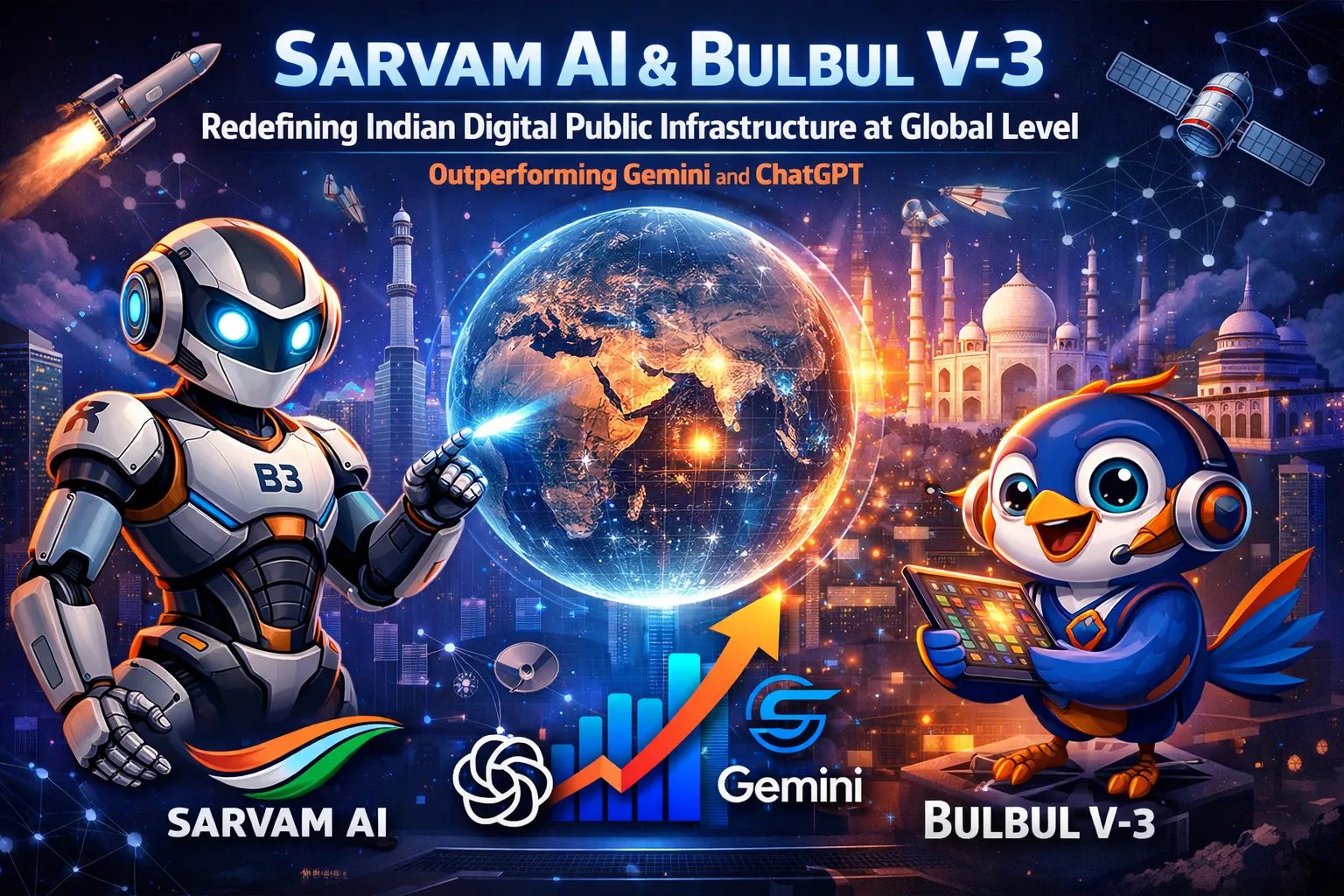
Sarvam AI’s latest large language model, Bulbul V-3, represents a major leap in India’s AI ecosystem. Designed for multilingual intelligence, governance applications, and Digital Public Infrastructure (DPI), Bulbul V-3 aims to bridge the linguistic and digital divide in India. Positioned against global AI leaders like Google’s Gemini and OpenAI’s ChatGPT, Bulbul V-3 focuses on Indic language depth, affordability, and sovereign AI capabilities. It marks a shift from dependency on foreign AI platforms toward India-led digital innovation aligned with the country’s DPI model.
The rise of sovereign AI initiatives, companies like Sarvam AI are pushing India into the next frontier of AI-powered public infrastructure. Their flagship model, Bulbul V-3, is designed not merely as a chatbot but as a multilingual, governance-ready AI engine tailored for India’s scale, diversity, and developmental priorities.
This development signals India’s ambition to build AI systems that serve its 1.4+ billion citizens not just English-speaking elites while competing globally. Sarvam AI is an Indian artificial intelligence startup focused on building foundational AI models optimized for Indian languages and Digital Public Infrastructure use cases.
Key Focus Areas:
-
Multilingual AI models for Indic languages
-
AI integration into government services
-
Voice-first technology for rural India
-
Scalable AI infrastructure aligned with India Stack
Sarvam AI’s mission aligns with India’s push for AI sovereignty — reducing reliance on foreign LLMs and ensuring that AI systems are trained on local contexts, dialects, and governance frameworks.
What is Bulbul V-3?
Bulbul V-3 is a next-generation large language model (LLM) developed by Sarvam AI with a primary focus on:
-
Deep Indic language understanding
-
Code-switching (Hindi-English, Tamil-English, etc.)
-
Governance and citizen service applications
-
Low-cost, scalable deployment
Unlike generic global AI systems, Bulbul V-3 is trained extensively on Indian linguistic datasets and socio-administrative contexts.
How Bulbul V-3 Competes with Gemini and ChatGPT
While global models like Gemini (by Google) and ChatGPT (by OpenAI) dominate the international AI landscape, Bulbul V-3 differentiates itself in the following ways:
-
Multilingual Depth in Indic Languages:
-
Global AI systems primarily optimize for English and major global languages. Bulbul V-3 focuses on:
-
-
-
20+ Indian languages
-
Regional dialects
-
Mixed-language communication (Hinglish, Tanglish, etc.)
-
-
DPI Integration Readiness:
-
Bulbul V-3 is designed to integrate with:
-
Aadhaar-enabled services
-
UPI-based digital transactions
-
Government grievance redressal systems
-
Agricultural and health advisory platforms
-
-
Cost-Efficiency and Accessibility:
-
Optimized for low-bandwidth environments
-
Designed for smartphone-first users
-
Voice-enabled interactions for non-literate populations
-
Data Sovereignty: Unlike foreign AI systems hosted and governed outside India, Bulbul V-3 supports:
-
Data localization
-
Compliance with Indian IT and data protection laws
-
Reduced geopolitical dependency
Strengthening India’s Digital Public Infrastructure
- India’s DPI is built on open APIs that allow startups and private players to build services over public digital rails like payments and identity. This encourages innovation, reduces entry barriers, and ensures scalable digital growth.
- Interoperability, Different platforms banking, identity, welfare, and documentation—work seamlessly together. This integration reduces duplication, improves efficiency, and enhances citizen convenience.
- Public-Private Collaboration the government builds core infrastructure while private firms innovate on top of it. This hybrid model combines public accountability with market-driven efficiency.
- AI-Powered Citizen Helpdesks, Bulbul V-3 can provide 24/7 multilingual assistance for government schemes, document support, and grievance filing, reducing bureaucratic delays and improving service delivery.
- Smart Public Grievance Systems, AI can automatically categorize complaints, detect urgency, and identify recurring governance issues, enabling faster and more accountable administrative responses.
- AI-Driven Agricultural Advisory by integrating weather, soil, and market data, Bulbul V-3 can guide farmers on crop choices, pest alerts, and price updates in regional languages.
- Vernacular Legal and Health Assistance the model can simplify legal rights and basic health guidance in local languages, making essential services accessible to rural and digitally underserved populations.
Global Implications:
India’s AI-for-DPI approach offers a new development model for the Global South, Countries in Africa, Southeast Asia, and Latin America could adopt similar AI-DPI frameworks, positioning India as a global AI governance leader.
-
Affordable AI for emerging economies
-
Open, scalable digital governance models
-
Linguistic inclusivity at population scale
Challenges Ahead
Despite its promise, Bulbul V-3 faces several challenges:
-
Competing with massive R&D budgets of global tech giants
-
Ensuring data quality across diverse languages
-
Avoiding algorithmic bias
-
Scaling infrastructure sustainably



Comments
All Comments (0)
Join the conversation