Why Are Highway Signboards Green and Not Red, Yellow or Blue?
Discover why highway signboards are green instead of red, yellow, or blue. Learn the science, safety reasons, visibility benefits, international standards, and meaning of different road sign colours in India.

Many of you travelled on the highway, and you all have seen a signboard in green colour. But do you often think, why are highway signboards green and not red, yellow or blue?'
In India, a highway plays an important role in many sectors, including trade & transportation and travelling passengers, which are some of the important connecting routes all over the nation.
But why are the highway signboards in green colours and not in red, yellow or blue? Let’s explore this common query with proper reasons behind this.
What Do Different Colours Mean on Indian Roads?
Before we talk about green, let us understand how road sign colours work in India.
| Sign Colour | Where You See It | What It Means |
| Green | National Highways | Direction, distance, destinations |
| Blue | City roads, urban areas | Local routes, nearby facilities |
| Yellow | Warning signs | Danger ahead, sharp turns, school zones |
| Red | Mandatory signs | Stop, do not enter, no parking |
| Orange | Construction zones | Road work ahead |
So green is specifically used for highway direction signs. This is not just an Indian rule. Countries like the USA, UK, and many others follow the same system.
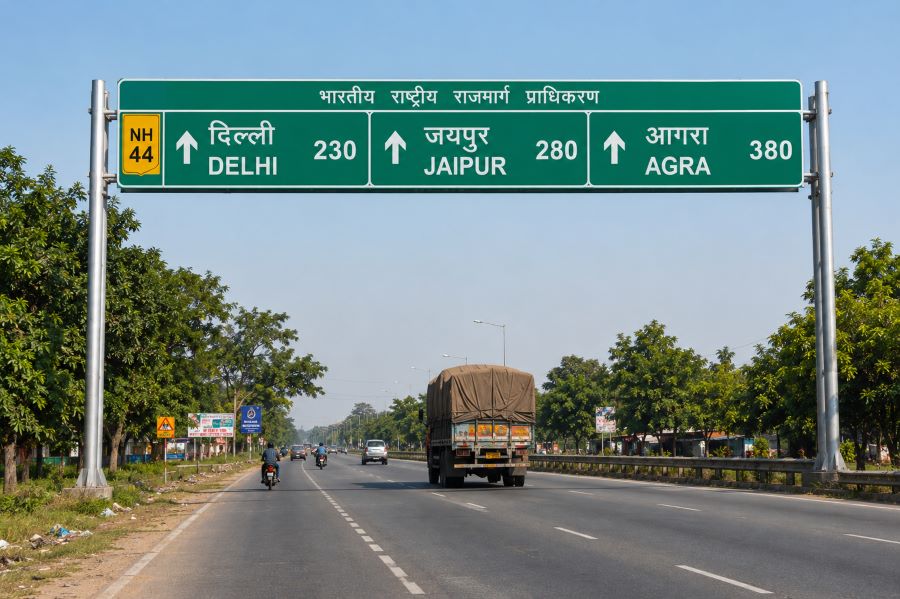
Why Are Highway Signboards Green in Colour?
Highway signboards are green in colour because of the following reasons given below:
1. Green is the easiest colour for humans to read.
In our eyes we have special cells known as rods and cones. These cells respond to different wavelengths of light (wavelengths are like the "speed" of a colour of light).
Green is in the center of all colours. It is not too light or pink or too dark or brown. This means that the colour green is the easiest for brain to quickly process.
At 80-100 km/h, you have just a second or two to read a sign. The white on green is the easiest and quickest readability.
In fact, a survey was conducted on a real highway in the late 1950s which tested various coloured signs. Green signs with white letters were seen by over half of the drivers and were the easiest to read.
2. Green Does Not Create Panic or Distraction
Consider a red colour; what does it mean? Stop. Danger. Emergency. Your brain would be alarmed every time you saw a sign on the highway if it were red. At high speed this can be dangerous.
Green is a peaceful colour. Nothing happens in your brain to make you feel like you need to respond. It just states, "Some useful information. This helps to keep drivers at ease and on the road.
It has also been demonstrated that green is associated with decreasing stress levels. The mere presence of green can actually help to reduce the heartbeat. A driver who is not in a hurry on a fast highway is a safe driver.
3. Green Blends With the Surroundings But Still Stands Out
The highways run through fields, forests, hills and open spaces. This natural environment consists mainly of green/brown.
Here's a fun fact. Though green is a colour that is considered to blend in with nature, a bright green board with white bold letters is extremely easy to see when contrasted with a sky or a road background. It doesn't stand out in a bad way, it's not too flashy.
Yellow is used for warnings, and if this is used for direction, drivers are going to get confused, as in the sign.
4. Green Signs Are Clearly Visible at Night
Night driving on the highway is prevalent in India. Green signs have a special reflective coating on them. The light reflects back as soon as your car's light comes into contact with the sign. This is referred to as "retroreflectivity".
The dark background and contrast between the white letters and the green background are striking. These signs can and should be read a distance away and allow adequate time for the driver to make the necessary preparations for the turn or exit.
Red and blue signs are less easily read at night at higher highway speeds due to differing light reflectivity and the less robust contrast.
5. It Is an International Standard
Many countries throughout the world, such as the United States, Canada, the United Kingdom, and Australia, use the colour green for highway direction signs. This international standard is significant as it allows drivers to identify what is ahead of them even when they are driving to a different area or country in the world.
This became the system in use in India as well. The Ministry of Road Transport and Highways (MoRTH) adopts these international guidelines in regard to road signage. A consistent system throughout will eliminate confusion and accidents.
Why are highway signboards not in red, yellow, or blue colours?
Highway signboards are not in red, yellow, or blue colours because of the following reasons given below:
1. Red Colour: Only used for stop/danger/required rules. Drivers would be confused and panic at speed if red were used for directions.
2. Yellow Colour: Warning signs such as sharp curves, a speed bump, and school zones are in yellow. If all directions were yellow, then the driver wouldn't be sure if their speed had to be reduced or if they just had to be aware of a distance.
3. Blue Colour: For local routes and local facilities (such as hospitals, petrol pumps, etc.) in cities and towns. Sometimes, on highways, blue signs provide information about services. It would be confusing to use blue on all highway direction signs.
4. White Colour: It is too bright and causes glare – particularly at night.
5. Green Colour: This colour represents calm, safety, ease on the eye, seen day and night and universal understanding. Hence, green colours has been chosen highway signboards
Facts About Different Colour Strips on Road
Since you know what the reasons are for highway signboards in green colours, here you should also know the facts about different colour strips on the road. What do they mean?
-
Yellow strips on a milestone: You are on a national highway.
-
Green stripe on a milestone: You are on a state highway.
-
Black or Blue stripes: District or rural road.
Green boards direct on the highway; a green stripe on a milestone indicates type of road. Interesting, right?
So, now you all know highway signboards are in the green colour because this colour is calm, highly visible, and easy to identify, and this colour is also accepted by the International Road Safety. So the next time you see a green signboard on a highway, you will know it is not just a design choice. It is a well-thought-out decision based on science, safety, and global standards.

Prabhat Mishra is a Subject Matter Expert and digital journalist with an extensive background in the competitive exam landscape and over 4 years of experience in education, national and international news, and current affairs. Over his tenure with top knowledge platforms like Mentorship India, IAS BABA, IAS SARTHI, and now Jagran Josh, he has a deep understanding of government exams like UPSC and State PCS, including UP and Bihar, as he has already qualified for the UPPCS 2022 Mains and Bihar 68th Mains. With his core expertise in history, polity, geography & current affairs, he specialises in creating well-researched, aspirant-centric content and simplifying complex topics for competitive examinations.


-1781272086252_t.webp)
