Who Is Known As The Father Of Genetics?
Gregor Johann Mendel is known as the Father of Genetics. Between 1856 and 1863, he experimented on pea plants to discover fundamental laws of inheritance: dominance, Segregation, and Independent Assortment, which laid the groundwork for modern medical genetics and agriculture.
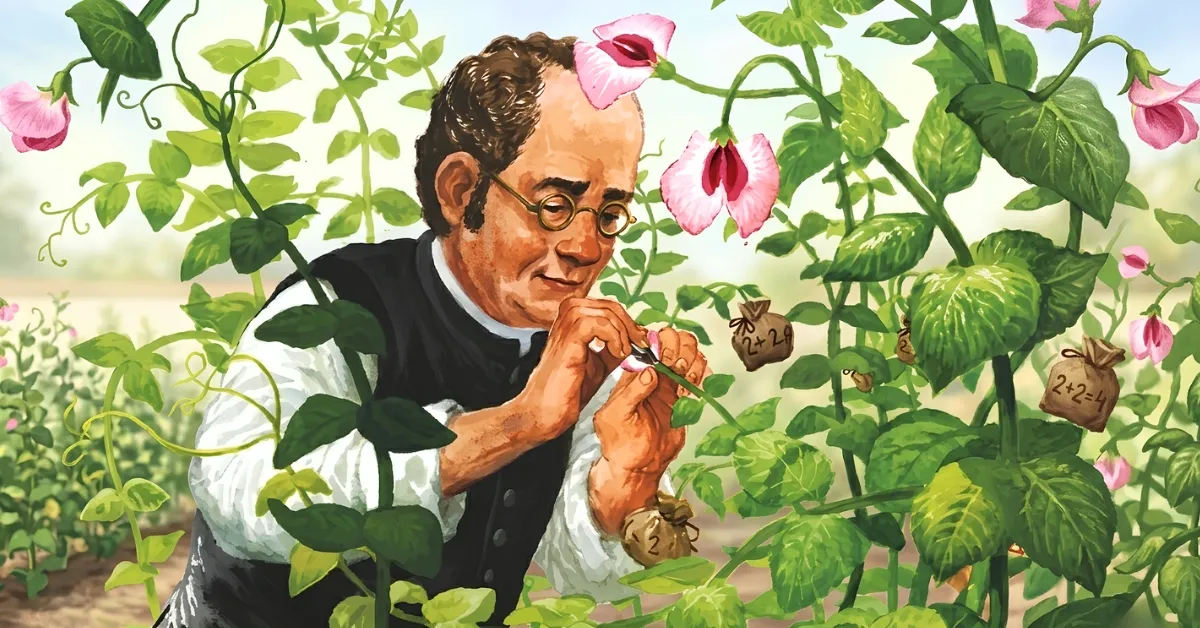
Did you know that the scientist who discovered the hidden genetic code in human beings is nothing but a monk who failed to impress his mentor two times with his performance? Gregory Mendel did not use any sophisticated lab equipment or any group of scientists in universities to discover things. Rather, this scientist achieved wonders just by watching around 28,000 pea plants in the monastery garden in the nineteenth century. These revolutionary discoveries of the monk were kept untouched on the library bookshelf for nearly three decades.
Who Is Known As The Father Of Genetics?
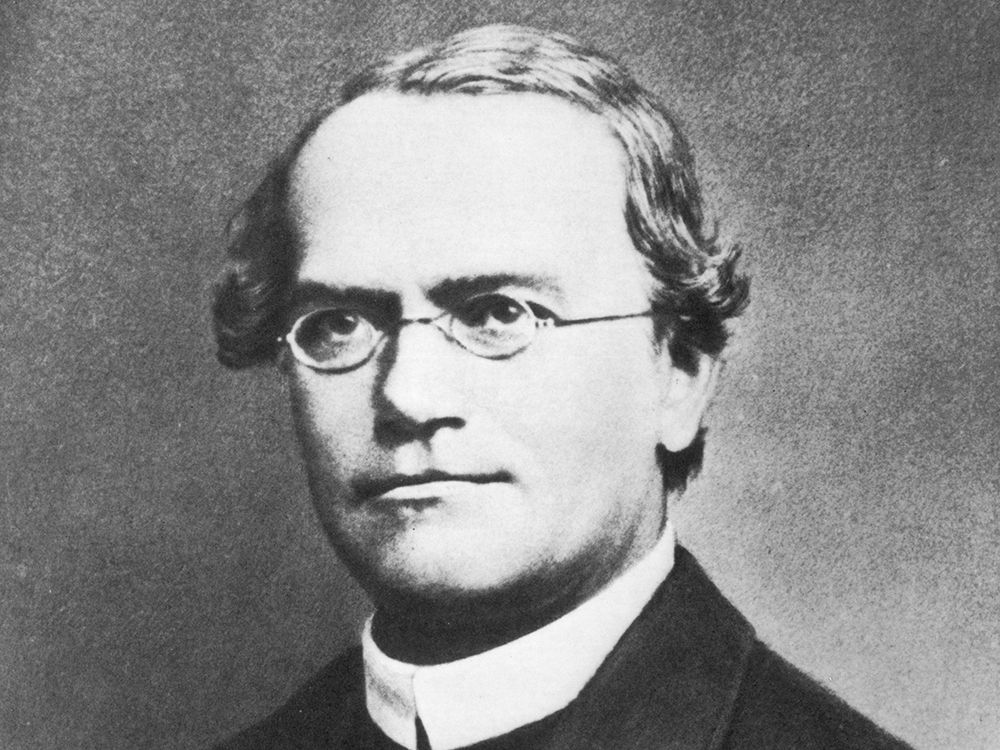
Gregor Johann Mendel is recognised as the Father of Genetics in the whole world.
Gregor Johann Mendel was born in 1822 in a little village in Silesia (which is now known as the Czech Republic, but during that time was part of the Austrian Empire). This little boy was born in a farming family, and his childhood was not a smooth one for him. He went through tough times financially, but his love for nature and mathematics made him more determined.
In the year 1843, Gregor Johann Mendel joined the Augustinian Order of St Thomas’s Abbey, Brno, for his education without bothering his parents. In the abbey, he adopted the name of Gregor.
What Were Mendel’s Key Experiments?
Between 1856 and 1863, Mendel performed extensive experiments using the edible garden pea (Pisum sativum) in his monastery garden.
- The garden pea was chosen by Mendel for the following three practical reasons:
- It can be easily grown on a large scale.
- It exhibits clear distinctions between its contrasting characteristics (like tall and short plants and round and wrinkled seeds).
- Its sexual reproduction is easy to control by means of hand pollination.
Over the course of seven years, Mendel kept a record of the following seven contrasting traits:
- Shape of seed: Round/Wrinkled
- Colour of seed: Yellow/Green
- Colour of flower: Purple/White
- Shape of pod: Inflated/Constricted
- Colour of pod: Green/Yellow
- Position of flower: Axial/Terminal
- Height of plant: Tall/Dwarf
In Mendel’s experiment of crossing tall pure lines with dwarf pure lines, he made an unusual discovery. In the F1 generation, all plants were not medium-sized, but tall. But when he crossed tall F1 plants amongst themselves, then in the F2 generation, he got the plants in the ratio of 3 tall plants to 1 dwarf plant.
What Are Mendel's Laws of Inheritance?
Mendel was able to establish three basic principles based on the results of his experiments:
1. The Law of Dominance
One out of two contrasting characters masks the other. The character that is expressed in the first generation is the dominant one (for example, tallness), whereas the unexpressed one is recessive (for example, dwarfness).
2. The Law of Segregation
During the formation of germ cells (gametes), there is a separation of the characters of each trait such that each cell possesses one character per gene.
3. The Law of Independent Assortment
Characters or genes of different traits are inherited separately from one another. For instance, there is no relationship between a plant being either yellow or green and whether the seed is either round or wrinkled.
Why Was His Work Ignored During His Lifetime?
"Mendel's work, Experiments on Plant Hybrids, was published in 1866 in the Proceedings of the Brno Natural History Society and remained unnoticed by the scientific world."
Main Reasons Why His Work Went Unnoticed:
- Too Early: The scientists during those times used to believe in the concept of "blending inheritance", according to which the offspring was just a blend of characteristics of its parents, like when blue and yellow colours blend to form green.
- Heavily Based on Mathematics: Mendel used mathematics to explain biological concepts like ratio and probability, which was quite different from what biologists of those times used to do.
- Limited Availability: The regional journal that was published at Brno had only limited availability among the prominent European scientists.
He continued to remain unrecognised for his groundbreaking work till his death in 1884. It took as many as sixteen years after his death for three separate scientists (Hugo de Vries, Carl Correns, and Erich von Tschermak) to come across Mendel's works independently.
How Does Mendel's Work Impact Us Today?
Mendel’s Laws paved the way for further advancements in biology:
- Agricultural Science: Techniques used in agriculture for growing resistant crops have been achieved through Mendelian genetics, which has helped in producing crops that are resistant to diseases and can give higher yields than normally expected, like hybrid wheat and rice.
- Medical Genetics: This is an application of the principles of Mendel where information is provided about the inheritance of genetic problems like thalassaemia, sickle cell anaemia or colour blindness within one’s family.
- Gene Editing: Recent technology of gene editing, like CRISPR-Cas9, is an outcome of the efforts made by Mendel.

Kriti Barua is a skilled digital journalist and communications professional with 4+ years of experience, currently writing for the General Knowledge section at Jagran New Media. She has established herself as a subject matter expert in History, Geography, Trending National and International News, Sports, Science, and Defence, producing clear, reliable, and search-optimised content that connects with readers worldwide.
Kriti holds a BA degree from Delhi University and a one-year diploma in TV Production and Journalism, an academic background that adds research depth and strong storytelling instincts to her writing. Her experience spans brand writing, content marketing, and digital media, giving her a sharp understanding of what makes content both helpful to readers and visible in search.
At Jagran New Media, she applies this expertise to national and international news coverage, query-based articles, and in-depth pieces across her specialist subject areas. Her content is defined by easy language, factual accuracy, strong keyword strategy, and reader-friendly storytelling.